
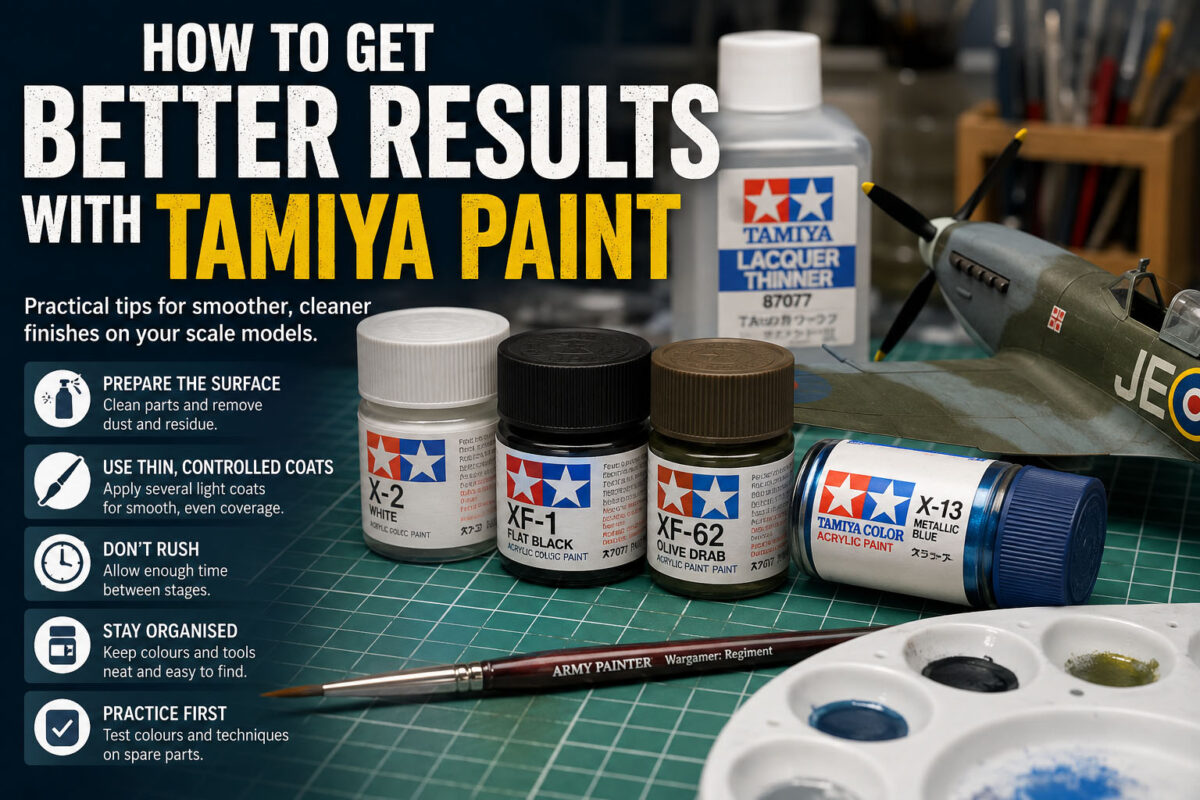
Tamiya paint has become one of the most popular choices for scale modellers because of its broad colour range and suitability for a wide variety of subjects. Whether you’re building aircraft, military vehicles, ships, cars or science fiction kits, there’s a good chance you’ll come across a recommended Tamiya colour during your project.
This guide isn’t intended to explain how to paint an entire model. Instead, it focuses on the small improvements that often make the biggest difference to your final finish. If you’ve ever wondered why one model looks smooth and consistent while another appears patchy or uneven, the answer is usually preparation and technique rather than the paint itself.
Start with a Clean Surface
One of the easiest ways to improve your results is before the paint bottle is even opened.
Dust, fingerprints and mould-release residue can all affect how evenly paint covers the surface. Taking a little extra time to prepare the model helps create a more consistent finish and reduces the chance of visible imperfections appearing later.
Surface preparation also makes it easier to judge how well each coat is covering, particularly on larger aircraft or vehicle panels.
Use Thin, Controlled Coats
A common mistake is trying to achieve full coverage in one application. Multiple light coats generally produce a smoother finish than one heavy coat.
Allowing each coat to settle before applying the next also helps preserve recessed detail, rivets and panel lines that can quickly become softened by excessive paint build-up.
This approach is equally valuable whether you’re painting small cockpit components, armour details or larger exterior surfaces.
Choose the Right Brush for Small Details
Even if most of your project is airbrushed, detail painting is usually completed by hand. Using a brush that matches the size of the area being painted gives greater control and often results in cleaner edges.
A quality brush also makes it easier to apply several light coats rather than trying to force paint into difficult areas.
If you’re looking to upgrade your detail brushes, the range of Army Painter Paint Brushes offers a variety of options suitable for precision painting.
Think About Colour Planning
Before starting a project, spend a few minutes deciding the order in which colours will be applied.
Painting from the most difficult areas outward often reduces the amount of masking required later. It also helps avoid repeatedly handling freshly painted surfaces while working on nearby details.
Breaking a model into logical painting stages usually produces a cleaner, more organised workflow.
Don’t Rush Between Stages
One of the biggest improvements many modellers make is simply allowing enough time between painting steps.
Moving on too quickly can make masking, detail painting or weathering more difficult than it needs to be. A patient approach often results in sharper colour separation and fewer corrections later in the build.
Keep Similar Paint Systems Together
Many experienced modellers prefer to work within a single paint range during a project simply because colours are easier to organise and replace later.
That doesn’t mean you have to use only one manufacturer. Alternative paint systems can be useful depending on your preferred workflow or the specific colours you require.
If you’re interested in exploring other acrylic paint systems, you may also want to look at the ATOM Paint Sets, AK 3rd Gen Paint Sets, Humbrol Paint Sets and ICM Paint Sets. Each offers coordinated collections that can simplify colour selection for particular subjects.
Keep Individual Colours Organised
As your paint collection grows, it becomes increasingly useful to organise colours by manufacturer, finish or project.
Keeping related colours together saves time during painting sessions and makes it much easier to identify gaps when planning future builds.
If you prefer buying individual colours rather than complete sets, the range of ICM Paint Bottles is another option worth exploring alongside other paint systems.
Practice on Spare Parts
Every kit provides opportunities to test colours, coverage or painting techniques before working on the visible parts of your model.
Unused sprue, spare parts or hidden internal components can all be useful places to check your approach. Spending a few minutes experimenting beforehand is often much quicker than correcting mistakes after the main painting stage.
Build Consistency Rather Than Perfection
The best-looking models are rarely the result of one secret technique. Instead, they’re built on a series of small, repeatable habits.
- Prepare the surface carefully.
- Apply several light coats instead of one heavy coat.
- Use brushes suited to the task.
- Plan the painting sequence before opening the paint.
- Allow adequate time between stages.
- Test new colours or techniques before committing to the model.
Each of these improvements may seem minor on its own, but together they produce noticeably cleaner, more consistent finishes.
Final Thoughts
Tamiya paint has earned its popularity because it offers scale modellers a versatile and well-established colour range. Getting the best results, however, depends just as much on preparation, patience and technique as it does on the paint itself.
By concentrating on careful surface preparation, controlled application and an organised painting workflow, you’ll steadily improve the quality of your finishes from project to project. The goal isn’t perfection on every model, but developing reliable habits that make each build a little better than the last.
