
A good solvent cement should almost disappear from the workflow. Parts should sit correctly, a small touch of adhesive should run along the seam, and the joint should become firm without flooding detail. That is the appeal behind this Tamiya Extra Thin review: it is not simply a popular plastic glue, but a highly controlled tool for assembling polystyrene kits cleanly.
For aircraft, armour, ships, cars and many science-fiction kits, Tamiya Extra Thin Cement has earned its place on countless benches. Its very thin consistency and capillary action make it particularly effective when parts already fit well. It is not the right adhesive for every material or every repair, however, and understanding its limits is the difference between crisp construction and softened, damaged plastic.
What Tamiya Extra Thin Cement Actually Does
Tamiya Extra Thin is a liquid solvent cement for polystyrene plastic. Rather than forming a thick layer between two parts, it temporarily softens the mating surfaces. When the solvent evaporates, the plastic effectively welds together. A properly made joint is therefore far stronger and neater than one held together by a surface adhesive alone.
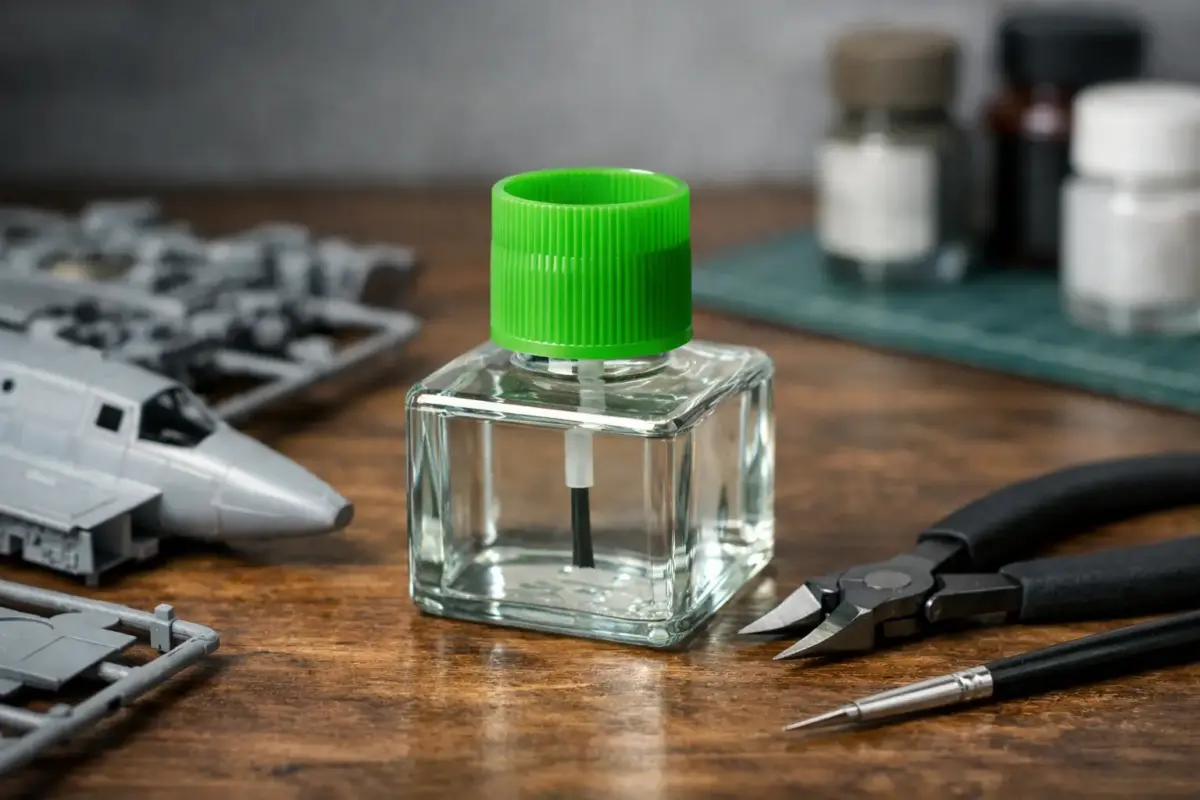
The cement is supplied in a square glass bottle with a fine brush fixed to the cap. That brush is one of the product’s strongest features. It holds a controlled amount of liquid and lets the modeller place cement precisely at a panel edge, locating pin, bulkhead or long fuselage seam.
Its thinness is the key. Bring two dry-fitted styrene parts together, touch the brush to the join, and the cement flows through the gap. This capillary action is especially useful on long, visible seams where applying glue before assembly would risk squeeze-out or uneven coverage.
Tamiya Extra Thin Review: Performance on the Bench
On well-engineered kits, the performance is excellent. The cement travels readily along a seam without needing to brush repeatedly over the surface. A wing half, hull section or road-wheel pair can be aligned first and then bonded from the outside, allowing you to concentrate on fit before committing the joint.
The bond begins to grab quickly, but there is normally enough time to make small adjustments. That working window is useful for conventional kit construction, particularly when fitting cockpit tubs, suspension units or internal bulkheads where several surfaces meet at once. Hold the parts with gentle pressure for a short period, then leave the assembly alone to cure properly.
One useful technique is to apply very light pressure after the cement has entered the seam. A fine bead of softened plastic may rise along the join. Once fully cured, this can often be sanded back, reducing the need for filler. It works best on plain structural joins. Do not use it around delicate raised rivets, finely engraved panel lines or textured armour surfaces unless you are confident that the seam can be cleaned up without losing detail.
The brush also makes Tamiya Extra Thin effective for smaller tasks. It is well suited to securing cockpit components, photo-etched plastic substitutes such as kit-supplied styrene details, vehicle stowage brackets and small sub-assemblies. For very tiny parts, transfer only the smallest amount from the brush tip. The cement is thin enough to creep beneath a part and mark surrounding plastic if over-applied.
Where the Standard Formula Excels
The standard Tamiya Extra Thin formula is a strong general-purpose choice where you need controlled flow but still want a little time to position parts. It suits most mainstream injection-moulded kits and is particularly useful for:
- long fuselage, wing and hull seams;
- armour hulls, turret halves and running gear;
- interior structures, bulkheads and cockpit assemblies;
- areas where glue must reach after dry-fitting;
- joins that will later be sanded, filled or painted.
It is a practical bottle to keep open during the main assembly stage of almost any styrene project. The square base is stable on the bench, although it is still wise to keep it clear of elbows, cables and cutting mats that may catch the bottle.
The Trade-Offs to Know Before Buying
Extra Thin is not a gap-filling adhesive. If two parts have a visible gap, warped mating surfaces or damaged locating tabs, the solvent will not build material back into the join. It may bond the parts, but the gap will remain. In those cases, a thicker liquid cement, sprue reinforcement, plastic strip, filler or a two-part approach may be more appropriate.
It is also unforgiving on visible surfaces. The brush can deposit more cement than expected, and the liquid may run into recessed detail or across a polished panel. Fingerprints pressed into softened plastic, a spill on a wing surface or excess cement around a canopy frame can create work that no modeller wants. Dry-fit first, apply sparingly, and avoid handling the area until the plastic has hardened.
The product is intended for polystyrene. It will not reliably bond polyethylene or polypropylene, which are common in some bases, toys and flexible accessories. It is not the preferred choice for resin, metal, vinyl, rubber or photo-etch either. Cyanoacrylate adhesive is generally better for resin and metal parts, while clear parts often benefit from a dedicated canopy glue or carefully used PVA-based adhesive.
Clear styrene deserves special caution. Solvent cement can craze transparent parts, leave fogging, or wick into an area that cannot be repaired. If a clear part must be joined with solvent cement, use the smallest possible amount on an unseen contact point. For most canopies, navigation lights and lenses, a specialist clear-parts adhesive is the safer route.
Standard Extra Thin or Quick-Setting?
Tamiya also offers Extra Thin Cement Quick-Setting, and the choice depends on the job rather than one being universally better. Quick-Setting is useful for small parts, repetitive assemblies and joins that need to hold almost immediately. It can speed up armour running gear, simple sub-assemblies and parts where the fit is already assured.
The standard formula is generally easier for careful construction because it gives more adjustment time. It is the better starting point for beginners and remains the more forgiving option when aligning long seams or complex multi-part assemblies. Experienced modellers often keep both: standard Extra Thin for controlled assembly and Quick-Setting for jobs where speed and a fast grab are genuinely helpful.
Neither replaces a thicker cement entirely. A conventional liquid cement can be more useful where a joint needs a little more body, while tube cement still has a place for large, rough-fitting parts where the adhesive must help bridge minor imperfections. The best glue choice follows the joint, not the label.
Best Practice for Cleaner Joints
Preparation matters more than the amount of cement used. Remove sprue gates and mould seams from mating surfaces, test the fit without adhesive, and make sure locating pins are not preventing parts from closing fully. Paint between two surfaces can also weaken a solvent-welded joint, so scrape contact areas back to bare plastic where possible.
Apply the cement with the parts held together rather than painting it broadly across both surfaces. Let capillary action do the work. On a long seam, work in short sections so alignment stays under control. A small clamp, elastic band or low-tack tape can hold an assembly, but avoid excessive pressure that distorts thin plastic.
After bonding, give the joint time. It may feel secure quickly, yet the softened plastic beneath the surface can remain tender for longer. Sanding too soon can tear the seam or reveal a depression later. For major fuselage, hull or body joins, leaving the assembly overnight before serious clean-up is usually worthwhile.
Ventilation is essential. Solvent cement has strong fumes and should be used in a well-ventilated modelling area. Keep the cap on when not actively applying it, avoid prolonged exposure, and store the bottle upright and away from heat, flames and children. A tidy work surface is not just convenient here – it helps prevent accidental spills.
Is It Worth Adding to Your Glue Selection?
For plastic kit builders, Tamiya Extra Thin Cement is a dependable bench staple rather than a novelty purchase. Its precision brush, reliable capillary flow and strong welded joints make it particularly valuable on modern kits with close-fitting parts. It rewards dry-fitting and measured application, which are habits that improve any build.
It does have boundaries: it will not fill a poor join, it can damage clear parts, and it is unsuitable for many non-styrene materials. Used alongside a thicker plastic cement, cyanoacrylate and a clear-parts adhesive, though, it covers a large proportion of routine assembly work. For a new project, choosing the right adhesive before the first sprue is cut is one of the simplest ways to make every subsequent stage more enjoyable.
