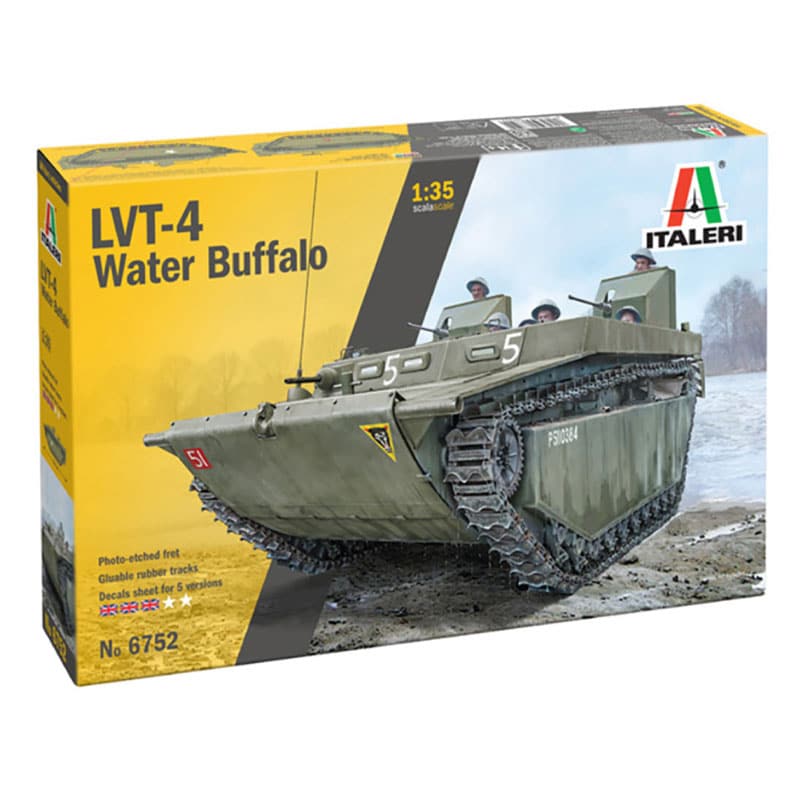
Italeri LVT-4 Water Buffalo (1/35) 6752
Out of stock
SKU: IT6752
MPN: 6752
 Italeri
Join the waitlist
Enter your email below and we will notify you when this item is back in stock.
Italeri Plastic Model Kit
Italeri LVT-4 Water Buffalo (1/35) 6752
LVT-4 Water Buffalo was a major advancement in the series of amphibious landing vehicles developed by the United States during World War II. Originally designed for troop and equipment transport in amphibious assaults, these tracked vehicles, often referred to as “Amtraks,” played a crucial role in both the Pacific and European theatres. The LVT-4 featured a redesigned layout, placing the engine centrally to make room for a rear ramp — a critical innovation that allowed light vehicles and artillery to be loaded and unloaded quickly during beach landings.
This configuration enabled more efficient support of front-line troops in intense combat environments. Its success is reflected in the fact that it became the most widely produced and used version of the LVT family. Italeri’s detailed 1:35 scale model captures the rugged functionality of the LVT-4 with accuracy and realism, making it an excellent addition to any World War II modelling collection.
- Scale: 1:35
- Includes glueable rubber tracks
- Photo-etched parts for enhanced detail
- Decals for five marking options
Note: This model kit requires assembly and painting. Glue, paints and tools are not included and must be purchased separately.
History:
The LVT-4 Water Buffalo was a pivotal asset in World War II amphibious warfare. Evolving from earlier LVT designs originally conceived for cargo transport in swampy terrain, the LVT-4 was adapted for frontline military use. With its innovative rear ramp, it became the preferred choice for landing operations, enabling faster deployment of men and materiel under fire. It saw extensive use in Pacific campaigns, including landings at Saipan, Leyte, and Okinawa, and was also deployed in the European theatre during the Rhine crossings. Its rugged design and amphibious versatility earned it a reputation as a reliable and indispensable tool for Allied forces. More than 8,000 units were built, and its legacy lives on in the development of modern amphibious assault vehicles.
Discover more from this range