
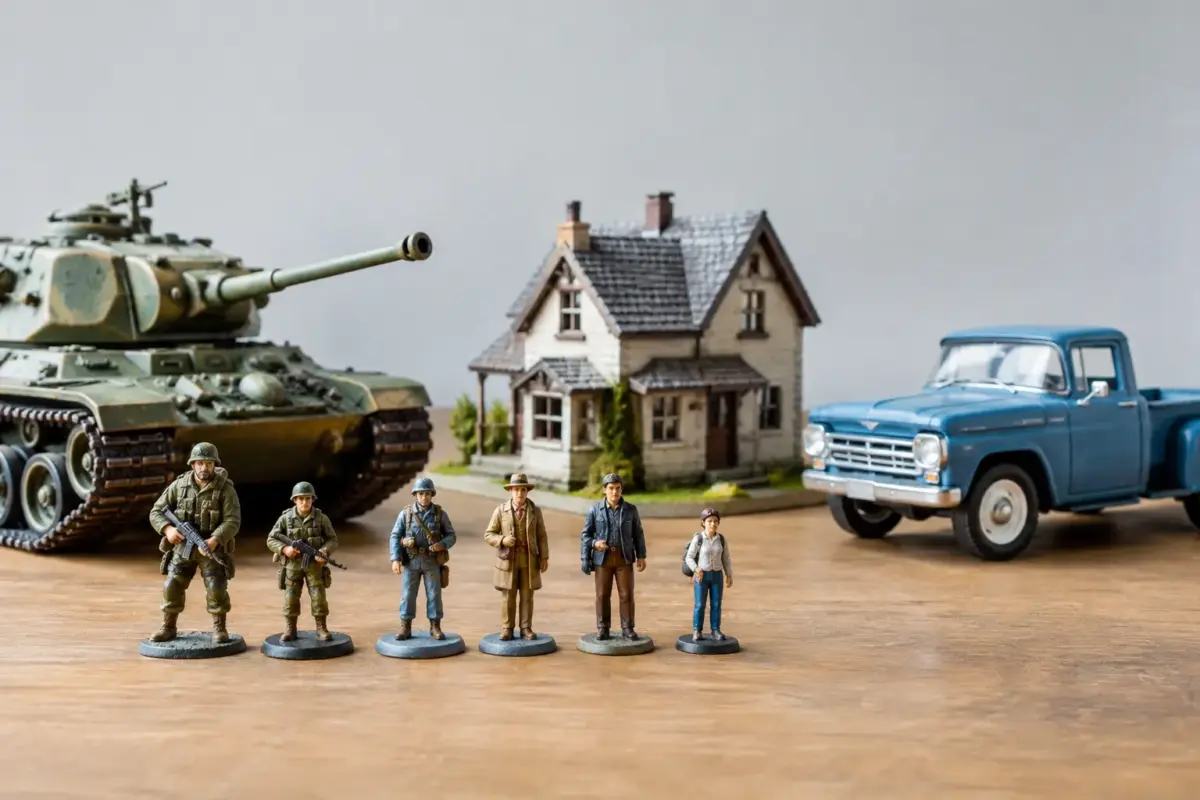
A 1:72 Spitfire, a 1:35 Sherman and a 28mm fantasy figure may all look like manageable bench projects, but they belong to very different modelling ecosystems. This model scale guide explains what the numbers mean, how physical size changes between scales, and how to choose figures, accessories, paints and scenery that look right together.
What model scale actually means
Model scale is the relationship between the model and the full-size subject. A scale written as 1:72 means one unit on the model represents 72 of the same units on the real object. A 1:72 aircraft measuring 14 cm in wingspan represents an aircraft with a real wingspan of roughly 10.08 metres.
The smaller the second number, the larger the model. That can feel counter-intuitive at first: 1:24 is much larger than 1:72, while 1:144 is smaller than both. Scale affects far more than display space. It influences the level of moulded detail, the size of aftermarket parts, the availability of crew figures and ground equipment, the amount of paint required, and the practicalities of weathering.
A kit’s stated scale is a useful starting point, but it is not an absolute guarantee that every item marked with the same ratio will match perfectly. Older tooling, manufacturer interpretation, real-world production variations and the dimensions of particular subjects can all create small differences. For most projects, though, matching the stated scale remains the right approach.
Model scale guide: the common scales at a glance
Certain scales have become standards because they offer a strong mix of range, detail and display practicality. Choosing one of them makes it much easier to build a coherent collection and find compatible accessories.
Aircraft scales
For aircraft, 1:72 is one of the most popular choices in the UK. It offers a huge choice of aircraft from the First World War to modern jets, without demanding a large cabinet. Fighters are compact, while bombers and transport aircraft still make an impressive centrepiece. Fine cockpit, wheel-bay and surface detail can be enhanced with decals, photo-etched parts and resin accessories, although handling very small pieces requires care.
At 1:48, aircraft become noticeably more substantial. Cockpit details, landing gear and weathering effects are easier to see and work on. It is an excellent scale for a single, highly detailed subject, but a four-engine aircraft can take up considerable shelf space. At 1:32, the emphasis is firmly on presence and detail. These kits suit modellers who want open panels, detailed engines or a figure beside the aircraft, and who have room to display the finished build.
Smaller 1:144 aircraft work well for airliner collections, large bombers and modern aircraft subjects where space is limited. Their compact dimensions make clean construction and restrained finishing especially important.
Military vehicle scales
Armour modellers will encounter 1:35 more than any other scale. It is the benchmark for tanks, soft-skin vehicles, artillery, soldiers, stowage and diorama accessories. A 1:35 kit gives enough room for convincing chipped paint, dust, mud, tools and fabric texture, while the breadth of available figures makes scene-building straightforward.
The trade-off is space. A 1:35 main battle tank is substantial, and a diorama containing multiple vehicles soon becomes a major project. For builders who prefer smaller displays or want to model armour alongside 1:72 aircraft, 1:72 and 1:76 are practical alternatives. Both support compact vehicles and small vignettes, though they should not be mixed casually. A 1:72 vehicle is slightly larger than a 1:76 equivalent, and the difference is noticeable when figures, buildings and road vehicles are placed side by side.
Ships, cars and railways
Ship scales vary widely because real vessels vary so dramatically in size. A 1:700 warship allows a fleet to fit in a cabinet, while 1:350 provides more scope for railings, rigging, deck fittings and realistic sea bases. A 1:200 ship can be a remarkable showpiece, but it needs planning before purchase: check the finished length, case size and work area as carefully as the subject itself.
Car kits commonly appear in 1:24 and 1:25. These are close enough for many display purposes, but they are not identical. If you intend to build a workshop scene, use figures, garage equipment and signage designed for the kit’s stated scale where possible. Smaller 1:43 diecast subjects are popular with collectors, while 1:12 motorcycles and cars offer room for exceptional mechanical detail.
Railway modelling uses its own familiar standards. OO gauge is 1:76.2 and is widely used in Britain, while HO is 1:87. The track gauges can appear similar, but the buildings, people, vehicles and scenic accessories are not directly interchangeable if accurate proportions matter. N gauge is smaller again, typically 1:148 in British outline modelling.
Choosing a scale for your first project
The best scale is not automatically the biggest one or the one with the most parts. Start with the subject you genuinely want to finish, then consider your workspace, budget, eyesight and display area. A well-built 1:72 fighter or 1:35 armoured car is more satisfying than an oversized project that remains half complete.
Beginners often find medium-sized kits easiest to handle because the parts are visible without becoming unwieldy. A straightforward 1:72 aircraft, 1:48 single-engine aircraft, 1:35 military vehicle or 1:24 car can be a sensible first choice, depending on the subject. Check the kit’s skill level, parts count and finish requirements rather than relying on scale alone. A small, highly detailed limited-run kit may be less forgiving than a larger mainstream kit.
It also pays to think beyond the box. Before starting, identify the adhesive, primer, paints, brushes or airbrush supplies, masking materials and finishing products required. Scale Model Shop’s scale-led categories are useful when you want to match a kit with figures, decals, aftermarket details or scenic materials without piecing the project together from several suppliers.
Matching figures, accessories and scenery
A convincing scene depends on consistent proportions. In a 1:35 diorama, use 1:35 crew, fuel drums, ammunition crates, buildings and vegetation where the product specifies a scale. A 1:48 pilot will look oversized beside a 1:72 aircraft, even if the difference seems small on the packet.
Figures need particular attention. Human height is one of the quickest visual checks: an average 1.8-metre adult is about 25 mm tall in 1:72, 37.5 mm in 1:48 and 51 mm in 1:35. Pose also matters. A seated driver, crouching infantryman or leaning mechanic may appear shorter for perfectly correct reasons, so assess the whole figure rather than measuring from boots to head.
Scenery is less exact in some respects. Soil, rubble, static grass and water effects can work across several scales because real natural materials are irregular. Manufactured items such as doors, brick courses, telegraph poles, road signs and fencing are less forgiving. Oversized bricks or a tiny doorway can immediately undermine an otherwise excellent model.
Wargaming introduces another complication: miniature figures are often labelled in millimetres rather than ratios. A 28mm range may be described as heroic, true-scale or measured to the eye rather than the top of the head. Treat it as its own visual system. Terrain and vehicles can sometimes be adapted, but compare actual dimensions before assuming compatibility with a traditional kit scale.
Paint and weathering change with scale
The real colour reference may stay the same, but the way colour appears on a model changes with size. On smaller subjects, heavy pre-shading, stark panel fading and large paint chips can make the finish look exaggerated. A more restrained approach usually reads better at viewing distance. Fine filters, subtle washes and carefully placed dry-brushing often give 1:72 and 1:700 subjects more believable depth than high-contrast effects.
Larger scales allow greater variation in texture and tone. A 1:35 vehicle can carry layered dust, pigment deposits, directional rain marks and worn edges without looking overdone, provided the effects reflect how the vehicle was used. At 1:24 and 1:32, texture matters even more: thick paint or coarse pigments can look out of scale very quickly.
This does not mean every smaller model needs lighter paint or every large model needs dramatic weathering. Lighting, the real subject’s finish, reference photographs and the intended viewing distance all matter. Build colour in thin, controlled layers, and pause regularly to look at the model from the distance at which it will normally be displayed.
Plan the display before committing
The box dimensions rarely tell the full story. A finished aircraft needs clearance for wings, antennae and a base; a tank needs room for its barrel and stowage; a ship needs a long, protective case. Measure the finished dimensions stated by the manufacturer, then allow extra room for handling and dust protection.
If you collect several subjects, staying within one or two scales brings practical benefits. Your figures, bases, vehicles and many accessories remain useful across future projects, and a cabinet looks more considered when its display pieces share a visual language. Mixing scales is still perfectly valid when each model is displayed separately, especially for subjects that are hard to find in your usual scale.
Choose the scale that suits the model you want to build, the detail you enjoy adding and the room you have to display it. Once those three elements agree, selecting the right kit and the compatible supplies around it becomes much simpler.