
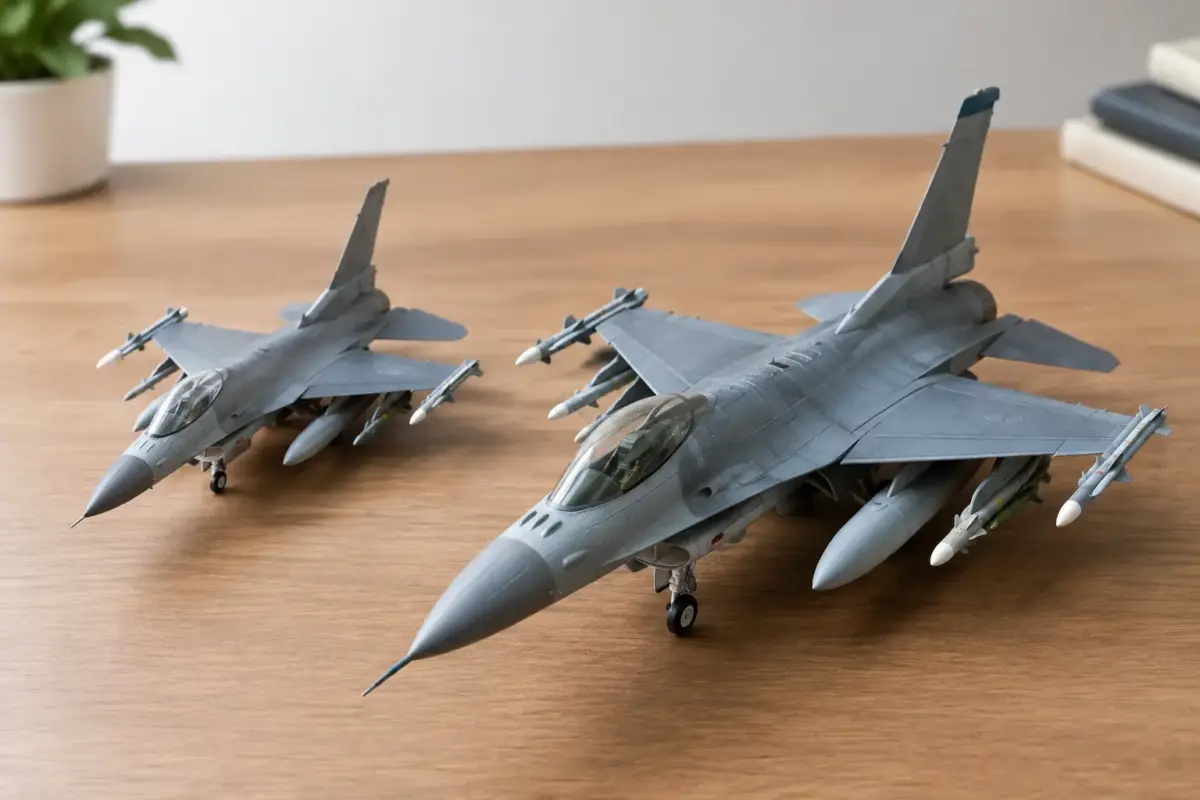
A Spitfire in 1/72 can sit comfortably in the palm of your hand. The same aircraft in 1/48 has enough presence to show off cockpit detail, subtle weathering and a convincing airfield base. That practical difference is at the heart of the 1/72 versus 1/48 aircraft question. Neither scale is inherently better; the right choice depends on the subject, the finish you enjoy and, quite often, the shelf space you actually have.
1/72 versus 1/48 aircraft: the essential difference
Scale tells you how many times smaller the model is than the real aircraft. In 1/72 scale, 1 unit on the kit represents 72 units on the real machine. In 1/48, 1 unit represents 48. A 1/48 model is therefore one and a half times the length and span of its 1/72 equivalent, but the overall visual difference feels larger because it occupies substantially more display space.
Take a single-engined fighter as an example. A 1/72 Hurricane is generally around 13 to 14cm long, while a 1/48 version is closer to 20cm. Move up to a Lancaster, B-17 or Tornado GR.4 and the choice becomes much more consequential. A larger-scale bomber can dominate a cabinet, whereas its 1/72 counterpart remains practical for a collection of several aircraft.
The scale also changes the building experience. Small parts, cockpit visibility, panel treatment, aftermarket options and the amount of surface available for painting all affect how satisfying a kit will be for a particular modeller.
Why 1/72 remains a favourite
For many British aircraft enthusiasts, 1/72 is the natural home scale. It has a long history in the hobby, an enormous range of subjects and a particularly strong selection of RAF, Fleet Air Arm, Cold War and modern British aircraft. If you want a collection that runs from a First World War biplane through to a Typhoon FGR.4, 1/72 makes that ambition realistic.
Its greatest advantage is efficient use of space. A display shelf can accommodate several 1/72 fighters where one or two 1/48 kits might fit. This matters for modellers building squadrons, aircraft families or chronological collections. A row of Spitfire variants, for example, is easier to assemble and display in a shared scale than a mixture of sizes.
1/72 also makes larger subjects accessible. Four-engined bombers, maritime patrol aircraft, transport aircraft and modern fast jets with wide wingspans can still be displayed without needing a dedicated room. A 1/72 Vulcan is certainly not small, but it is much more manageable than the same aircraft in 1/48.
There is a common assumption that 1/72 kits lack detail. That may have been fair for some older moulds, but modern tooling has changed the picture considerably. Current 1/72 releases can include finely engraved panel lines, well-appointed cockpits, detailed wheel bays, separate control surfaces and highly capable decal sheets. Careful painting and restrained weathering can produce a remarkably convincing model.
The compromise is physical scale. Cockpit details are smaller, transparencies can be harder to mask, and delicate undercarriage or aerials demand a light touch. Some details simply need to be suggested rather than reproduced in full. This is not a weakness if you enjoy the challenge of precision, but it can be frustrating for builders who want every lever, harness and hydraulic line clearly visible.
Best suited to 1/72
1/72 is especially rewarding for collections, large aircraft, limited display space and projects where the overall aircraft shape and markings matter more than highly visible interior detail. It is also a sensible choice for modellers returning to the hobby and learning airbrushing, decal work or weathering techniques on a manageable canvas.
What 1/48 offers the detail-focused modeller
A 1/48 aircraft kit gives the modeller more room to work, both literally and creatively. Cockpits are large enough for instrument panels, seat harnesses, placards and convincing cockpit colours to make a real contribution to the finished model. Radial engines, gun bays, wheel wells and open canopies become focal points rather than tiny suggestions.
That additional area makes painting more expressive. Pre-shading, post-shading, marbling, paint fading and oil-based weathering effects are easier to control when they are not compressed into a small wing panel. National markings and stencils also tend to be more legible. For aircraft with distinctive wear, such as naval jets, desert aircraft or heavily used Second World War fighters, 1/48 gives you room to develop the finish without exaggerating it.
Aftermarket support is another major attraction. The scale is well served by resin cockpits, ejection seats, photo-etched sets, metal landing gear, masks, replacement wheels, weapons sets and specialist decals. None of these are compulsory, and a good kit can look excellent straight from the box, but 1/48 makes extra detailing more visible and therefore more worthwhile.
The trade-off is cost and commitment. A larger kit commonly uses more plastic, has more parts and may need more paint, primer, masking material and weathering products. A 1/48 modern jet with full stores can quickly become a substantial project. This is ideal if you prefer one carefully finished centrepiece, but less suitable if you want to complete several builds over the year.
Best suited to 1/48
Choose 1/48 when cockpit detail, open panels, realistic ordnance and layered finishing techniques are central to the appeal. It works particularly well for single-seat fighters, naval aircraft and subjects you want to make the focus of a diorama or display base. It is also an excellent scale for trying detail upgrades, because your work is easier to see and handle.
Size is not the only consideration
It is tempting to reduce the choice to available shelf space, but the subject itself should influence the decision. A 1/48 Tiger Moth or Bf 109 is compact and satisfying. A 1/48 Shackleton, Halifax or C-130 is a different proposition altogether. Conversely, a 1/72 Harrier or F-16 can still provide enough surface detail and visual interest to be a rewarding standalone build.
Kit quality matters just as much as scale. An older 1/48 tooling with heavy raised lines and awkward fit may not be a more enjoyable build than a newer, accurately engineered 1/72 release. Before choosing, consider the specific kit’s mould age, engineering, decal options and whether it represents the precise variant you want.
Accuracy preferences also differ. Some modellers enjoy correcting small shape issues, adding cockpit details and researching airframe-specific features. Others would rather build cleanly, paint well and move on to the next project. Both approaches are valid. The best scale is the one that supports the way you actually build, rather than the version of the hobby you think you ought to pursue.
Paint, weathering and tools for each scale
The same core equipment works in both scales: sprue cutters, sanding sticks, liquid cement, primer, suitable paints, brushes or an airbrush, and decal solutions. The difference lies in control and restraint.
In 1/72, fine sanding grades, a sharp blade, a good pair of tweezers and a magnifier can make a bigger difference than a large collection of extras. Paint layers need to stay thin so engraved detail is not softened. Weathering should be scaled down too. Heavy chipping, wide panel-line washes and oversized paint fading can make a small aircraft look toy-like very quickly.
In 1/48, there is more scope for tonal variation and surface effects, but restraint still matters. Real aircraft weather according to their environment, maintenance and service history. A carrier-based Phantom can carry very different staining from a well-kept display aircraft or a post-war RAF trainer. Reference photographs should guide the finish more than a fashionable weathering technique.
Canopies deserve special attention in either scale. In 1/72, pre-cut masks can save time and produce sharp framing on very small transparencies. In 1/48, masking remains useful, but the larger canopy also rewards careful interior framing, clear parts polishing and an open-cockpit presentation where appropriate.
Display plans can decide the scale
Before ordering a kit, measure the intended shelf, cabinet or base. Include the wingspan, tailplane, propeller clearance and any stand or diorama border. This sounds obvious, yet many modellers have completed an impressive aircraft only to discover that it fits nowhere sensible.
Think about the collection as well. A uniform 1/72 display has a pleasing, museum-like coherence and allows broad coverage of a subject. A 1/48 collection can be more selective, with each build receiving more time, accessories and display space. Mixing scales is perfectly acceptable, particularly if models are displayed separately, but a mixed-scale squadron scene rarely looks convincing.
For a diorama, 1/48 can make figures, ground equipment and aircraft servicing scenes easier to detail. 1/72 has its own strength: it allows a wider scene, such as a dispersal with several fighters or a larger section of airfield, without requiring an enormous baseboard.
Make the choice fit your next project
If you are drawn to breadth, squadrons and big aircraft in a sensible footprint, 1/72 is hard to beat. If you want a single aircraft to reward close inspection, cockpit work and more ambitious finishing, 1/48 is usually the more satisfying route. Many experienced modellers keep both scales, choosing according to the aircraft rather than treating scale as a fixed loyalty.
A good next step is to pick the subject you genuinely want to build, check its finished dimensions, then plan the paint, markings and display treatment before the box arrives. That small bit of planning makes it far easier to choose compatible supplies and turns a promising kit into a project you will be pleased to put on the shelf.
