
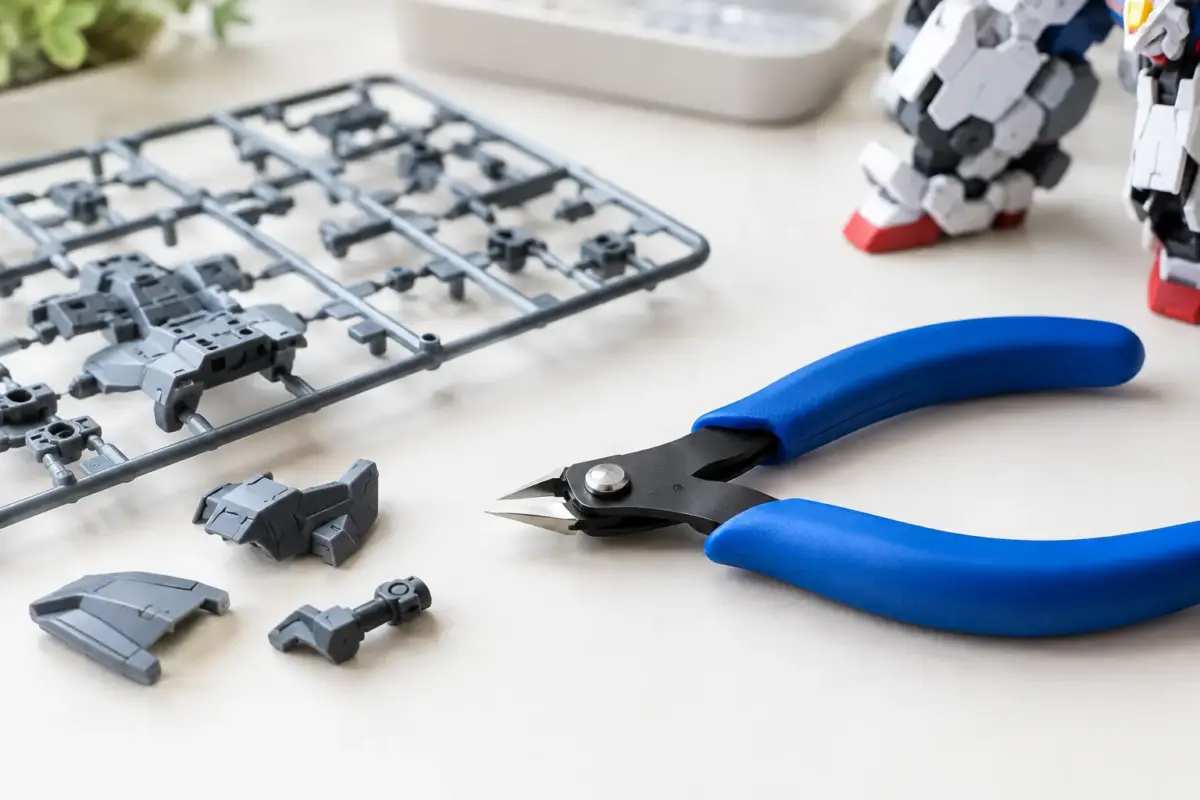
A small white stress mark on the leading edge of an aircraft wing can spoil a perfectly good paint finish. So can a torn locating pin, a snapped antenna or a gouge across a delicate figure component. The best scale model cutters do more than separate parts from the sprue: they give you control at the very first stage of a clean build.
For most modellers, cutters are among the most-used tools on the bench. They are not all designed for the same job, however. A heavy-duty pair that makes short work of thick kit runners is not the tool to bring close to a 1/700 ship railing or a finely moulded 1/35 stowage part. Choosing well means cleaner parts, less sanding and fewer avoidable repairs.
What makes the best scale model cutters?
The right cutter depends on the plastic, the size and position of the gate, and how fine the part is. What matters most is the cutting geometry. A standard side cutter uses two bevelled jaws that meet to pinch through plastic. It is durable and useful, but the wedging action can leave a pronounced nub or stress the part if used too close to the surface.
Single-blade nippers work differently. One exceptionally sharp, flat-sided blade passes against a supporting anvil-like jaw, shearing the runner rather than crushing it. On polystyrene, this generally leaves a much neater cut and reduces the amount of trimming needed afterwards. They are particularly valuable for modern kits with fine gates, clear parts and parts intended to be painted in a high-gloss finish.
That does not mean every modeller needs the most delicate precision nipper for every task. Fine single-blade cutters cost more and can be damaged by thick sprue, resin, wire or photo-etched brass. A practical bench setup often includes one dependable general-purpose side cutter and one precision nipper reserved for delicate plastic parts.
Jaw size and access matter
Slim, pointed jaws can reach gates tucked between armour road wheels, inside aircraft undercarriage bays or close to raised surface detail. Wider jaws are stronger but may not fit into a tight area without forcing the part or clipping nearby detail.
Look at the kit before choosing your tool. A large 1/24 car body may have substantial attachment points that call for a sturdy cutter followed by a sanding stick. A 1/144 aircraft cockpit control column needs a fine cutter, then a careful trim with a sharp hobby knife. The smallest tool is not automatically the best choice if the gate is thick.
The main cutter types for a modelling bench
General-purpose side cutters
Standard side cutters are the sensible workhorse. They are ideal for thick sprue, large armour hull sections, railway building parts and less delicate components. They are also the safer option for cutting non-plastic materials, provided the manufacturer’s guidance allows it.
Their limitation is finish quality. Cut a gate flush to a visible surface with ordinary side cutters and the jaws can compress the plastic, leaving a crater or pale stress mark. Leave a small length of runner attached instead, then remove the remainder with a knife, chisel blade or sanding tool.
Precision single-blade nippers
For clean removal from standard polystyrene sprues, precision nippers are often the leading choice. Brands such as Tamiya, GodHand and DSPIAE are well known among experienced modellers for fine jaws and crisp cuts. A quality pair can make a noticeable difference on Gundam kits, aircraft interiors, figures and any model where parts must fit cleanly with minimal clean-up.
The trade-off is care. These cutters are precision instruments, not miniature bolt cutters. Do not use them on thick runners, clear sprue unless the maker permits it, resin casting blocks, metal wire or photo-etch. Avoid twisting the jaws during a cut, and do not drop them onto a hard floor. The fine blade can chip or lose alignment.
Flush cutters
The term ‘flush cutter’ is sometimes used broadly, so inspect the jaw design rather than relying on the name alone. A good flush cutter can leave a close, tidy cut on plastic and is a useful middle ground between a basic side cutter and a premium single-blade nipper.
They suit modellers who want a cleaner finish on most kits but still need a durable everyday tool. As with any cutter, keep a slight gap between the jaws and the finished part unless you are confident the gate is thin and the surface is not under tension.
Specialist cutters for other materials
Resin, metal and photo-etch need their own approach. Resin casting blocks are often better removed with a razor saw, as cutting them with nippers can crack the part. Photo-etched brass is best cut on a hard surface with a dedicated photo-etch cutter or sharp blade. Fine wire may require suitable wire cutters.
Using one pair of premium plastic nippers for all three jobs is an expensive false economy. Keep materials separate and your precision cutters will retain their edge for far longer.
How to remove parts without damaging them
Even the best cutter cannot compensate for poor technique. Begin by supporting the part with your free hand, especially if it is long, thin or already under tension in the sprue. This prevents it springing away as the final gate is cut.
For a delicate component, make the first cut a few millimetres away from the part. Once it is free, place it on the cutting mat and remove the remaining nub gradually. This two-stage method is slower than cutting flush in one movement, but it is far safer around thin trailing edges, transparent parts and detailed surfaces.
Orient the flat side of a single-blade nipper towards the piece you want to keep. Close the handles in a controlled movement rather than squeezing hard. If the cutter hesitates, stop. The gate may be too thick for that tool, and forcing it risks damage to both the part and the blade.
After cutting, inspect the attachment point under good bench lighting. A fine sanding sponge, sanding stick or scraper will remove a slight nub without flattening surrounding detail. On curved fuselage halves or vehicle mudguards, use the smallest abrasive area possible and check your progress frequently.
Choosing cutters by project type
Aircraft builders usually benefit from fine-jawed nippers because cockpit components, aerials, pylons and undercarriage doors often sit on narrow gates. Keep a sturdier pair nearby for major wing, fuselage and stand components.
Armour modellers need both strength and precision. Hull and running gear sprues can be heavy, while tools, handles, towing cable brackets and spare track links reward a clean shear. If you build kits with individual-link tracks, comfortable handles are worth considering because cutter use soon becomes repetitive.
Ship modellers and figure painters tend to place the highest value on delicate jaw access. Masts, gun barrels, railings, hands and equipment can be surprisingly vulnerable before paint has even reached the bench. A precision nipper paired with a sharp blade and magnification is often more useful than an oversized cutter with extra leverage.
Gundam and other snap-fit builders may want two grades of nipper. Use a general cutter for the first removal from the runner, then a sharp single-blade pair for the final cut. This reduces the white marks sometimes seen on coloured plastic and helps preserve a clean, unpainted finish.
Care, storage and sensible safety
Wipe cutters clean after use, particularly if plastic residue has built up around the jaws. Store them dry, ideally with a protective cap or in a tool case where the tips cannot strike other tools. Never lever parts apart with the cutter tips or use them as pliers.
Cut away from your fingers and keep the part low over the mat. Sprue fragments can fly, so eye protection is sensible when tackling thick runners or brittle plastic. If a part is too awkward to hold safely, change the method rather than rushing the cut.
A good pair of cutters should make model preparation quieter and more deliberate. Start with a sturdy tool for the demanding work, save your precision nippers for fine polystyrene, and leave enough material to finish each gate properly. If you are building up a new tool kit, Scale Model Shop can help you match cutters, abrasives and other essentials to the kind of projects you enjoy making.