
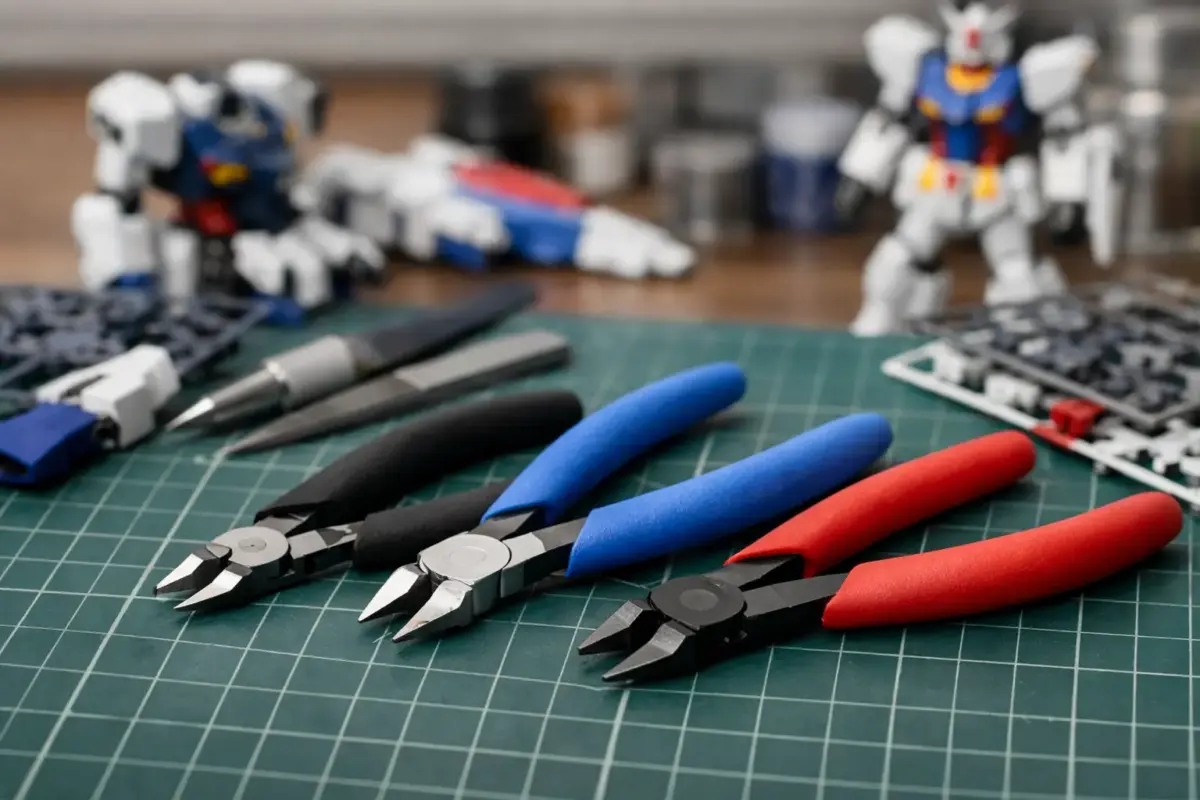
A poor pair of cutters can make a very good Gunpla kit feel needlessly hard work. If you are looking for the best nippers for Gunpla, the right choice is less about buying the most expensive tool on the shelf and more about matching the cutter to the way you build, the grades you buy, and the finish you expect.
Gunpla builders usually notice the difference in three places straight away: how cleanly the part comes off the runner, how much stress whitening is left around the gate, and how much clean-up is still needed with a knife, file, or sanding sponge. Good nippers do not remove all finishing work, but the right pair can reduce it significantly and make the whole build process more precise and more enjoyable.
What makes the best nippers for Gunpla?
The key detail is the cutting action. Not all hobby nippers are designed for the same job, even if they look similar at a glance. For Gunpla, there are two broad types that matter most: double-bladed nippers and single-bladed nippers.
Double-bladed nippers have cutting edges on both sides. They are common, durable, and often the best place for beginners to start. They cope well with general runner removal and are usually more forgiving if you are still learning how much pressure to use. They also tend to be better value, which matters if you are building casually or splitting your budget across paints, tools, decals, and finishing supplies.
Single-bladed nippers are the tool most builders mean when they talk about premium Gunpla cutters. One side is sharpened to cut, while the other side supports the plastic. That geometry allows a cleaner, more controlled cut on polystyrene, especially when trimming close to the part. Used properly, they can leave a noticeably smaller nub and less visible stress on the surface.
The trade-off is durability. Fine single-blade nippers are not general-purpose cutters. They are not intended for thick gates, clear hard plastics, metal parts, resin casting blocks, or twisting parts off runners. Use them outside their intended range and the edge can chip. For many modellers, the best setup is not one pair but two: a sturdier cutter for first removal and a finer nipper for the final close cut.
Choosing the right Gunpla nippers for your build style
If you mainly build High Grade kits and want a dependable tool without spending heavily, a quality double-bladed nipper is often the sensible option. It will handle routine assembly well, give you much better control than very cheap generic cutters, and still leave a manageable nub for clean-up.
If you build Master Grade or Perfect Grade kits regularly, or simply care about the cleanest possible part separation, a premium single-bladed nipper starts to justify its price. On larger projects, the time saved over dozens or hundreds of gates adds up. More importantly, the reduced risk of chewing the plastic around visible armour panels can make finishing far easier.
If you paint all your kits, the decision changes slightly. Since priming and paint can hide minor surface marks, you may not need the absolute finest cut on every build. In that case, a solid mid-range pair combined with careful knife and sanding work can be more cost-effective than chasing the top-end option.
For straight-builders who want crisp snap-fit results with minimal extra work, better nippers matter more. Bare plastic shows every mark. On white, dark blue, red, and gloss-finish parts especially, a rough cut is hard to ignore.
Single-blade vs double-blade nippers
The best nippers for Gunpla are often described as single-blade, but that is only half the story. Single-blade cutters excel at the final trimming cut, close to the part surface, on suitable styrene. They are precise tools, not heavy-duty ones.
Double-blade nippers are more versatile across the bench. They are useful for first cuts away from the part, for thicker sections of runner, and for jobs where preserving a delicate premium edge would be a waste. Many experienced modellers keep both within reach because each does a different part of the job better.
A good way to think about it is this: the first cut is about safe separation, the second cut is about finish quality. If you try to make one pair do both jobs all the time, you usually compromise either durability or surface finish.
When premium nippers are worth it
Premium single-blade nippers are worth the investment when you build often, value clean presentation, and work mainly with standard plastic Gunpla runners. They are especially useful on visible exterior parts where nub marks are awkward to remove without flattening nearby detail.
They are less essential if you are still testing whether Gunpla will become a long-term hobby, or if your current budget needs to cover basics like a craft knife, sanding tools, panel liner, and a cutting mat. In those cases, it is often better to buy a reliable mid-range cutter first and upgrade later with a clearer sense of your preferences.
Features worth checking before you buy
Edge type matters most, but it is not the only consideration. Handle comfort makes a difference on larger kits. If the spring tension is too stiff or the grip shape does not suit your hand, fatigue sets in quickly during long building sessions.
Jaw size and tip access also matter. Slim, pointed jaws help when gates sit in tight spaces between parts on the runner. Bulkier nippers can still cut well, but they may force awkward angles that increase stress on the part.
Build quality is another practical consideration. Smooth action, good alignment, and a protective cap for storage all help extend the life of the tool. On finer nippers in particular, proper storage is not a minor extra. A chipped edge usually means the cutter has been used on the wrong material or knocked about on the bench.
Finally, consider spare availability and brand consistency. Established hobby tool brands usually provide more predictable quality control, which is useful when you are buying a tool meant to last through many kits.
How to use Gunpla nippers for cleaner cuts
Even the best nippers for Gunpla will leave marks if they are used badly. Technique matters as much as the tool. The usual approach is a two-step cut: first, remove the part from the runner with a little distance left from the gate; second, trim the remaining nub more carefully once the part is free.
That first cut protects the part from unnecessary stress. Trying to cut flush immediately, especially on a thick gate, can pinch and whiten the plastic. Once the piece is separated, you can support it properly and make a more controlled finishing cut.
With single-blade nippers, orientation matters. The flat support side should sit against the part, with the cutting blade on the waste side. That gives the cleanest result. It is also wise to leave the tiniest amount of material rather than forcing a perfectly flush cut every time. A light pass with a sanding sponge or hobby knife is safer than gouging the surface.
Clear parts need extra care. Many builders avoid using fine nippers too aggressively on transparent plastic because stress marks can show badly. On those parts, slower cutting and conservative trimming are usually the better route.
Common mistakes when buying nippers
The most common mistake is assuming the most expensive cutter is automatically the right first purchase. If you are new to the hobby and still learning gate removal, a fragile premium nipper can be an expensive way to learn bad habits.
The second mistake is using one tool for everything. Gunpla, resin, metal wire, etched brass, and thick sprue gates do not all belong to the same cutter. Matching the tool to the material protects both the finish of the model and the life of the nipper.
The third is overlooking the rest of the workflow. Nippers are important, but they work best as part of a proper bench setup that includes a knife, sanding options in suitable grits, and good lighting. Cleaner cuts are useful because they reduce finishing time, not because they eliminate finishing altogether.
So which type should you actually buy?
For most beginners, a dependable mid-range double-bladed nipper is the practical starting point. It is affordable, durable, and capable enough for regular HG and RG builds with sensible clean-up afterwards.
For regular builders who want neater results and build often enough to justify a dedicated tool, a two-nipper setup is usually the strongest option: one robust pair for runner removal and one fine single-blade pair for close trimming. That approach gives you better control and protects your premium cutter from jobs it was never meant to do.
For experienced Gunpla modellers chasing the cleanest straight-build finish, a high-quality single-blade nipper is often the standout choice, provided it is used correctly and only on suitable plastic. If you are unsure which direction suits your bench best, a specialist retailer such as Scale Model Shop can help you narrow it down based on budget, build frequency, and the kinds of kits you tackle most often.
The right nippers should make your build feel calmer, cleaner, and more controlled – and that is usually the best sign you have chosen well.
