
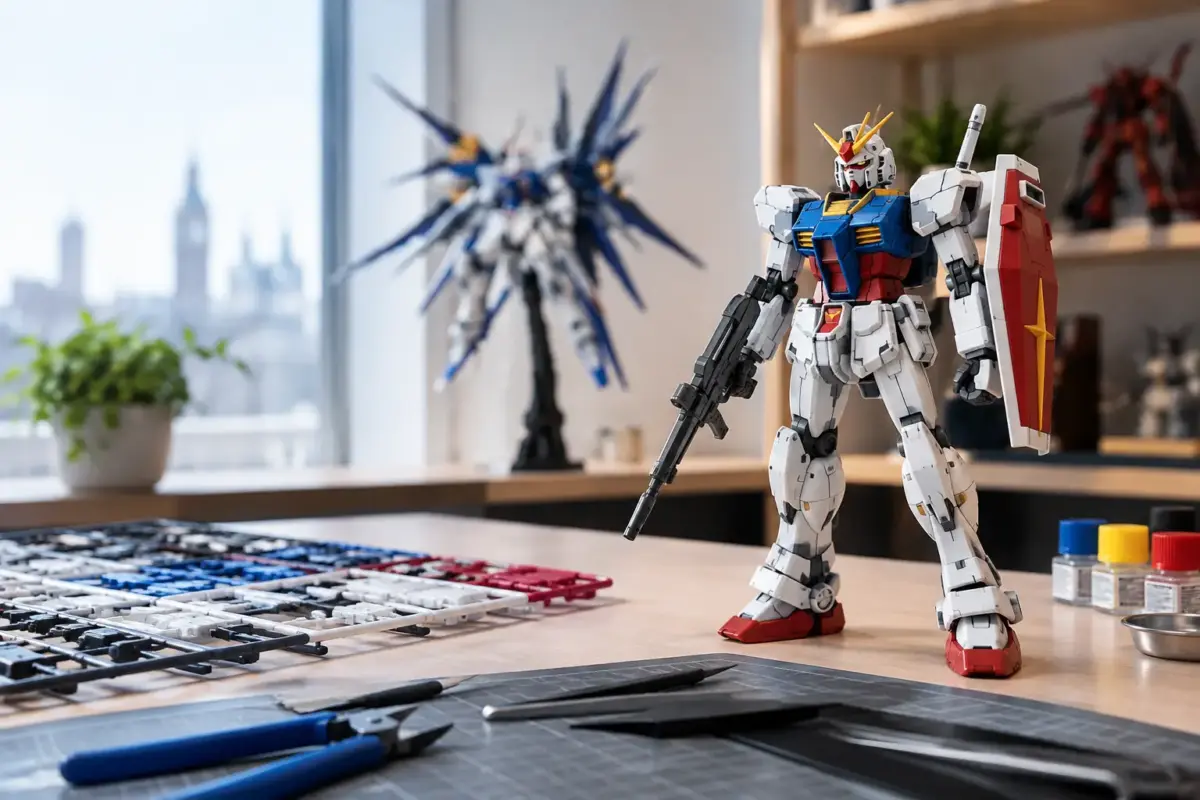
A well-built Gunpla kit no longer has to choose between a clean anime finish and serious scale-model craftsmanship. The most interesting Gundam building trends 2026 are coming from builders who combine both: careful surface preparation, controlled colour variation, convincing wear where it makes sense, and a display plan considered before the first runner is cut.
For UK modellers, that shift makes Gundam a particularly rewarding subject. A high-grade kit can be an enjoyable weekend build; the same kit can also become a long-term detailing project with a painted inner frame, refined panel lines, photo-etched accents and a compact hangar base. The key is choosing techniques that suit the kit, the design and the finish you actually want to display.
Gundam Building Trends 2026: Cleaner, More Intentional Finishes
The move away from indiscriminate weathering continues. Gunpla builders are still using chipping, streaking and dust effects, but with more restraint and a clearer visual reason for each mark. A pristine mobile suit can look exactly right if it is intended as a parade, factory-fresh or anime-inspired build. A hard-worked machine needs evidence of use, but that evidence should follow edges, access panels, feet, thrusters and moving armour sections rather than appearing evenly across every surface.
This is good news for builders developing their finishing skills. A satin or matt clear coat, crisp panel lining and a few carefully placed decals can produce a convincing result without turning the project into a weathering exercise. Conversely, a battle-worn finish benefits from a planned sequence: gloss coat for decals and washes, protective clear coat, then controlled chipping and pigments. Rushing these layers is still the most common cause of cloudy finishes, damaged decals and unwanted tide marks.
Colour separation is also becoming more sophisticated. Rather than painting every armour part in a radically different shade, builders are using closely related tones to distinguish panels. A slightly cooler blue on a shoulder insert, an off-white on selected armour plates, or a darker red beneath a main red armour tone adds depth while preserving the recognisable character of the suit. This approach rewards accurate masking and thin paint application more than dramatic contrast.
The Return of the Well-Prepared Straight Build
Not every impressive Gundam build begins with full repainting. In 2026, there is renewed respect for the refined straight build: gates removed properly, nub marks progressively sanded, panel lines cleaned up, stickers replaced or carefully applied, and the finish protected with an appropriate clear coat.
Modern Bandai engineering gives builders an excellent base, but it does not remove the need for fundamentals. A single-blade nipper makes the initial cut from the runner. A sharp hobby knife, sanding sponges in several grits and polishing tools deal with the remaining gate. On darker plastic, a light pass with a glass file can leave a remarkably clean surface, although it should be used with care around sharp edges and textured areas.
The trade-off is time. A straight build may use fewer paints and materials, but careful clean-up is not a shortcut. It is often the best route for a builder who wants a crisp display model without committing to an airbrush setup, and it gives newer modellers a sound basis for later custom work.
Clear Coats Are Becoming Part of the Design
Top coat choice is now more deliberate than the old assumption that every finished kit must be dead matt. Matt varnish can unify colours, reduce the toy-like sheen of bare plastic and make panel lines read clearly. It suits military-inspired real robot schemes especially well.
Satin works beautifully for many Gundam subjects because it retains a subtle engineered finish. Gloss has its place on polished armour, sensor housings, metallic parts and showpiece builds, but it reveals every scratch and speck of dust. Test your preferred finish on a spare runner first, particularly when working over decals, metallic paint or ABS parts. Compatibility and curing time matter as much as the brand on the bottle.
Mechanical Detail Without Overloading the Kit
A popular direction this year is selective mechanical detailing. Builders are adding metal verniers, replacement antennae, etched mesh, pipework and small photo-etched parts where they create a clear focal point. Thruster bells, backpack interiors, exposed frame sections and weapon assemblies benefit most because these areas already suggest engineering complexity.
The principle is simple: detail should reinforce the kit’s forms, not obscure them. A Master Grade frame can carry more added cabling and painted pistons than a compact High Grade. On a smaller 1/144 kit, a few metallic details and painted sensors are often more effective than filling every panel with aftermarket parts.
Scribing remains a major skill area, but it is becoming more disciplined. Extra panel lines should follow armour geometry and avoid cutting through areas that need to flex during assembly. Use a scriber with guide tape, make several light passes instead of one heavy cut, and sand the raised edge before priming. If the line does not make the armour look more purposeful, leave it out.
Custom Colours With a Scale-Modelling Mindset
The familiar Gundam palette is still popular, but custom schemes are increasingly drawing from aircraft, motorsport, naval and armour modelling. Desaturated whites, grey-blue frames, warning-colour details and unit markings can make a familiar design feel personal without losing its identity.
Paint modulation is subtler than it is on many military vehicle models. The aim is usually to break up large armour panels, not to create obvious light-to-dark bands. A darker pre-shade around joins, a restrained highlight in the centre of a panel, or a post-shade along lower surfaces can be enough. Thin, controlled coats through an airbrush remain the most reliable method, but brush painters can achieve strong results with modern acrylics, a wet palette and several diluted layers.
Metallics deserve special attention. Inner frames, weapons and verniers can quickly look like one uniform silver mass. Varying black, steel, aluminium, burnt metal and clear colours gives those assemblies depth. It is worth deciding which components are structural metal, heat-stained exhausts, painted machinery or exposed hydraulics before reaching for a paint pot.
Displays Are Becoming Part of the Build
A finished Gundam is increasingly being treated as a small scene rather than an isolated kit on a shelf. That does not necessarily mean a large diorama. A simple painted plinth, a launch-deck section, a ruined urban base or a clear action stand can establish scale and movement without distracting from the mobile suit.
For a dynamic pose, test the balance before committing to glue or paint. Heavy weapon loads and extended flight stands put real stress on joints, especially on older kits. Strengthening a connection with a metal pin or choosing a more stable stand may save an otherwise excellent build from a fall later on.
Hangar-style displays remain popular, but they work best when the surrounding detail supports the model’s scale. Oversized railings, excessively thick cables and random crates can make even a finely finished kit look smaller and less convincing. Check the kit scale before selecting figures, ground crew, decals and scenic accessories.
Better Project Planning at the Workbench
The practical trend behind better Gunpla is project planning. Builders are buying fewer duplicate items and choosing materials around a finish plan: primer suited to the plastic, colours that work together, a panel-line method compatible with the paint layers, decals, clear coats and weathering products that will not react badly with one another.
A typical painted project benefits from a few dependable categories: precision nippers and sanding tools for preparation, primer for surface consistency, paints for armour and frame, masking materials for colour separation, decals or waterslides for markings, and clear coats to protect the work. Add washes, pigments and chipping fluids only when they support the intended story of the model.
This is where buying from a specialist modelling supplier is useful. Being able to source the kit, compatible paints, airbrush consumables, decals, tools and display materials together makes it easier to keep the project coherent. At Scale Model Shop, the same category-led approach helps builders move from a basic kit to a finished display without having to guess at every stage.
Build for the Result You Want to See
The strongest Gundam builds of 2026 are not defined by the number of modifications or the cost of the tools used. They are defined by consistency. Clean joins, thoughtful colours, purposeful markings and effects that match the imagined service life of the machine will always read better than a collection of techniques applied simply because they are popular.
Choose one or two new skills for your next kit, whether that is removing nub marks to a higher standard, trying waterslide decals, painting an inner frame or creating a small display base. A Gundam kit rewards that kind of steady progression, and each finished model leaves the next project with a clearer direction.
