
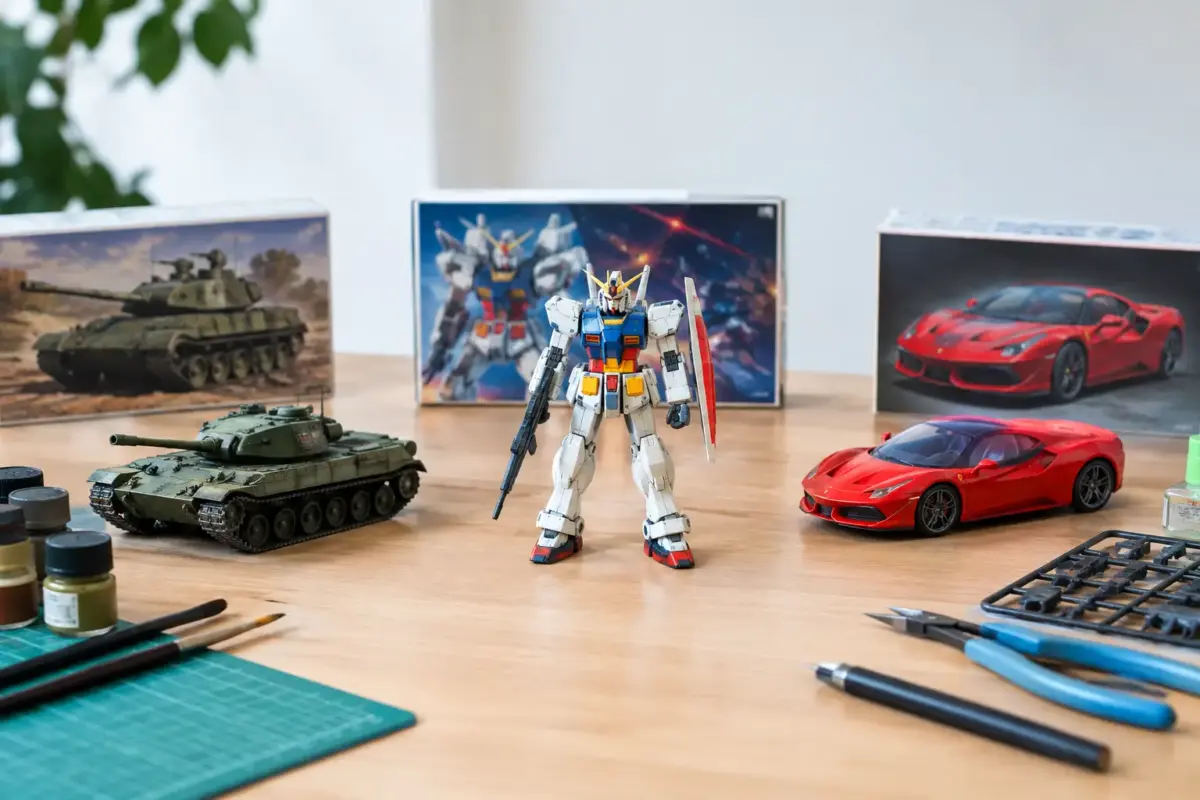
A new kit can look straightforward until the project list starts growing: primer, adhesive, cockpit colours, masking tape, decals, weathering products and perhaps replacement parts. A useful model hobby brand comparison is therefore less about declaring one manufacturer “best” and more about choosing ranges that work together for the model, finish and level of detail you have in mind.
For UK builders, availability matters too. The finest aftermarket set is of little help if it delays a build for weeks or requires you to source compatible paints from three different places. Start with the subject and scale, then compare brands by what they genuinely offer your project.
Model Hobby Brand Comparison: Start With the Kit
Kit brands have different priorities. Some focus on accessible builds with sensible part counts and clear instructions; others aim for high parts density, fine surface detail and complex engineering. Neither approach is automatically better. A weekend build of a familiar aircraft may call for a forgiving kit, while a competition-standard armour project can justify a more involved assembly.
Airfix remains a natural choice for many British subjects and builders who value well-supported mainstream releases. Recent toolings often provide sharp detail and logical construction, while the range also includes approachable starter sets. They are particularly useful when returning to the hobby or building with an older teenager, although individual kits still vary by tooling age.
Tamiya has earned its reputation for precise fit and thoughtful engineering. Its aircraft, military vehicle and car kits are often a pleasure to assemble, especially where alignment can make or break the finished model. The trade-off is that a kit may favour clean construction over every conceivable variant option, and some older releases show their age beside newer moulds.
Revell covers an exceptionally broad selection of aircraft, ships, armour, vehicles and more. It is worth looking closely at the specific kit rather than judging the box alone: the catalogue includes new-tool releases, reissues and kits originating from other manufacturers. This breadth is valuable when the subject matters most, but checking scale, mould date, decals and intended skill level will help set expectations.
Specialist brands can be the right answer for subjects that mainstream manufacturers do not cover. Short-run, resin or limited-run kits may offer rare aircraft marks, unusual military vehicles or niche naval subjects. They commonly demand more test-fitting, cleaning of parts and occasional scratch-building. For an experienced modeller, that is part of the appeal. For a first project, it can turn a relaxing build into an avoidable battle.
Detail versus buildability
Compare the kit’s engineering before comparing its marketing claims. Fine recessed panel lines, separate control surfaces and a large photo-etch fret can be attractive, but they also add decisions and opportunities for misalignment. A well-built, carefully painted kit with restrained detail will usually look more convincing than an over-complicated model rushed through the final stages.
Check whether the kit includes the version you want, too. Decal options, ordnance, crew figures, clear parts and alternative parts for different production blocks can save considerable expense. Conversely, an aftermarket cockpit, metal barrel or decal sheet may be worthwhile if the base kit has the right overall shape and fit.
Compare Paint Brands by System, Not Just Shade
Paint choice affects preparation, airbrushing, brush work, weathering and the final varnish. The best brand for one task may not be the best for the next, which is why experienced modellers often use more than one paint system on the same bench.
Vallejo is widely used for water-based acrylics, particularly for brush painting figures, details and wargaming miniatures. Its colour ranges provide a strong starting point for military and historical subjects, and the dropper bottles make repeatable mixing easier. When airbrushing, use the appropriate thinner and allow enough curing time before masking. Acrylic does not automatically mean indestructible.
AK Interactive offers wide colour and weathering ranges built around modern modelling workflows. Its 3rd Generation acrylics are popular for airbrushing and brush painting, while the brand’s weathering products give armour, aircraft and diorama builders plenty of scope for filters, streaking, mud and dust effects. The key is to follow the intended order of application rather than treating every bottle as interchangeable.
Ammo by Mig Jimenez is similarly strong for subject-led colour sets and finishing products. Sets matched to particular theatres, nations or vehicle families can remove much of the research from paint selection. They are convenient, but use reference photographs where possible. Operational vehicles fade, collect dust and receive field repairs; a set of accurate base colours is the start, not the finish.
Mr Hobby’s aqueous acrylics and lacquer-based Mr Color paints are valued for fine spraying and durable finishes. Lacquers can produce excellent results, particularly on aircraft and automotive subjects, but demand appropriate ventilation, compatible thinners and sensible safety practice. They are not simply a stronger alternative to water-based acrylics – they are a different system with different handling requirements.
Tamiya acrylics remain a familiar bench staple, especially for airbrushing and mixing. Their alcohol-based formulation behaves differently from many water-based acrylics, so use suitable thinners and test a paint combination on spare plastic before committing to the model. Tamiya’s spray cans can also be a practical choice for large, even coats when an airbrush is not available.
Match the finish products
Primer, clear coat and weathering media deserve the same care as the main colours. A lacquer clear coat over an insufficiently cured acrylic layer can cause trouble, while enamel washes applied over an unprotected acrylic finish may stain or damage it. A sensible sequence is primer, base colours, gloss clear for decals and washes where required, weathering, then the desired final sheen. Test unfamiliar products on a spoon, scrap plastic or an old kit first.
Tools and Adhesives: Buy for the Job
Tool brands are best compared by precision, durability and the task they solve. A side cutter for removing delicate parts should leave a clean cut close to the sprue. A broad hobby knife blade is useful for trimming and scraping, while a fine blade helps with small details. One inexpensive tool that performs poorly can damage a kit faster than many builders expect.
Tamiya tools are a dependable benchmark for cutters, files, tweezers, sanding products and masking tape. Their tape is particularly useful where clean paint demarcations matter, although burnishing the edge gently and spraying light coats remain essential. Other specialist tool makers offer excellent alternatives, particularly for sanding sponges, scribers, micro-drills and photo-etch bending.
Adhesive should match the material. Thin liquid cement is ideal for capillary action along close-fitting styrene joints. A slower-setting cement gives more time to align larger assemblies. Cyanoacrylate is useful for photo-etch, resin and small repairs, but can fog clear parts and becomes brittle under stress. PVA-style canopy glue is often the safer option for transparencies and can also help secure small clear lenses.
If you are buying tools for a first serious build, prioritise a quality cutter, knife, sanding selection, tweezers, liquid cement, masking tape and a small set of brushes. Add an airbrush, compressor, photo-etch tools or rotary equipment when the project actually calls for them. Specialist equipment earns its place through regular use, not through an impressive-looking workbench.
A Better Way to Choose Between Brands
Before filling the basket, compare each brand against four practical questions:
- Does it make the exact scale, subject or material required for this project?
- Is it compatible with the paints, adhesives and finishing products already on your bench?
- Does its complexity suit the time and experience you want to invest?
- Can you obtain the consumables, spares and matching products without interrupting the build?
This approach avoids brand loyalty becoming a limitation. A 1/35 armour build might combine a Tamiya kit, AK Interactive paints, Ammo weathering products, Vallejo detail colours and aftermarket accessories. That is not inconsistency; it is selecting the strongest option at each stage.
Price should be viewed in the same way. A cheaper kit that needs replacement decals, filler, extra detailing and several hours of correction is not always the lower-cost route. Equally, a premium kit is not necessary when a simpler release captures the subject you enjoy and leaves room in the budget for paints, tools and a proper display base.
Scale Model Shop stocks the breadth of brands needed to build a coherent project rather than a collection of unrelated products. If compatibility is unclear, asking for guidance before ordering is usually quicker and cheaper than correcting a problem after paint has reached the model.
The most satisfying brand choice is the one that keeps you moving from sprue to finished display piece. Pick the kit that makes you want to start, the materials you can use with confidence, and the details that add something visible to the finished model.
