
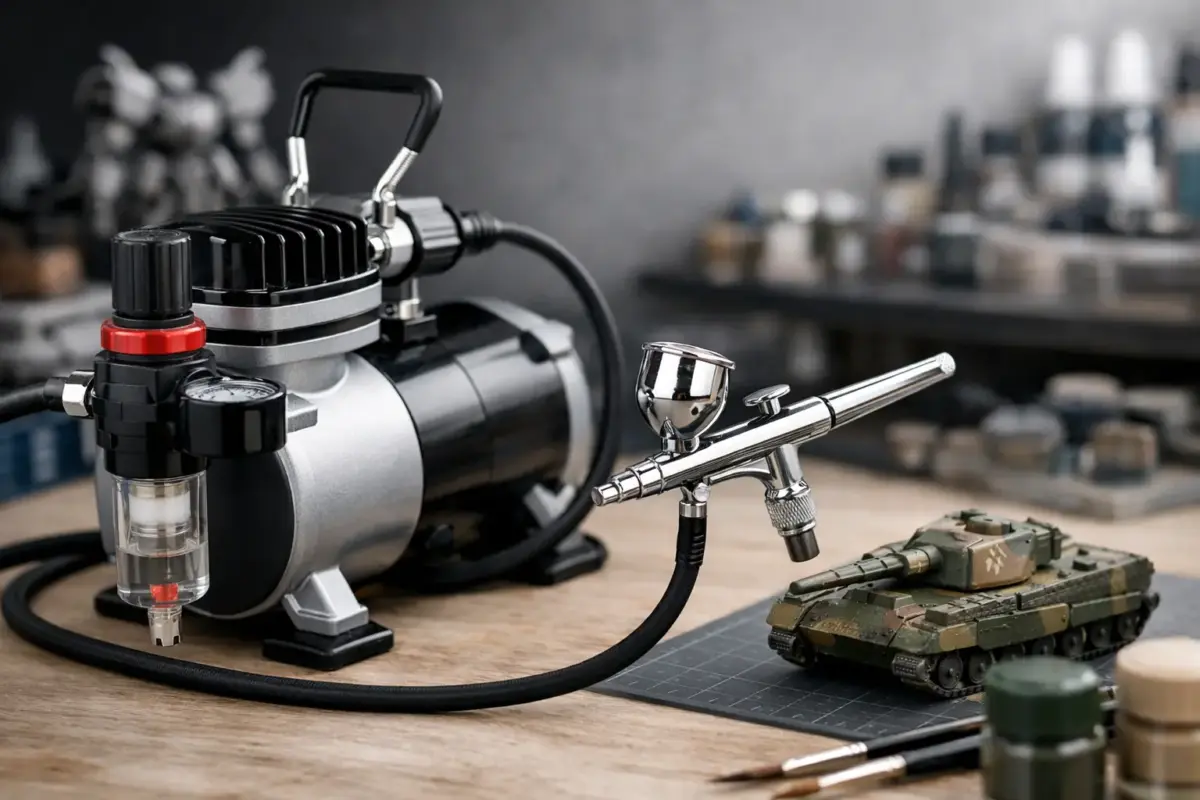
That first burst of spitting paint usually tells you the problem is not the airbrush at all. For many modellers, the real bottleneck is the compressor. If you are trying to choose the best compressor for airbrushing models, the right answer depends less on brand loyalty and more on how you build, where you spray, and what finish you expect on the bench.
A compressor for scale modelling does a very specific job. It needs to deliver steady, controllable air at the lower pressure ranges used for primers, base coats, mottling, marbling, figure shading and fine camouflage work. The needs of a modeller are not the same as those of a workshop user running air tools. Compact size, low noise, moisture control and predictable pressure matter far more than sheer output.
What makes the best compressor for airbrushing models?
For most hobby use, the sweet spot is a small piston compressor designed for airbrush work, ideally with an air tank, regulator and moisture trap. That combination gives you stable airflow, sensible pressure adjustment and far less chance of pulsing through the brush.
The air tank is often the feature that separates a decent entry-level setup from one that feels noticeably easier to live with. A tank stores compressed air so the motor does not need to run constantly while you spray. That reduces noise, evens out airflow and usually helps the compressor last longer. If you spray indoors, especially in the evening, that matters.
A regulator is just as important. Different modelling tasks need different pressure. Primer may behave well around 20 to 30 PSI depending on the product and needle size, while close-in detail work can call for much less. Without a proper regulator, pressure control becomes guesswork. You can compensate at the airbrush to a point, but that is not the same as having stable, repeatable settings.
The moisture trap is easy to overlook until water spits into a fresh coat of paint. Compressing air creates condensation, and British weather does not always help. If you spray regularly, especially for longer sessions, moisture control is not optional.
Tank or tankless?
If you are comparing compressors, this is usually the first real fork in the road. Tankless units are smaller and often cheaper. They can suit occasional users, especially if bench space is tight and your sessions are short. For simple priming, broad coverage on larger subjects, or very light hobby use, they may do the job perfectly well.
The trade-off is consistency and noise. Tankless compressors tend to run more often, and some produce a slight pulse in airflow that becomes more noticeable during fine work. If you mainly paint Luftwaffe mottling, post-shading on armour, pre-shading panel lines or subtle figure transitions, that can become frustrating.
A tanked compressor usually feels more composed. Air delivery is smoother, the motor cycles rather than running continuously, and the whole setup is better suited to regular use. For many modellers, this is where the best value sits – not because it is the cheapest option, but because it removes problems that interfere with the painting stage.
Noise matters more than spec sheets suggest
Many hobbyists spray in a spare room, loft, shed or shared family space. That makes noise level a practical buying factor, not a luxury. A compressor can have excellent output figures on paper but still be unpleasant to use if it chatters loudly every few seconds.
Oil-less piston compressors are common in the hobby because they are low maintenance and clean, but they vary quite a bit in sound. A quieter unit with a tank is usually easier to live with for home use. If you paint late at night, in a flat, or near other people, this can be the difference between spraying often and putting jobs off.
Do not just think about your current setup either. Plenty of modellers start with occasional use, then move on to more regular painting once they realise how much easier an airbrush makes priming, varnishing and consistent coverage. Buying slightly above your current needs can be sensible if it keeps the compressor useful as your skills grow.
Pressure range and control for model work
The best compressor for airbrushing models is rarely the one with the highest maximum PSI. What you need is stable low-pressure control. Most scale modelling jobs happen in a relatively modest pressure range, but that range still needs flexibility.
Heavier primers and varnishes may need more pressure, particularly through larger nozzles. Acrylics thinned for detail work may need much less. Metallics, clear coats and lacquer paints can all behave differently. A compressor that lets you adjust pressure accurately is far more useful than one that simply claims a high top end.
An easy-to-read gauge helps, especially if you use several paint systems. Once you find a pressure that works for a specific primer, camouflage coat or weathering pass, you will want to return to it consistently. Repeatability saves paint, time and test spoons.
Compatibility and fittings
This catches out more beginners than it should. Not every hose and airbrush fitting matches out of the box. Before buying a compressor, check the outlet thread, hose type and whether you need an adaptor for your chosen airbrush.
If you already use a mainstream hobby airbrush, finding a compatible setup is usually straightforward. Still, it is worth confirming. A good compressor with the wrong fittings is just an extra parcel and another delay before you can get paint down.
Power supply, plug type and on-bench footprint are worth checking too. For UK buyers, this sounds obvious, but imported compressors sometimes create avoidable hassle. A tidy, stable unit that fits your bench space and connects properly is part of the value.
What type of modeller are you?
The best choice changes with the work you do. If you mainly build 1/72 aircraft, 1/35 armour and standard injection kits, a quiet piston compressor with tank, regulator and moisture trap will cover nearly everything. It gives enough control for detail work without being overcomplicated.
If you are a beginner moving from brushes to your first airbrush, avoid buying purely on price. The cheapest compressors can work, but many are loud, basic and short on control. That often leads people to blame the airbrush or paint when the airflow is the weak link.
If you paint figures, miniatures or tight camouflage patterns, prioritise smooth delivery and fine pressure adjustment. This is where a tanked setup earns its keep. Fine atomisation is easier when the air supply is calm and predictable.
If you mostly prime resin kits, spray larger RC bodies or cover broad surfaces, airflow demand rises a little. You still do not need an industrial machine, but you may benefit from a stronger hobby compressor and a setup that can sustain longer sessions without struggling.
Features worth paying for
Some upgrades are genuinely useful, while others are less important than they appear. Auto start-stop is worthwhile because it allows the compressor to refill the tank and then rest. Rubber feet or vibration damping help more than many buyers expect, particularly on hard desks. A carry handle is handy if your spraying area is not permanent.
Twin-piston compressors can offer faster fill and stronger performance, but they are not automatically the best option for everyone. They may cost more and can be bulkier. For typical scale model painting, a well-made single-piston tanked compressor is often enough.
What matters most is reliability. A dependable motor, solid regulator, decent moisture trap and sensible noise level will do more for your painting than flashy claims. The aim is a setup that disappears into the background and lets you focus on finish quality.
So what should most modellers buy?
For the majority of hobbyists, the best compressor for airbrushing models is a quiet, oil-less piston compressor with a tank, regulator, moisture trap and standard hose compatibility. That specification suits beginners, returning modellers and experienced builders alike. It handles primers, base coats, camouflage, varnishes and weathering work without turning the compressor itself into a compromise.
Tankless units still have a place if space and budget are tight. They are not automatically poor choices. But if you can stretch to a tanked model, the improvement in consistency and day-to-day usability is usually worth it.
If you are buying as part of a full bench setup, think in terms of the whole painting workflow. Paint type, thinner choice, needle size, cleaning routine and extraction all affect results. The compressor is the foundation. Get that right, and every other part of airbrushing becomes easier to diagnose and improve.
At Scale Model Shop, that is often the most useful way to look at airbrush equipment – not as a standalone gadget, but as part of a complete modelling system that needs to work reliably from primer to final flat coat.
A good compressor will not make every paint behave perfectly, and it will not replace practice. What it will do is remove one of the biggest causes of inconsistency, so your time at the bench goes into improving technique rather than fighting the airflow.
