
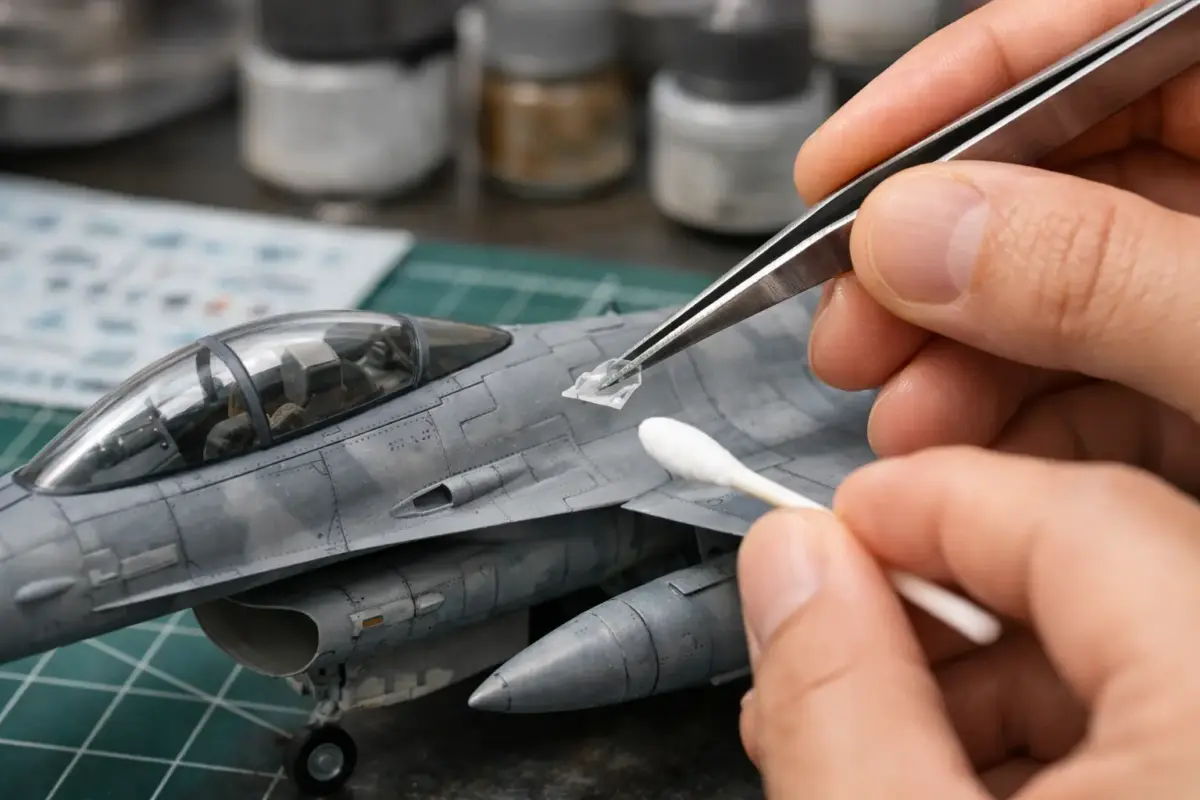
A well-painted model can still look unfinished once the markings go on badly. Silvering, torn carrier film and decals that refuse to settle over panel lines are some of the most common frustrations in the hobby. If you are learning how to apply model decals, the good news is that the process is straightforward once the surface, tools and timing are right.
Decals are often treated as the very last job, but they really sit in the middle of the finishing stage. The paint finish underneath matters, the solutions you use matter, and the clear coat afterwards matters just as much. Get those parts working together and even a basic kit sheet can look sharp and convincing.
What you need before you start
You do not need a huge bench full of specialist gear, but a few reliable items make a real difference. At minimum, have a shallow dish of clean lukewarm water, tweezers, a soft brush, small sharp scissors or a hobby knife, cotton buds and kitchen roll. A gloss varnish is strongly recommended, and decal setting and softening solutions are worth having if you work on aircraft, armour or any subject with raised or recessed detail.
A smooth working method matters more than speed. Old decals can crack, very thin decals can fold over on themselves, and some kit sheets react aggressively to strong softeners. It is always sensible to test one small stencil first if you are unsure how a particular sheet will behave.
How to apply model decals without silvering
The biggest mistake is applying decals straight onto a matt finish. Matt paint has a slightly rough texture, and tiny air pockets can get trapped beneath the carrier film. That is what causes silvering – the frosty, patchy effect that shows up most clearly under light.
To avoid that, apply a gloss coat over the painted model before you start decalling. It does not need to look toy-like or overly shiny forever. The gloss is there to create a smooth surface so the decal film can sit flat. Once the markings are fully dry and sealed, you can bring the finish back to satin, matt or whatever suits the subject.
Cleanliness also matters. Dust, sanding residue, fingerprints and weathering powders can all interfere with adhesion. If the model has been sitting on the bench for a while, wipe the surface gently before glossing or decalling.
Preparing the decal sheet
Cut each decal out as you need it rather than dropping several into water at once. This gives you more control and reduces the chance of losing small stencils. Trim close to the printed marking when practical, especially on older sheets with more visible carrier film, but do not cut so tightly that you risk damaging the design.
Some decals release from the backing paper in ten seconds, others take half a minute or more. Soak the decal briefly, then place it on a clean surface for a moment rather than leaving it floating in water. That pause often helps the adhesive activate properly without over-softening the film.
Positioning the decal
Before sliding the decal into place, brush a little clean water or decal setting solution onto the model surface. That gives you some movement so you can position the marking accurately. Slide the decal gently off the backing paper with a soft brush rather than pulling it free with tweezers.
Once it is on the model, nudge it into position carefully. National markings, serials and unit insignia are usually the first details viewers notice, so it is worth taking your time with alignment. Check them from more than one angle. A roundel or number can look straight from one side and still be slightly off when viewed head-on.
When you are happy with the position, wick away excess water with the edge of kitchen roll or a cotton bud. Roll rather than wipe. Wiping can drag the decal out of place or tear it.
Using decal solutions on panel lines and rivets
This is where a good finish often becomes an excellent one. Decal setting solutions help improve adhesion. Decal softening solutions do the heavier work, making the film conform over recessed lines, rivets, weld seams and other surface detail.
Apply the softer sparingly and then leave the decal alone. This is the stage that catches many modellers out. The decal may wrinkle, crease or look ruined for a while. That is usually normal. As the solution does its job, the film relaxes and pulls down over the detail. Touching it too early can tear it beyond recovery.
Different brands vary in strength. Mild solutions are easier for beginners and work well on most modern decal sheets. Stronger solutions are useful for stubborn decals or heavily detailed surfaces, but they can damage thin decals if overused. If one light application has not fully pulled the film into a panel line, let it dry first, then repeat. Several gentle passes are usually safer than one heavy flooding.
What to do if a decal will not settle
If a decal bridges across a panel line after drying, use a very sharp blade to make a tiny cut along the line, then apply another small amount of softening solution. This gives the film somewhere to relax into. The same approach works on access hatches and raised details, but keep the cuts minimal and precise.
If silvering appears after the decal has dried, prick the affected area with a fine needle and feed in a little setting solution. It will not always save a badly applied decal, but it often improves light silvering enough that the final clear coat and weathering hide the rest.
Common mistakes when applying model decals
Rushing is the usual culprit. Large markings placed over compound curves, such as aircraft nose art or racing stripes, need patience. So do long carrier-film decals on missiles, propeller blade logos and ship deck markings.
Another common issue is handling decals before they have fully cured. Even if they look dry after an hour, they can still shift or mark under masking, weathering washes or clear coats. Leaving them overnight is the safer option.
There is also a trade-off between kit decals and aftermarket sheets. Kit decals are convenient and often perfectly usable, but they can sometimes be thick or slightly off-register. Aftermarket decals may offer finer printing and better subject accuracy, but they can also be thinner and less forgiving to handle. Neither is automatically better in every case. It depends on the manufacturer, the age of the sheet and the finish you want.
Sealing and finishing decals
Once the decals are dry and fully settled, seal them under a clear coat. This protects them during weathering and helps blend the carrier film into the paintwork. For many military subjects, that means another gloss or satin layer before washes, followed by a final matt or satin coat at the end. For civilian subjects, racing cars or natural metal aircraft, a glossier final finish may be more appropriate.
This stage is also where the markings start to look painted on rather than stuck on. A good clear coat softens the edge of the film visually, and careful weathering helps integrate the decals with the rest of the model. Exhaust staining over insignia, dust over lower hull numbers and gentle fading on wing markings can all improve realism when used with restraint.
Older decals and delicate sheets
Older decals can be brittle, yellowed or weak on adhesive. If you are working on a vintage kit, treat the sheet cautiously. Warm water that is too hot can make fragile decals curl badly, and rough handling will often split them. In some cases, a dedicated decal film product applied before use can rescue an old sheet, though it adds another layer of film and may require closer trimming.
Very modern, very thin decals bring the opposite problem. They often look excellent once down, but they can fold, stretch or grip instantly if the surface is too dry. More water on the model and a lighter touch usually help.
For modellers building across scales and subjects, it is worth keeping a small range of decal solutions, varnishes and fine tools on hand so you can match the method to the kit. That is often the difference between forcing a product to work and choosing one suited to the job.
Good decal work rarely looks dramatic while you are doing it. It is a series of small, careful decisions that pay off once the model is on the shelf. Take your time, let each stage dry properly, and if a marking fights back, adjust the method rather than pushing harder. That patient approach nearly always gives the cleaner result.
