
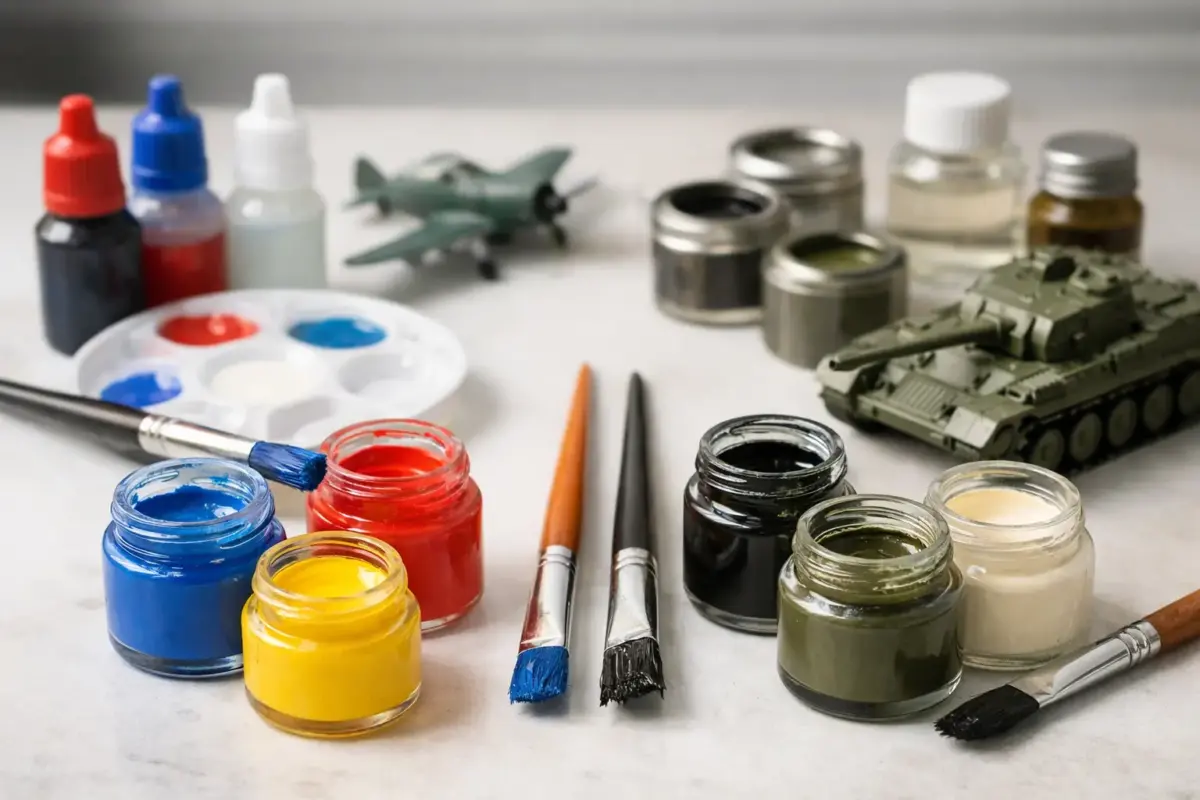
The first time a paint reacts badly with a wash, pulls up under masking tape, or clogs the airbrush halfway through a camouflage pattern, the acrylic vs enamel paints question stops being theoretical. For scale modellers, it affects finish quality, working time, weathering compatibility and, quite often, whether a paint session feels straightforward or needlessly frustrating.
There is no single winner because acrylics and enamels behave differently at each stage of the build. The right choice depends on what you are painting, how you apply it, how much ventilation you have, and the sort of finish you want to achieve. If you build aircraft one week and hand-paint figures or stowage the next, there is every chance both paint types will earn a place on your bench.
Acrylic vs enamel paints: the core difference
At hobby-bench level, the practical difference is simple. Acrylic paints generally dry faster, clean up more easily, and are often the first choice for modellers using an airbrush indoors with limited tolerance for strong solvent smells. Enamel paints dry more slowly, level out beautifully when brushed, and tend to cure to a tougher finish that stands up well to handling and masking.
That broad picture helps, but it does not tell the whole story. Not all acrylics are identical. Water-based acrylics, alcohol-based acrylics and lacquer-acrylic hybrids can behave very differently. Likewise, enamel formulations vary by brand and purpose. In modelling terms, what matters is not only the chemistry but the workflow around it – primer, thinner, drying time, varnish, weathering products and final handling.
When acrylic paints make more sense
Acrylics are often the easier starting point, especially for newer modellers. They are widely available across military, aircraft, naval and figure ranges, and many lines are designed around brush painting or airbrushing straight from the bottle. If you are building at a desk in the house rather than a fully ventilated workshop, acrylics are usually the more comfortable option.
Fast drying is one of their biggest strengths. You can lay down a base coat, move on to detail painting, and be ready for masking or varnish much sooner than with enamel. For production-style workflows – batch painting figures, spraying RAF camouflage, or getting multiple sub-assemblies through primer and base colour in an evening – acrylics save time.
They also work very well for layered effects. Because they dry quickly, you can build opacity with several thin coats rather than risking one heavy pass. That is useful on cockpit interiors, wheel bays, stowage, uniforms and small detail parts where control matters more than brute coverage.
The trade-off is that acrylics can be less forgiving. Some dry on the needle when airbrushing. Some leave brush marks if overworked. Some lift if masking is too aggressive or if the paint has not fully cured over the primer. With acrylics, surface preparation and thinning matter a great deal. A properly primed model and the correct thinner usually make the difference between a paint that feels fussy and one that behaves exactly as it should.
Best uses for acrylics on models
Acrylics suit airbrushed base coats, fine detail work, interiors, figures, clear workflow between colours, and projects where low odour and easy clean-up are priorities. They are especially handy for builders who want to keep moving through a project rather than waiting overnight between major steps.
When enamel paints earn their place
Enamels still have a loyal following for good reason. They brush exceptionally well, often covering more smoothly than acrylics and staying wet long enough to self-level. If you hand-paint details, tools, tyres, leather items or small fittings, enamel can give a cleaner finish with less effort.
Their slower drying time is not always a drawback. On the contrary, it can be a major advantage when you need a paint to settle smoothly over a surface without dragging. On larger areas, especially when brushing, that extra open time helps reduce visible strokes and patchiness.
Enamels also tend to cure harder. For kits that will be handled repeatedly during assembly, masked for complex patterns, or weathered with more aggressive techniques, that tougher finish gives a bit more confidence. Many experienced armour and aircraft modellers still value enamels for exactly this reason.
The downside is obvious enough. Enamels require enamel thinner or white spirit-type cleaners, they smell stronger, and they need more ventilation. Drying and curing times are longer, so your project may pause between coats. If you prefer quick evening sessions with minimal clean-up, enamel can feel slower and more demanding.
Best uses for enamels on models
Enamels are particularly useful for hand brushing, smooth gloss or satin finishes, durable top coats on frequently handled parts, and situations where longer working time improves the result. They can also be very effective for small detail painting where coverage and levelling matter more than speed.
Airbrushing: acrylic vs enamel paints in practice
For airbrush users, both can produce excellent results, but the experience is different. Acrylics are usually chosen for convenience. They dry quickly, they are easier to clean from the airbrush, and many modern hobby ranges are designed specifically for fine atomisation and colour matching across modelling subjects.
That said, acrylics can punish poor technique. Incorrect thinning, too much pressure, or spraying too far from the surface can lead to dry spray, tip-dry and grainy texture. If your acrylic sessions are inconsistent, it does not necessarily mean the paint is poor. It may simply need the right thinner, retarder or pressure setting.
Enamels often spray very smoothly and can produce a lovely even coat, especially on car bodies, aircraft fuselages and larger armoured vehicles. They generally stay workable longer in the airbrush and are less prone to drying on the tip mid-session. However, cleaning takes longer and the solvent smell is harder to ignore.
If you spray regularly indoors, acrylics will usually be the practical choice. If you have a well-ventilated setup and prioritise finish quality above speed, enamels remain a serious option.
Brush painting and detail work
For pure brush painting, enamels often feel easier straight away. They flow better, level better and give you longer to move the paint before it starts setting. That is why some modellers still reach for enamel on cockpit details, tools, pioneer equipment, exhausts and small accessories.
Acrylics can absolutely be brushed well, but they reward a slightly different approach. Thin coats, a good-quality brush and minimal reworking are the key. Put the paint on, let it level as much as it can, and leave it alone. Going back over half-dry acrylic usually makes the finish worse rather than better.
For figure painters and miniature builders, the decision often comes down to style. Acrylics are better suited to layering, glazing and fast repetition. Enamels are less common there, though still useful for specific details and effects.
Durability, masking and weathering compatibility
If you routinely use masking tape for hard-edged camouflage or invasion stripes, durability matters. Enamels generally have the edge once fully cured. They resist lifting well and cope with handling. Acrylics can also perform perfectly well, but only if applied over a sound primer and given enough curing time.
Weathering introduces another variable. Many modellers deliberately combine paint families to reduce the risk of disturbing earlier layers. For example, an acrylic base coat under enamel washes can be a sensible workflow because the wash thinner is less likely to attack a properly cured acrylic layer. The reverse can also work, but you need to know what each product is based on.
This is where compatibility becomes more important than loyalty to one system. Primers, base coats, clear coats and weathering products all need to work together. If you are mixing brands, test first on scrap or a spare part rather than assuming every thinner will play nicely with every finish.
Which should beginners choose?
For most beginners, acrylics are the easier recommendation. They are more convenient, lower in odour, quicker to clean up and generally better suited to modern hobby workspaces. If you are learning how to thin paint, use an airbrush, or paint indoors, acrylic gives you a more accessible starting point.
That does not mean enamels are old-fashioned or only for advanced modellers. They remain excellent paints, particularly for brush work and for builders who value their smooth finish and toughness. In fact, some beginners find enamel detail painting easier because the paint does not dry on the brush nearly as fast.
A sensible approach is to choose one main system for your base coats, then add the other where it genuinely improves the result. Plenty of experienced builders spray acrylics, brush selected details in enamel, and use whichever weathering products best suit the finish they want.
So, acrylic or enamel?
If you want speed, easier clean-up, lower odour and a workflow that suits regular airbrushing, acrylic is usually the better fit. If you want smoother brush performance, longer working time and a tougher cured finish, enamel still deserves serious consideration.
At Scale Model Shop, we see plenty of modellers use both rather than treating it as a strict either-or choice. That is often the most practical answer. Match the paint to the job, the brand to the technique, and the thinner to the formula.
The best paint is the one that lets you finish the model the way you intended, with fewer compromises and fewer surprises at the bench.
