
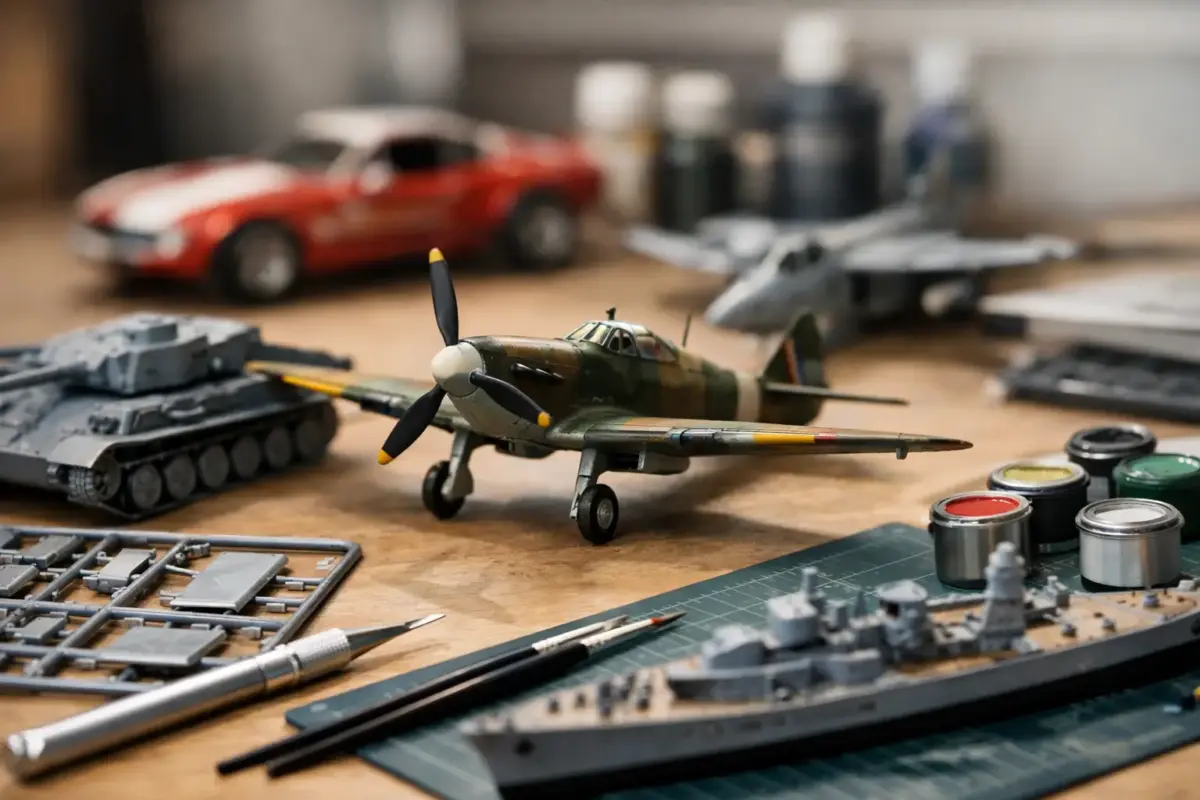
Choosing your first Airfix kit usually comes down to one moment – you spot a subject you genuinely want to build, then realise not every starter set is equally beginner-friendly. The best starter Airfix kits are the ones that keep early frustration low while still giving you a model you will be pleased to put on the shelf.
That matters more than most newcomers expect. A kit can have attractive box art and still be a poor first project if the parts are tiny, the fit is fiddly, or the paint call-outs ask too much of someone who is just learning basic assembly and brush control. For a first build, simplicity, clear instructions and sensible part counts matter just as much as the subject itself.
What makes the best starter Airfix kits?
For a genuine beginner, the best place to start is usually an Airfix Gift Set or Starter Set built around a well-engineered subject in a forgiving scale. You want manageable parts, clear sprue layout, uncomplicated camouflage and a build sequence that does not punish small mistakes.
Aircraft in 1:72 are often a strong choice because they offer good detail without demanding too much display space. Some 1:43 and 1:32 vehicle subjects can also work well, particularly if you would rather avoid canopies, landing gear and the alignment checks that aircraft kits sometimes require. The trade-off is that larger scales may have fewer tiny parts, but they can also show brush marks more clearly if the finish is not prepared carefully.
A good starter kit usually has four things in its favour. The first is sensible engineering – major parts line up well, with minimal filling. The second is a paint scheme that a beginner can complete without masking three different camouflage colours on day one. The third is a part count that feels achievable over a few evenings. The fourth is instructions that are genuinely easy to follow.
Best starter Airfix kits to consider first
Supermarine Spitfire Mk.Ia in 1:72
If someone asks for one of the safest recommendations in the best starter Airfix kits category, the early Spitfire is usually near the top. It is iconic, compact, and familiar enough that most builders already know roughly what the finished model should look like.
As a first project, it offers a good balance of interest and restraint. You get classic RAF lines, a straightforward single-engine layout and a subject with plenty of historical appeal, but without the complexity of larger multi-engine aircraft. The main caution is paintwork. RAF camouflage can be simple compared with more elaborate schemes, but it still asks for neat brush handling around the upper surfaces.
Hawker Hurricane Mk.I in 1:72
The Hurricane is often even kinder to beginners than the Spitfire. Its shape is slightly less delicate, the stance is reassuringly solid, and many builders find it a little less intimidating when working through early assembly steps.
It is a strong first choice if you want a Battle of Britain subject without immediately jumping into a more fiddly build. As with the Spitfire, you still need care around the canopy frames and undercarriage, but the overall build tends to feel accessible and satisfying.
Folland Gnat in 1:72
For a first jet, the Gnat makes a lot of sense. It is small, cleanly shaped and usually less complicated than larger Cold War aircraft. There is less external clutter to deal with, which helps a beginner focus on basic fitting, seam cleanup and finishing.
Red display schemes can be appealing here because they look striking on the shelf. The downside is that strong colours often need careful coverage to avoid streaking with a brush. If you are patient with thin coats, though, it can be an excellent early build.
Messerschmitt Bf 109E-4 in 1:72
Not every beginner wants RAF subjects, and the Bf 109 is a logical alternative. It is one of those kits that gives you a well-known Second World War aircraft with a compact footprint and a build path that is usually manageable for newer modellers.
Its main appeal is balance. It has enough cockpit and airframe detail to feel like a proper scale model, but not so much that the project becomes demanding. The real decision here is whether you want to tackle mottling or a more straightforward finish. Some Luftwaffe schemes are very beginner-friendly, while others are better left until your second or third kit.
Volkswagen Beetle in 1:32 or 1:43
If aircraft are not your thing, a simple car can be a better place to begin. The Beetle is a particularly welcoming subject because the shape is familiar, the assembly is easy to understand, and the finished result still has real display appeal.
Cars remove some of the usual beginner hurdles such as fragile aerials, underwing stores and fine landing gear. They introduce a different challenge instead – body finish. A smooth painted shell rewards patience and surface preparation. Still, for many newcomers, that is easier to learn than aircraft alignment and camouflage.
Mini Cooper in beginner-friendly scale formats
The Mini is another excellent first car kit because it combines recognisable British character with generally straightforward construction. Smaller road cars can be less daunting than racing subjects covered in sponsor markings or complex body add-ons.
This type of build suits anyone who wants a clean, tidy project with fewer military-specific details to research. You can concentrate on neat assembly, wheel alignment and tidy paintwork without needing specialist historical knowledge.
Willys Jeep in 1:76 or similar small military scale
A small military vehicle is often overlooked when discussing the best starter Airfix kits, but the Willys Jeep deserves a mention. It is compact, practical and usually less paint-intensive than a tank with multiple running gear parts.
For a beginner interested in military modelling, it is a sensible halfway point between a simple car and a more involved armour subject. You still learn basic chassis and body assembly, but without immediately wrestling with long track runs or complex suspension.
Cromwell or similar entry-level tank in 1:76
A beginner tank kit can be a very good starting point if you want something sturdy and forgiving. Small-scale armour tends to handle minor glue and paint imperfections better than aircraft, and weathering can help hide early finishing mistakes rather than expose them.
The caution is in the running gear. Even a modest tank has more repetitive parts than a small aircraft or car. If you enjoy military vehicles and do not mind patient assembly, though, an entry-level Cromwell-type subject can be a rewarding first armour build.
How to choose between starter Airfix kits
The right first kit depends less on what is easiest in theory and more on what will keep you motivated through the build. If you love Battle of Britain aircraft, a Spitfire or Hurricane is usually a better first purchase than a technically simpler subject you do not care about. Interest carries you through sanding seams and waiting for paint to dry.
It is also worth thinking about finish. If you are brush painting, subjects with cleaner colour layouts are often more forgiving than disruptive camouflage or glossy car bodies. If you already have masking tape, primer and a few decent brushes, your options widen considerably.
Scale matters too. Smaller scales keep costs and shelf space under control, but very small parts can be awkward for younger builders or anyone returning to the hobby after a long break. Larger scales can be easier to handle, though they sometimes ask for a higher standard of visible finish.
A few practical points before you start
Even the best starter Airfix kits build more cleanly with the right basics on the bench. A sharp sprue cutter or side cutter, a modelling knife, liquid cement or tube cement used sparingly, a sanding stick, and a couple of reliable brushes will make a noticeable difference.
Paint choice matters as well. Starter sets are convenient because they help you begin without assembling a full paint rack on day one. The trade-off is that many modellers quickly want a broader range of colours, better brushes or upgraded finishing products once the first kit is underway.
Take your time with dry fitting before gluing, especially around fuselage halves, hull sections and clear parts. Most beginner frustration comes from rushing assembly rather than from the kit itself. Clean joins and patient paint application will improve almost any result more than buying a more advanced kit ever could.
If you are not sure where to begin, specialist retailers such as Scale Model Shop can usually help narrow the choice by subject, scale and difficulty, which is often more useful than simply picking the newest box on the shelf.
A first Airfix build does not need to be perfect. It just needs to be enjoyable enough that you want a second one, and that is usually the clearest sign you chose well.
