
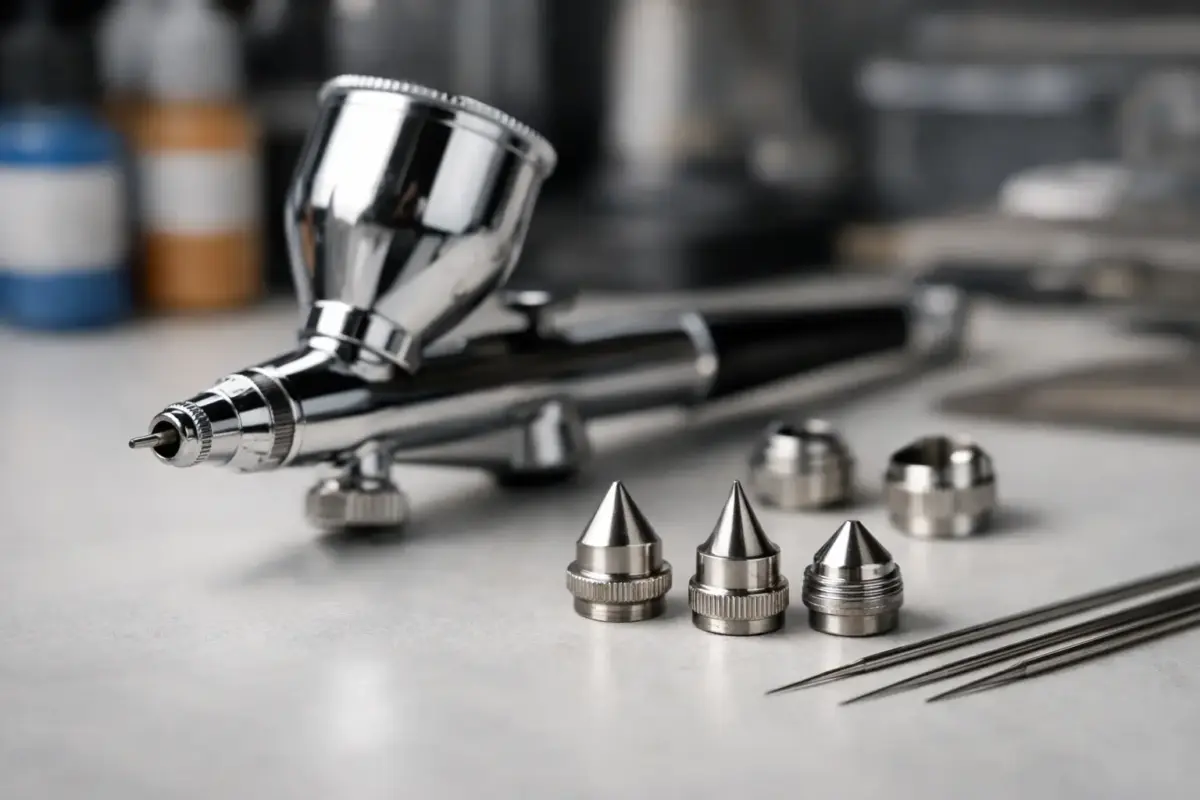
A lot of airbrush problems get blamed on paint when the real issue is the setup. If your primer feels rough, your fine lines spider or varnish goes on pebbly, this airbrush nozzle size guide can help you work out what needs changing. For scale modellers, nozzle size affects far more than line width: it influences paint choice, thinning, pressure, finish quality and how enjoyable the session is.
As a quick guide, 0.15mm to 0.2mm nozzles are suited to fine detail, 0.25mm to 0.3mm offers the best balance for general model painting, and 0.4mm to 0.5mm makes primers, varnishes and broad coverage easier. Browse our airbrushes and accessories to build a setup around the models and finishes you regularly paint.
Why airbrush nozzle size matters
In practical terms, the nozzle controls how much paint can pass through the airbrush and how finely it can be atomised. Smaller nozzles are geared towards tighter work, but they ask more from your paint mix and cleaning routine. Larger nozzles flow heavier materials more easily, although they trade some precision for coverage.
There is no single best size for every bench. A Luftwaffe mottle on a 1/72 aircraft, a broad coat of olive drab on 1/35 armour and primer on resin figures all place different demands on the airbrush. The right choice depends on the paint type, the job in hand and how much control you want at close range.
Airbrush nozzle size chart
- 0.15mm to 0.2mm: fine camouflage, mottling, marbling, figures and miniature painting.
- 0.25mm to 0.3mm: general-purpose model painting, base coats, camouflage and weathering.
- 0.4mm to 0.5mm: primers, varnishes, metallics and broad coverage on larger models.
The chart is a useful starting point, but paint consistency, air pressure, spraying distance and trigger control also influence the result. A well-practised modeller can achieve surprisingly fine work with a 0.3mm setup, while even the smallest nozzle will struggle with paint that has not been prepared correctly.
Airbrush nozzle sizes explained
Most hobby airbrushes sit somewhere between 0.15mm and 0.5mm. You will also find larger setups for heavy primers and clear coats, but these are the sizes most scale modellers work with.
0.15mm to 0.2mm airbrush nozzles
This is the fine-detail end of the range. It suits close-in work such as mottling, fine marbling, post-shading, figure modulation and careful camouflage demarcations. If you paint 1/72 aircraft, 1/144 subjects, small figures or wargaming miniatures with subtle transitions, a nozzle in this range can be extremely useful.
The trade-off is paint preparation. Thicker acrylics, metallics and primers can become frustrating through a very small nozzle unless they are reduced properly and strained if needed. Tip dry is more noticeable, and cleaning needs to be thorough. For many modellers, this size works best as a specialist tool rather than the only airbrush on the bench.
0.25mm to 0.3mm airbrush nozzles
For many hobbyists, this is the sweet spot. A 0.3mm setup is often the most versatile option because it can provide respectable coverage while still producing controlled lines for camouflage, pre-shading and detail painting. If you only want one general-purpose airbrush, this is usually the most sensible place to start.
It works well with most hobby acrylics, lacquers and enamels once they are thinned correctly. Primers can also be sprayed through this size, although some thicker surface primers may need extra reduction or slightly more pressure. On aircraft, armour, ships and Gundam builds, it covers the majority of routine painting tasks without feeling too limited in either direction.
The Fengda Phantom 0.2mm and 0.3mm Gravity Feed Airbrush D1 provides both fine-detail and general-purpose sizes, making it a practical option for modellers who tackle a varied mix of painting tasks.
0.4mm to 0.5mm airbrush nozzles
Larger nozzles are ideal when paint flow matters more than fine-line control. They are well suited to primers, clear coats, varnishes, metallics, larger single-colour areas and broad coverage on 1/32 aircraft, 1/24 vehicles, big science-fiction kits or scenic work. If you spray rougher materials, heavily pigmented paints or products designed for durability, this range is generally more forgiving.
You can still do neat work with a 0.4mm or 0.5mm airbrush, but it takes more trigger discipline and distance control. Most modellers do not choose this size for intricate camouflage. Where it excels is consistency, especially when you want smooth coverage without constantly fighting clogging.
Matching airbrush nozzle size to the job
Thinking in terms of the task is usually more helpful than chasing the smallest possible line.
Priming
A 0.3mm nozzle can handle many primers, but 0.4mm or 0.5mm is often easier and faster. Primer tends to be thicker than standard paint and needs to cover the surface consistently, so a little extra flow helps. If you regularly work with resin, photo-etch-heavy builds or larger subjects, a bigger nozzle makes preparation coats much less of a chore.
Base coating
For base coating, 0.3mm is the all-rounder. It handles most acrylic and lacquer ranges well and gives enough control to avoid flooding raised detail. On smaller kits, it is precise enough to stay tidy. On larger kits, it remains efficient enough to cover panels sensibly.
Camouflage and modulation
For camouflage and modulation, 0.2mm to 0.3mm tends to be the practical range. A 0.2mm nozzle gives more finesse for close work, while 0.3mm provides slightly more flexibility if your paint mix is not perfect. If you enjoy freehand soft-edge camouflage, that balance matters.
Fine detail and miniatures
For fine detail, marbling and subtle weathering layers, 0.15mm to 0.2mm comes into its own. This range is especially useful when choosing an airbrush nozzle size for miniatures, figures and compact camouflage patterns. Many experienced modellers still achieve excellent detail with a 0.3mm setup because they know the airbrush, paint and pressure settings well. Skill can narrow the gap between sizes.
Varnishing
For varnishing, especially gloss coats before decals or protective matt finishes, 0.3mm to 0.5mm is usually preferable. Clear coats benefit from smooth, even application, and a larger nozzle reduces the risk of dry spray.
Paint type changes the answer
Nozzle choice is never separate from paint choice. Water-based acrylics, alcohol-based acrylics, lacquers and enamels all behave differently.
Lacquer paints often spray very well through smaller nozzles because they atomise cleanly and can be reduced effectively. They are a common choice for modellers who want fine control on aircraft camouflage or an ultra-smooth finish. Water-based acrylics can also perform well, but they are more sensitive to thinning ratios, pressure and environmental conditions. Through a 0.2mm setup, some ranges can be excellent while others may feel temperamental.
Metallics deserve separate consideration. Fine metallics may pass through a 0.3mm nozzle without trouble, but coarser metallic paints generally behave better through a 0.4mm nozzle or larger. The same applies to some primers and polyurethane-style surface products.
The biggest airbrush nozzle mistake beginners make
Many new airbrush users assume smaller means better. On paper, a 0.2mm nozzle sounds ideal because scale modelling involves detail. In practice, beginners often get better results from a 0.3mm airbrush because it is more forgiving. It tolerates slightly imperfect thinning, needs less constant cleaning and still offers enough control for most projects.
That does not make small nozzles overrated. It simply means they reward good technique rather than replacing it. If your trigger control, paint reduction and air pressure are consistent, a smaller setup can be a real asset. If not, it may magnify every small error.
Choosing a complete airbrush setup
Nozzle size is only one part of the system. The airbrush, compressor, regulator, paint consistency and pressure settings all need to work together. A complete option such as the Fengda Aurora Mini Compressor Airbrush Kit AS-302K offers a convenient starting point for building an airbrush setup.
When comparing different modelling airbrushes, think about the work you do most often. Fine aircraft camouflage places different demands on an airbrush than priming large armour models or applying clear coats to car bodies.
Should you use one airbrush or two?
If you build a broad mix of subjects, two setups often make more sense than forcing one airbrush to do everything. A common pairing is a 0.3mm airbrush for day-to-day painting and a 0.4mm or 0.5mm model for primers and varnishes. Another strong combination is a 0.3mm general-purpose airbrush plus a 0.2mm detail brush for camouflage and fine weathering.
For many hobbyists in the UK, that is a more practical upgrade path than buying a highly specialised detail airbrush first. It keeps routine jobs straightforward while giving you the option to reach for extra precision when the build calls for it.
Signs your nozzle size is wrong for the task
If paint constantly clogs despite sensible thinning and cleaning, the nozzle may be too small for that product. If you struggle to cover larger surfaces evenly without a patchy finish, the nozzle may be too fine for the job. If your camouflage edges are always too broad even at lower pressure and closer range, you may benefit from a smaller setup — or you may need to adjust your paint consistency and spraying distance.
Air pressure, needle condition, paint reducer, room temperature and spraying distance all affect performance. Nozzle size is important, but it is one part of a larger system.
What airbrush nozzle size should most modellers buy?
If you are choosing your first serious setup, start with 0.3mm. It is the most balanced option for scale modelling and suits the widest range of paints and tasks. It will handle many primers, apply standard base coats comfortably and still let you tackle camouflage, shading and weathering with proper control.
If your focus is fine-detail aircraft finishes, figure work or miniature painting, a 0.2mm airbrush can be a worthwhile second step. If you regularly spray primer, varnish and larger surfaces, 0.4mm or 0.5mm will save time and frustration.
The most useful choice is rarely the most extreme one. It is the setup that matches your paint range, typical subject matter and preferred way of working at the bench. Choose for the job you do most often, and your airbrush becomes a tool you trust rather than one you have to fight.
