
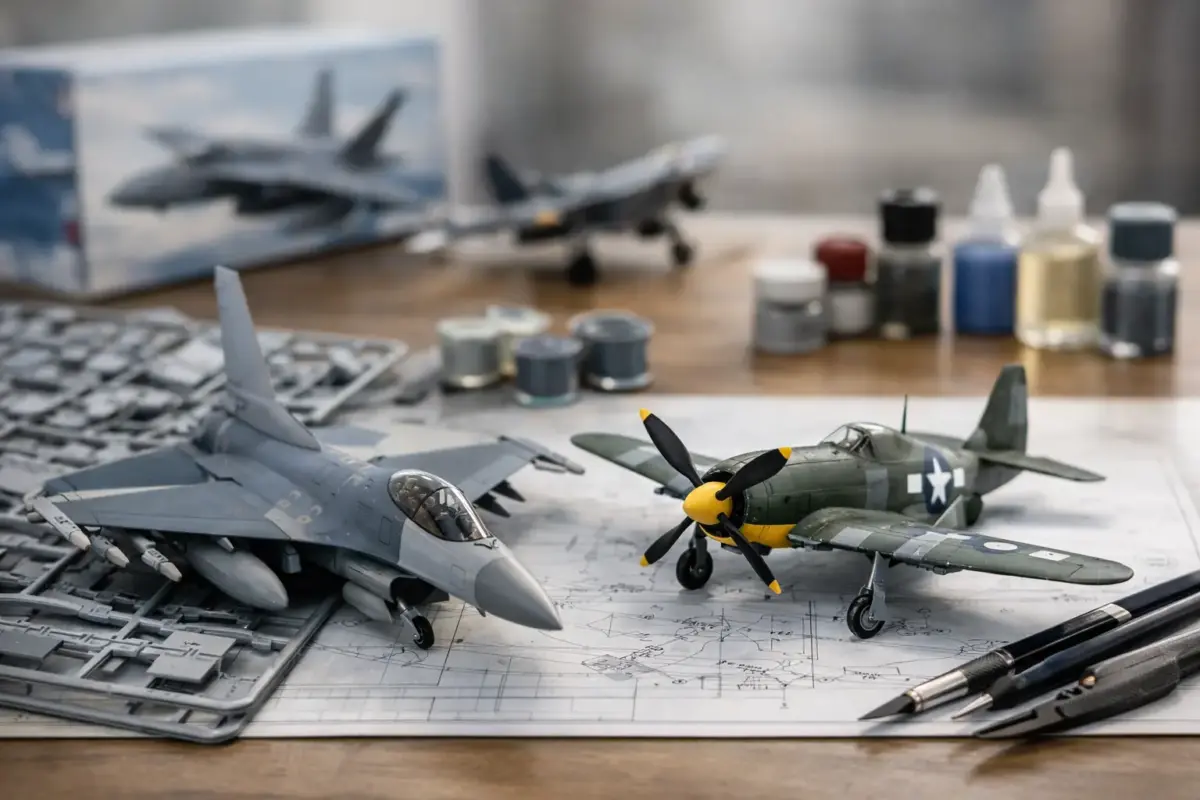
A Lancaster in 1/72, a Spitfire in 1/48, or a modern jet loaded with pylons and stencil data can all sit under the same heading of aircraft model kits, yet they ask very different things from the builder. That is where many purchases go right or wrong. The best kit is not simply the newest release or the one with the most parts. It is the one that matches your preferred scale, your bench setup, your finishing skills and the amount of time you actually want to spend on the build.
For most modellers, choosing well starts with being honest about the project rather than chasing the box art. Some builds are ideal weekend work. Others are long-form projects that need aftermarket parts, careful masking and a proper plan for painting and weathering. If you know which sort of build you want before you start browsing, the whole category becomes much easier to navigate.
What to look for in aircraft model kits
The first decision is scale, because scale affects almost everything else. A 1/72 kit is often a sensible choice if you want a manageable footprint, a good range of subjects and a display cabinet that does not fill up overnight. It is especially practical for bombers, maritime patrol aircraft and larger modern jets. By contrast, 1/48 tends to offer a stronger balance between size and detail for single-engine aircraft, with cockpits, wheel wells and surface detail that reward extra painting time without becoming unmanageable.
Larger scales such as 1/32 can be superb if you enjoy detail painting, open panels and visible cockpit work, but they demand more from your workspace, budget and finishing supplies. Paint consumption goes up, masking takes longer and any flaw is easier to spot. That does not make them harder in every respect, but it does mean they are less forgiving.
Fit quality matters just as much as scale. Some aircraft model kits are engineered for a straightforward build with clever part breakdown and positive locating points. Others come from older tooling where seams need more attention, clear parts need care and dry fitting is essential. Neither is automatically better. Older kits can still build into excellent display pieces, especially if you enjoy traditional modelling and do not mind adding your own refinement.
Subject choice also changes the workload. A Second World War fighter with a relatively simple canopy and modest undercarriage is usually more approachable than a modern aircraft with intake trunking, multiple stores, complex landing gear and extensive stencil markings. Naval aircraft can add another layer if you want weathered walkways, salt fading and carrier-specific details. The trick is to choose complexity that feels interesting rather than tiring.
Choosing by skill level and build style
Beginners often do best with aircraft kits that have fewer parts, sensible engineering and clear instructions. That does not mean basic-looking results. A well-designed starter project can still look excellent with careful assembly, tidy painting and restrained weathering. In fact, a cleanly finished simple kit often looks better than an over-ambitious build that loses momentum halfway through.
If you are returning to the hobby after a break, look for a subject you know well and a brand with a reputation for reliable fit. Familiar camouflage patterns and recognisable cockpit layouts make decision-making easier. You spend less time second-guessing references and more time enjoying the build.
Experienced modellers usually shop differently. They may be looking for a particular variant, a specific squadron option, recessed rivet detail, optional control surfaces or compatibility with resin cockpits, etched brass and aftermarket decals. At that level, the kit is only one part of the project. Paint ranges, weathering products, masking solutions and airbrush setup matter just as much.
That is why it helps to think in terms of the full workflow rather than the box alone. If a kit needs a natural metal finish, your choice of primer, surface preparation and metallic paints becomes critical. If it has extensive glazing, canopy masking products or pre-cut masks can save a great deal of time and frustration.
Scale, space and display planning
One of the most common mistakes with aircraft model kits is buying for the bench and forgetting the cabinet. A collection of 1/48 fighters is usually easy to accommodate. A run of 1/48 twin-engine aircraft is another matter. The same goes for 1/32 subjects, where wingspan and height quickly become part of the equation.
Display planning sounds dull until you realise it affects what you build next. If you prefer in-flight poses, you may want stands and a consistent way to present the collection. If you build wheels-down, consider whether undercarriage strength, tyre weighting and base options are important to you. Some modellers enjoy a uniform scale across an entire theme. Others are happy to mix scales to suit the aircraft. Both approaches work, but it helps to decide before the stash starts expanding faster than the available shelf space.
Paint, tools and finishing products matter
Aircraft modelling rarely ends with glue and a brush. Even a straightforward build benefits from the right primer, paint type and finishing products. Acrylics are popular for convenience and easier clean-up, while lacquer-based systems can give excellent durability and a very smooth finish when used correctly. Enamels still have their place, particularly for washes and certain weathering effects. There is no single right answer here. It depends on ventilation, working habits and the finish you are chasing.
Canopies, panel lines and decals tend to separate a decent build from a convincing one. A polished clear part, neatly painted frame lines and well-set decals change the whole impression of an aircraft. The same applies to weathering. Wartime aircraft can take exhaust staining, oil effects and subtle fading beautifully, but restraint matters. Modern jets often look best with controlled panel variation and operational wear rather than heavy-handed grime.
A few core tools make a noticeable difference: a good sprue cutter, sanding sticks in several grades, fine tweezers, a sharp craft knife and reliable masking tape. If you airbrush, thinner and cleaner compatibility become part of the planning. If you hand paint, paint consistency and brush quality matter far more than people sometimes admit.
Brand and tooling differences
Not all kits are designed with the same priorities. Some manufacturers lean towards ease of build and broad appeal. Others focus on fine surface detail, complex engineering or niche variants that appeal to dedicated enthusiasts. New tooling often brings better fit and more refined parts, but there are excellent older kits that still justify bench time, especially when the subject is attractive and the moulding remains crisp.
Instruction quality varies as well. Good diagrams, clear paint call-outs and sensible assembly order can save hours. Less helpful instructions are not a deal-breaker, but they do require more test fitting and reference checking. If you enjoy technical problem-solving, that can be part of the fun. If you want a relaxed project, choose accordingly.
This is where a specialist retailer can make a real difference. When the same place stocks the kit, the paints, the masking products, the filler, the decal solutions and the weathering range, it becomes much easier to build a complete basket around the project instead of discovering gaps halfway through. For many UK modellers, that practical side matters every bit as much as the kit brand on the box.
When aftermarket is worth it
Aftermarket parts can transform aircraft model kits, but they are not automatically necessary. Seat belts, turned metal pitot tubes, resin wheels and upgraded decals often give the best return without turning the project into surgery. Full resin cockpits and major conversion sets can be excellent, though they bring extra fitting work and are best chosen when the base kit justifies the effort.
There is also a point where aftermarket spending overtakes the value of buying a better kit to begin with. If you are adding multiple corrections, replacement clear parts and a full detail set to make an older tooling compete with a newer release, it is worth asking whether you are doing it for enjoyment or simply creating more work. Either answer is valid, but it should be deliberate.
Building for enjoyment, accuracy or both
Some modellers want exact block numbers, antenna fits and period-correct ordnance. Others want an enjoyable build that captures the look of the aircraft on the shelf. Most sit somewhere in the middle. The useful thing is knowing where you fall on that scale before you buy.
Accuracy-focused builds benefit from careful research and product compatibility. Enjoyment-led builds benefit from sensible project scope. Neither approach is more serious than the other. The hobby is broad enough for both, and the best purchases tend to be the ones that support the way you actually like to build.
If you are choosing your next aircraft project, think beyond the subject alone. Consider the scale, the tooling, the finish you want, the products you will need and how much bench time you can realistically give it. Get those decisions right and aircraft model kits stop being a gamble and start becoming the sort of project you will want to see through to the last aerial wire and final matt coat.
