
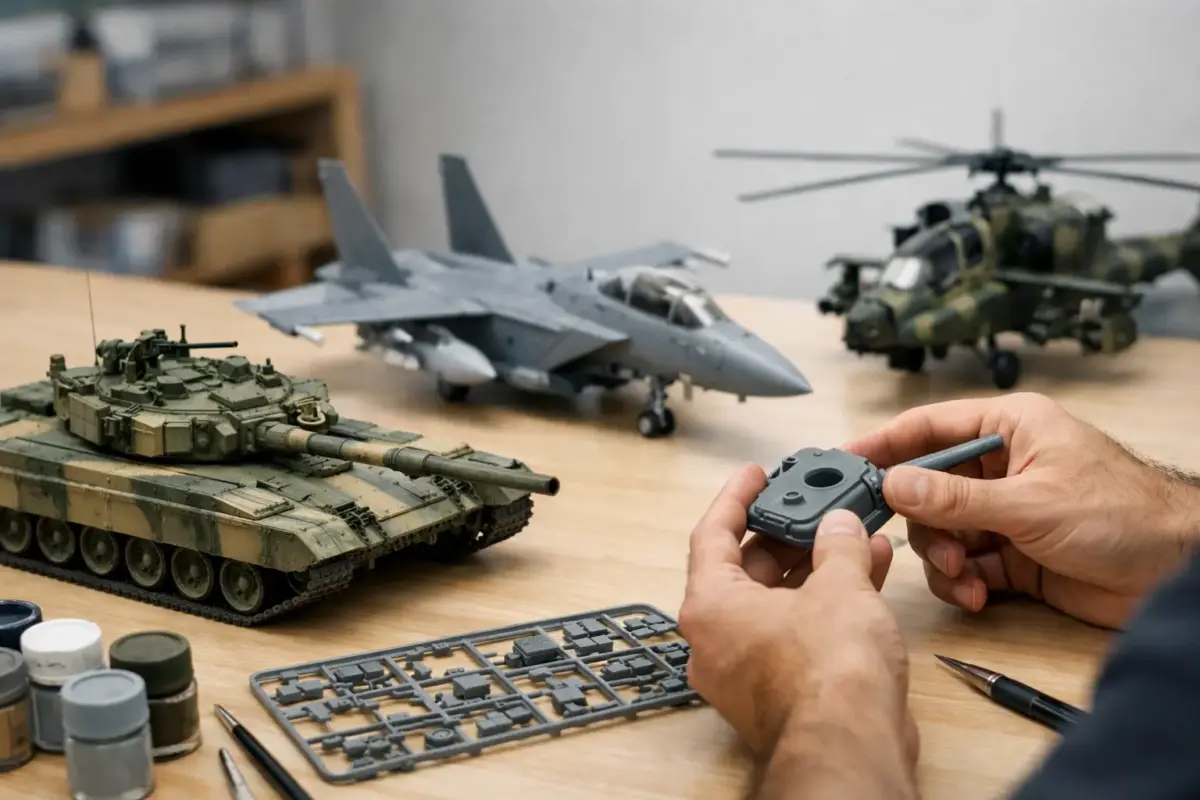
A 1:35 Tiger I with workable tracks and a full interior can look irresistible on the box art, but it is not the same proposition as a straightforward 1:72 Sherman with a dozen parts and a simple paint scheme. That is why choosing military model kits well matters. The right kit keeps a project moving, helps you get a clean finish, and makes it far more likely that the model reaches the display shelf rather than the stash.
For most modellers, the best starting point is not the most famous vehicle or the most heavily detailed release. It is the kit that matches your preferred scale, your bench space, your confidence with assembly, and the level of finishing you actually enjoy. Some builders want a quick armour subject for a weekend project. Others want a long-format build with photo-etch, aftermarket stowage, modulation, dust effects and a diorama base. Both approaches are valid, but the shopping list changes quite a bit.
How to choose military model kits
The first decision is scale. In armour modelling, 1:35 remains the standard for builders who want strong detail, broad aftermarket support and enough surface area to enjoy painting and weathering. It suits modellers who like adding cables, tools, stowage and subtle texture work. The trade-off is space. A collection of 1:35 tanks and self-propelled guns fills shelves quickly, and larger subjects can become substantial projects.
If you want more compact builds or intend to display multiple vehicles together, 1:72 and 1:76 make a lot of sense. These scales work well for wargaming-adjacent projects, convoy scenes, and broader collections covering several nations or campaigns. The detail is naturally smaller and can be less forgiving during assembly, but modern tooling has improved sharply. For many builders, these scales strike the right balance between realism, cost and storage.
Subject choice matters just as much as scale. Tanks are usually the easiest entry point because the shapes are familiar, references are widely available and weathering opportunities are generous. Soft-skin vehicles, artillery and half-tracks can be equally rewarding, though they often introduce more delicate parts and more visible interior areas. If you are drawn to figures, check whether the kit includes crew or whether separate figure sets would help bring the model to life.
Picking the right armour kit for your build style
Not every modeller enjoys the same stage of the process. Some like construction and engineering, especially on kits with link-and-length or individual track links. Others are more interested in paintwork, markings and finish. Being honest about that saves frustration.
A well-engineered Tamiya armour kit, for example, is often a dependable choice when you want good fit and a cleaner route to the painting stage. More complex releases from specialist brands can offer finer detail, alternate parts and specific production features, but they may expect more dry fitting, more cleanup and closer attention to the instructions. Neither is better in every case. It depends whether you want a relaxing build or a highly specific replica.
Era is another useful filter. Second World War German armour remains hugely popular because there is enormous kit choice and a broad weathering palette, from factory-fresh dunkelgelb schemes to heavily worn Eastern Front finishes. Allied vehicles offer just as much interest, especially if you prefer olive drab modulation, field-applied markings or British North West Europe subjects. Cold War and modern military vehicles bring a different feel altogether, with cleaner lines, reactive armour, modern camouflage patterns and distinct dust effects.
Difficulty is not only about part count
Beginners often assume that more parts automatically means a harder build. In practice, complexity comes from a mix of things: track type, suspension design, tiny grab handles, multipart tools, photo-etch, transparent parts and how precise the fit needs to be. A medium part-count kit with awkward alignment can feel more demanding than a larger but better designed one.
Instruction quality also makes a real difference. Clear assembly stages, sensible paint call-outs and well-labelled sprues remove a lot of avoidable friction. If you are buying for a newer modeller, a kit with straightforward engineering is usually a better investment than one loaded with optional extras they may never use.
What you need alongside military model kits
The kit is only the starting point. To complete an armour project to a good standard, you need the basics around it: cutters, a sharp hobby knife, sanding options, a reliable adhesive, primer, paints, brushes and, ideally, some form of varnish. If the kit includes decals, decal solutions are worth having as well, especially for markings that must settle over rivets, cast texture or Zimmerit.
Paint choice depends on how you like to work. Acrylics are popular because they are practical for indoor use and are available in extensive military colour ranges. Lacquer-based paints can offer excellent spray performance for experienced airbrush users, but they need proper handling and ventilation. Brush painters should look for colours with good self-levelling properties, while airbrush users may prioritise spray behaviour and dedicated thinners.
Weathering products are where many military subjects come alive. Washes help define recesses and raised details. Dry pigments can suggest dust, earth and worn running gear. Streaking products, oil paints and filters add variation to what would otherwise be a flat, single-tone finish. The key is restraint. A Soviet tank in harsh field conditions may justify heavy mud and fuel staining, while a parade-ground vehicle or a museum piece needs a very different touch.
Accessories can improve a build, but not every build needs them
Aftermarket tracks, turned metal barrels, resin stowage and photo-etch details can transform a kit, but they are not compulsory. In some cases they solve a genuine weakness, such as an overscale barrel seam or simplified engine grilles. In other cases they simply add time and cost.
A sensible approach is to build the core kit first and only add extras where they will be visible and worthwhile. A metal barrel on a 1:35 anti-tank gun may offer a clear upgrade. Replacing every clasp and bracket with brass on a closed-hatch vehicle might be less noticeable once painted and weathered. Budget matters too. It is often better to buy a good kit plus the right paints and adhesives than to overspend on detail sets and then compromise the finishing stage.
Best ways to shop military model kits by category
If you are browsing a specialist range, narrow the choice by four filters: scale, nation, era and brand. That usually gets you to a sensible shortlist quickly. A modeller looking for British armour in 1:35 from the Normandy campaign has very different needs from someone after a modern Russian AFV in 1:72.
Brand can be a practical filter rather than a loyalty statement. Some manufacturers are known for beginner-friendly fit. Others specialise in niche variants, high parts counts or exceptional surface detail. Knowing that helps set expectations before the box arrives.
It is also worth planning the complete project rather than buying piecemeal. If you have chosen a desert vehicle, think ahead about the correct base colours, pigments, washes and any stowage or figures that suit the setting. The advantage of shopping through a specialist supplier such as Scale Model Shop is that you can source the kit, paint system, tools and finishing products in one go, which avoids compatibility guesswork and mid-build delays.
When a simpler kit is the better purchase
Experienced modellers do not always need the most advanced release. A straightforward kit can be the right call if you want a test bed for a new weathering technique, a quick project between larger builds, or a subject for a group build with a fixed deadline. There is real value in kits that go together cleanly and leave room for finishing work rather than prolonged bench time correcting fit.
The same applies if you are returning to the hobby. Many former modellers come back expecting to pick up where they left off, only to find that modern materials and expectations have shifted. Starting with a manageable subject lets you re-establish core habits – surface prep, seam cleanup, priming and decal work – before tackling complex interiors or multimedia kits.
Military modelling is broad enough to support every pace of builder. Some projects are about deep historical accuracy and aftermarket refinement. Others are about enjoying an evening at the bench and seeing visible progress. If the kit suits the way you build, the result is usually better, and the hobby stays enjoyable. Choose for the project you want to finish now, not the one you imagine you ought to build, and the next box on the bench is much more likely to become a model worth displaying.
