
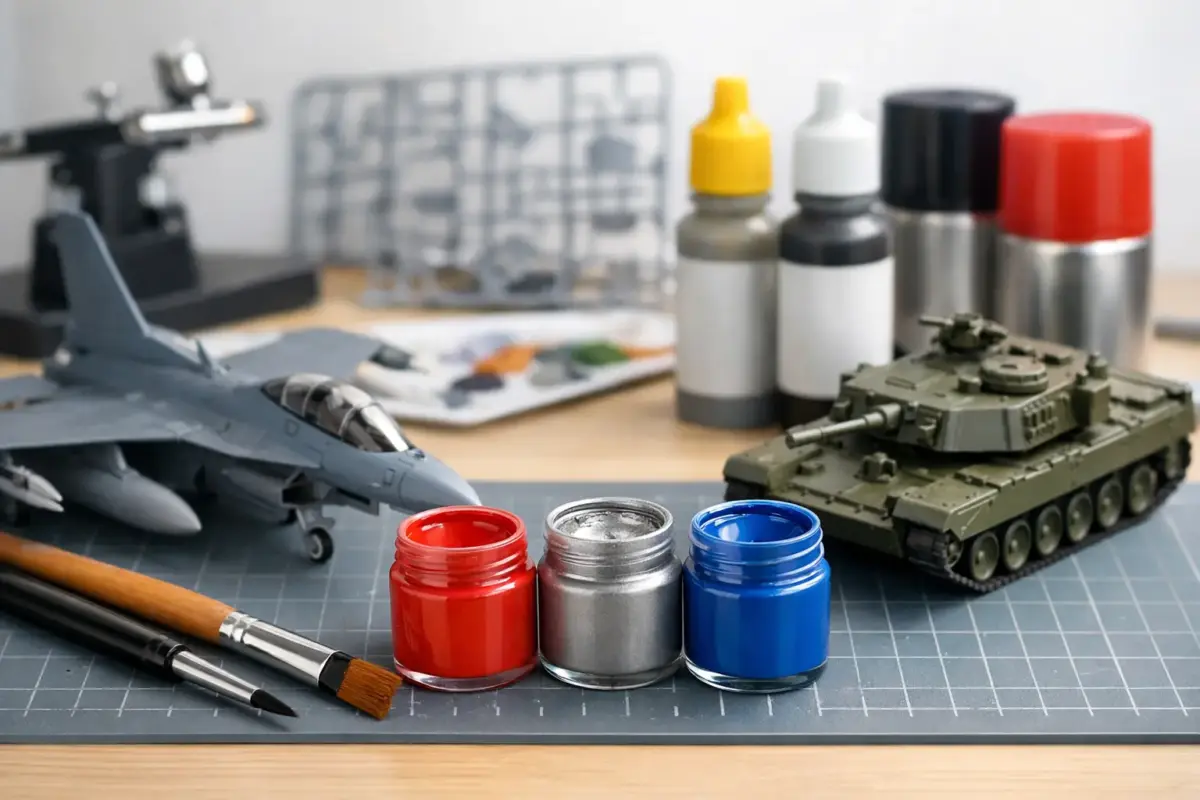
Pick the wrong paint and even a well-built kit can fight you all the way to the display shelf. The best paint for plastic model kits depends less on a single brand name and more on what you are building, how you paint and the finish you want. Aircraft modellers, armour builders, figure painters and Gundam fans often need different qualities from their paint system, so the right answer is usually a good match rather than a universal winner.
For many beginners, hobby acrylic paint is the most practical starting point. It offers convenient clean-up and ranges suited to brush painting, airbrushing or both. Enamels provide slower drying and smooth brush application, while lacquers deliver a durable finish that works particularly well through an airbrush.
What makes the best paint for plastic model kits?
For most modellers, the key qualities are predictable coverage, fine pigment, reliable adhesion over primer and a finish that suits later stages such as masking, decals and weathering. Paint also needs to work with your chosen application method. A brush painter may value self-levelling and slower drying, while an airbrush user usually wants smooth atomisation, easy thinning and a tougher cured surface.
That is why experienced builders often talk about paint ranges rather than individual colours. A strong range gives you primers, base coats, clear coats and compatible thinners in one system. This simplifies the workflow and reduces the trial and error that can occur when mixing products with different chemistries.
Acrylic, enamel or lacquer paint?
This is the first decision, and it affects almost everything that follows.
Acrylic paints
Acrylics are the easiest starting point for many plastic kit builders. They are widely available, generally lower odour than enamels or lacquers and convenient for home workbenches where ventilation may be limited. Good hobby acrylics from established modelling brands are suitable for brush painting, airbrushing or both, although each range will have its own strengths.
For brush work, acrylics can dry quickly, which is helpful for speed but less forgiving if you overwork the surface. Some ranges are excellent for cockpit details, figures and small assemblies, while others come into their own once properly thinned for an airbrush. If you mainly build indoors and want easier clean-up, acrylic paint for plastic models is often the sensible place to start.
Enamel paints
Enamels still have loyal users, especially among traditional aircraft and military modellers. They tend to level nicely with a brush and can give a very smooth finish when applied carefully. Their slower drying time can be an advantage on larger areas because it helps reduce visible brush marks.
The trade-off is a longer curing time, stronger smell and solvent-based clean-up. If you use weathering products heavily, enamels also need planning because enamel washes over enamel paint require a suitable barrier coat. They remain a solid choice for modellers who appreciate a slower, more deliberate painting process.
Lacquer paints
For many experienced airbrush users, lacquers are hard to beat for a smooth, durable finish. They spray beautifully, cure quickly and stand up well to masking. If you build modern jets, natural-metal finishes or armour with layered modulation, lacquer systems are often excellent performers.
The downside is stronger fumes, more demanding thinners and the need for proper extraction or a spray booth. They are not usually the first recommendation for a beginner painting at a kitchen table, but in the right setup they are among the best airbrush paints for plastic models.
The best plastic model paint by use case
Rather than hunting for one universal winner, choose your model paint by task.
Best paint for beginners
A good hobby acrylic range is usually the safest entry point. It keeps the process manageable, especially if you are learning surface preparation, thinning and brush control at the same time. Brands such as Tamiya, Vallejo, Revell, AK Interactive, Ammo by Mig and Mr Hobby all have strong followings, but each range behaves a little differently.
Tamiya acrylics are highly regarded, particularly for airbrushing, although many brush painters find them less forgiving than some water-based alternatives. Vallejo Model Colour is popular for brush work, while Vallejo Model Air is designed for spraying. Ammo by Mig and AK Interactive also offer modeller-focused ranges with military and aircraft colours matched to real subjects.
A coordinated selection such as the available Mr Hobby paint sets can make it easier to gather complementary colours for a project without choosing every shade individually.
Best paint for airbrushing
If your priority is airbrush performance, lacquer and alcohol-based acrylic systems tend to lead the field. Mr Hobby and Tamiya are popular choices for smooth atomisation and reliable finishes. Dedicated airbrush acrylics can also perform very well, especially when paired with the correct thinner and suitable pressure settings.
Compatibility is the detail that matters. A paint may be described as airbrush-ready, but needle size, compressor settings and working conditions can still affect the result. Fine-tuning with the appropriate thinner usually gives better results than trying to force a universal setup.
Best paint for brush painting
For hand painting details, interiors, tools, figures and small sub-assemblies, a paint that levels well is worth more than sheer toughness. Vallejo and Revell Aqua are often chosen for this reason, and many figure painters favour paints with strong opacity and a matt finish that accepts further shading.
If you brush-paint entire kits, enamel still has a strong case. It can produce clean coverage on larger surfaces if you work patiently. Modern acrylic ranges have also improved significantly, so beginners no longer need to assume enamel is the only route to a good brush-painted finish.
Best spray paint for plastic model kits
Spray cans provide quick, consistent coverage without requiring an airbrush and compressor. They are particularly useful for primers, broad base colours and larger components. The Tamiya AS spray paint range offers colours aimed at aircraft modelling and provides a convenient option for applying smooth, even coats.
Use several controlled coats rather than trying to achieve full coverage in one heavy pass. This gives you greater control around panel lines, raised detail and recessed areas.
Best paint for durable finishes and masking
If you regularly mask camouflage, invasion stripes or anti-glare panels, paint durability matters. Lacquers generally perform best once cured, followed by tougher acrylic systems over a suitable primer. Even excellent paint can lift if it is applied over bare plastic with poor surface preparation.
Primer matters more than many modellers expect
Ask why paint failed, and primer is often part of the answer. Plastic model kits vary in surface feel, mould-release residue and material hardness. A suitable primer improves adhesion, helps reveal seam flaws and gives colour coats a more even base.
Grey primer is the all-round choice for most builds. Black works well under metallics or as a base for pre-shading, while white is useful beneath bright colours, civil schemes and figures. If you build resin or mixed-media kits, primer becomes even more valuable because different materials can accept paint differently.
A dependable primer also helps you judge the character of your top coat. Olive drab, RAF camouflage tones and naval greys can look quite different over white than over black. If you are aiming for a particular finish, the undercoat should be part of the plan rather than an afterthought.
Preparation starts with sound assembly and clean surfaces. For plastic-to-plastic construction, the Plastic Weld range can help you create secure joins before seam work, priming and painting begin.
Brand choice matters, but so does the whole paint system
A lot of frustration comes from mixing unrelated products and hoping they behave. Sometimes they do; sometimes they wrinkle, separate or dry with a rough finish. The safer approach is to think in systems: primer, paint, thinner, varnish and weathering products that are designed to work together.
This is especially useful if you build multiple subjects within one area. Armour modellers may want matched modulation sets, dust effects and washable layers. Aircraft builders may prioritise accurate FS, RLM or RAF shades alongside dependable clear coats for decals. Figure painters often need strong brush performance, matt finishes and colours designed around skin, fabric and leather tones.
A category-led approach makes the process easier because you can build a complete paint workflow around your subject rather than buying colours in isolation.
How to choose paint for your next model kit
Start with your painting method. If you brush-paint most of your kits, choose a range known for hand application. If you airbrush, buy the appropriate thinner at the same time and avoid improvising with unsuitable alternatives.
Then think about the subject. An aircraft cockpit, a 1/35 plastic model kit and a 75mm figure all place different demands on paint. Fine details benefit from opacity and control, while large exterior surfaces need smoothness and consistency. Figures usually reward paints that layer cleanly and dry matt.
Finally, consider your work area. If you paint in a small indoor space, a lower-odour acrylic setup may be more practical than lacquer, even if lacquer offers a tougher finish. The best paint on paper is not the best choice if it does not suit your bench, ventilation or routine.
Common mistakes when painting plastic model kits
The first is buying by colour chart alone. A perfect shade is no use if the paint fights your application method. The second is skipping primer to save time. The third is assuming all acrylics behave in the same way. Some are excellent through an airbrush, some excel with a brush, and others need more care with thinning and drying conditions.
Another common problem is rushing curing times. Touch-dry and fully cured are not the same thing. If you mask too early, apply decals over soft paint or add strong weathering products before the surface is ready, even a quality paint can let you down.
Start with one proven range, use its matching thinner and primer, and test your combination on a spare piece of sprue before committing to the model. That small step can save a great deal of repainting.
So, what is the best paint for plastic models?
For beginners and indoor brush painting, hobby acrylics are usually the most practical choice. Enamels remain excellent for patient brush painters who value smooth levelling, while lacquers are a strong option for airbrush users seeking a durable finish that handles masking well.
The best plastic model paint is ultimately the one that suits your subject, application method and workspace. Choose a compatible primer, paint, thinner and clear-coat system, allow each layer to cure properly and build the finish with controlled coats.
A good paint choice should make the build more enjoyable, not more complicated. With a system suited to your technique, you can spend less time correcting finishes and more time adding the details that make a model worth a second look.
