
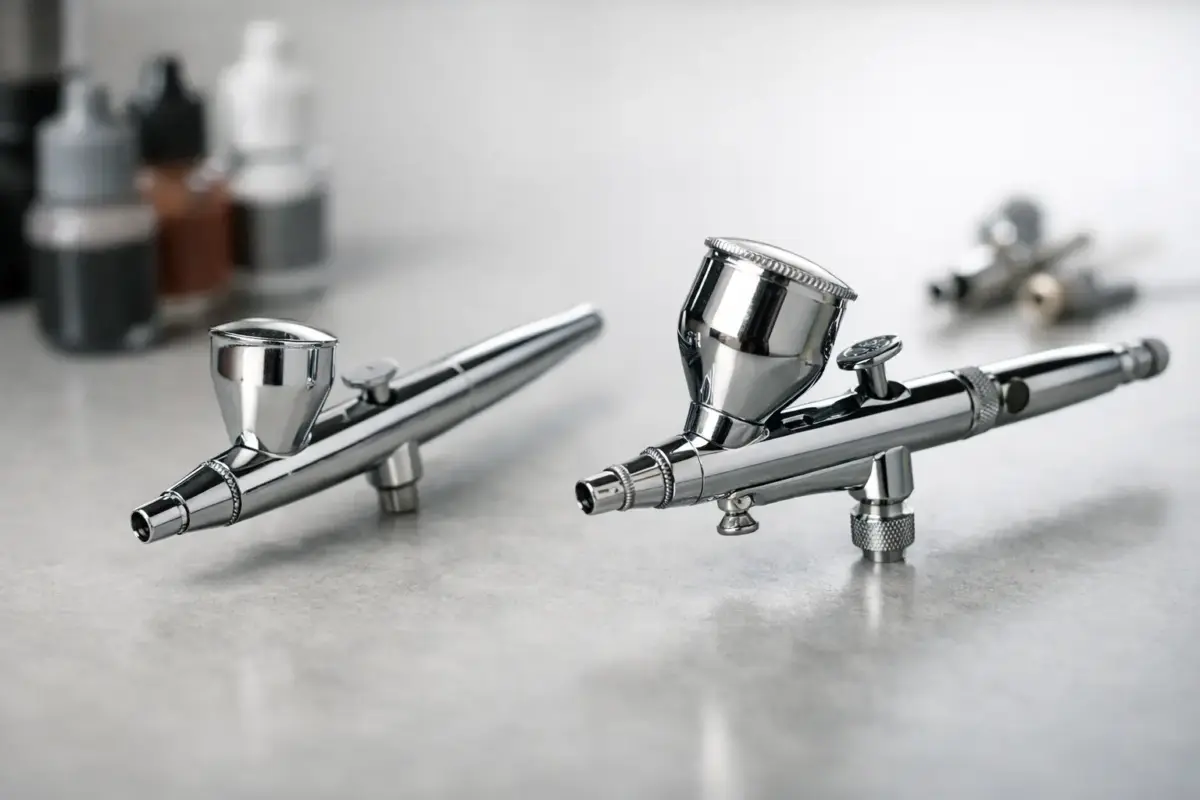
You usually notice the difference between a single action vs dual action airbrush the moment you try to spray a fine mottle on a 1/48 Luftwaffe fighter or feather a soft camouflage edge on armour. One feels straightforward and predictable. The other gives you more control, but it also asks more from your trigger hand. For scale modellers, that choice matters because the airbrush is not just a paint delivery tool – it shapes how easily you can prime, basecoat, pre-shade, varnish and finish a model to the standard you want.
Single action vs dual action – what is the actual difference?
The core difference is in how the trigger controls the airbrush. A single action airbrush uses the trigger for one function, usually airflow, while paint volume is set separately, often by adjusting the needle or a control screw. Once set, it sprays at that chosen paint level when you press the trigger.
A dual action airbrush combines both controls on the trigger. You press down for air and pull back for paint. That means you can vary paint flow as you work, without stopping to adjust the brush itself. In practical modelling terms, a single action setup is simpler to operate, while a dual action setup is more flexible in the middle of a pass.
That sounds like an easy win for dual action, but modelling tools are rarely that simple. More control is useful only if your projects need it and if you are comfortable using it consistently.
Why it matters for scale modelling
Not every modelling job demands ultra-fine trigger modulation. If your airbrush is mainly used for primer, single-colour coverage, clear coats, and broad base layers on larger subjects, a single action airbrush can do the job very well. It is also less intimidating for newer modellers who are still learning paint thinning, air pressure and cleaning routines.
Dual action becomes more valuable as your finishing work becomes more detailed. Luftwaffe mottling, marble coats, subtle post-shading, figure transitions, soft-edged camouflage and controlled weathering all benefit from being able to ease paint in and out during a stroke. On smaller scales, where overspray can spoil the effect quickly, that added control is often the reason experienced modellers prefer dual action designs.
When a single action airbrush makes more sense
Single action airbrushes are often dismissed as beginner tools, which is a bit unfair. They are straightforward, reliable and perfectly suited to plenty of workshop tasks. If you want repeatable coverage across a 1/35 tank hull, a 1/24 car body primer coat, or batches of terrain pieces for wargaming, predictable output can be an advantage rather than a limitation.
They also reduce the number of variables you are juggling at once. For hobbyists who are just moving from brush painting to airbrushing, that matters. Instead of balancing trigger movement, thinning ratio, pressure and distance all at the same time, you can focus on getting paint consistency and spray distance right first.
There is also a maintenance and cost angle. Single action airbrushes can be less fiddly to learn and, depending on design, may appeal to modellers who want a practical tool for coverage work rather than a precision instrument for intricate finishing.
Best uses for single action
Single action airbrushes are well suited to primers, varnishes, monotone basecoats, larger scale subjects, scenic work and repetitive spraying. They are often a sensible choice for railway scenery, wargaming terrain, broad hull and fuselage coverage, and any task where consistency matters more than on-the-fly variation.
If your painting style is methodical and you prefer to mask camouflage rather than freehand it, a single action airbrush may not feel restrictive at all.
Where dual action earns its place
Dual action airbrushes suit modellers who want to refine paint flow constantly as they work. That ability is especially useful when moving across panel lines, changing spray width mid-pass, or building translucent coats gradually. You can start with air only, introduce paint gently, then taper it off before stopping. That helps reduce spatter and gives a cleaner finish, particularly on fine work.
For aircraft modellers, this can be the difference between a hard-looking patch of paint and a controlled, scale-appropriate transition. For armour builders, it helps when creating modulation, dust tones and nuanced camouflage. Figure painters can also benefit when laying down smooth blends on larger surfaces or adding subtle tonal variation.
The trade-off is that dual action takes practice. A good dual action airbrush does not automatically produce better results. If paint is too thick, pressure is wrong, or cleaning is inconsistent, the extra trigger control will not solve that. In fact, it can make poor setup more obvious.
Best uses for dual action
Dual action airbrushes shine in freehand camouflage, mottling, pre-shading, post-shading, marbling, modulation, fine weathering passes and detail-focused finishing. They are usually the better long-term option for modellers who expect their airbrush work to become more advanced over time.
Single action vs dual action for beginners
If you are buying your first airbrush, the honest answer is that it depends on what you want to paint in the next six months, not in five years’ time. A beginner building 1/35 armour with masked camouflage, or spraying primers and varnishes on mixed subjects, may get on very well with a single action airbrush. It keeps the learning curve manageable and still opens the door to smoother finishes than a brush can usually provide.
A beginner focused on aircraft camouflage, fine-line work or more artistic paint effects may be better served by learning on a dual action from the start. Yes, there is more to master, but many modellers prefer to learn one versatile system properly rather than upgrading later.
The real risk is buying on assumption rather than use case. If precision finishing is your goal, a very basic single action setup may start to feel limiting fairly quickly. If you mainly need dependable coverage, a dual action airbrush may offer capability you rarely use.
Control, consistency and fatigue
One point that is often overlooked in the single action vs dual action discussion is comfort over a longer session. Dual action airbrushes require finer trigger coordination, and during long priming or basecoating sessions that can be more tiring. Single action airbrushes can feel more relaxed for repetitive work because the paint setting is already fixed.
On the other hand, once you are used to dual action, many modellers find it more natural because it becomes part of the rhythm of spraying. Press, pull, release paint, release air. It gives a level of control that can quickly become hard to give up.
This is why there is no universal best option. Workshop habits matter. So does subject matter. So does how much time you want to spend developing technique.
Cleaning and upkeep
Both types need proper cleaning, especially when spraying acrylic primers, metallics or varnishes. That said, the more precise your airbrush work, the more noticeable any internal residue becomes. Dual action users often operate closer to the edge of fine performance, so a partially clogged nozzle or a dry tip issue tends to show up sooner in the finish.
That does not mean dual action airbrushes are inherently troublesome. It simply means your cleaning discipline matters more when you rely on fine trigger response and narrow spray patterns. Flushes between colours, sensible thinning, and a full strip-down clean when needed are part of the routine whichever type you choose.
Which should you buy?
If your priority is ease of use, dependable coverage and a gentler learning curve, single action is a sensible choice. If your priority is maximum control, finer detail and room to grow into more advanced finishing techniques, dual action is usually the stronger investment.
For many scale modellers, the answer is not really single action or dual action in abstract. It is whether your bench time is spent priming and basecoating, or refining paint effects. Aircraft, figures and freehand camouflage tend to push the decision towards dual action. Terrain, broad coverage and straightforward finishing often sit comfortably with single action.
If you are unsure, think about the model currently on your bench and the next two after that. Buy for the work you actually do. At Scale Model Shop, that usually leads people to a better result than buying for the most advanced technique they might try someday.
A good airbrush should make your painting more controlled, not more complicated. Pick the one that fits your projects, your skill level and the way you like to build, and you will get far more value from it every time you sit down at the bench.
