
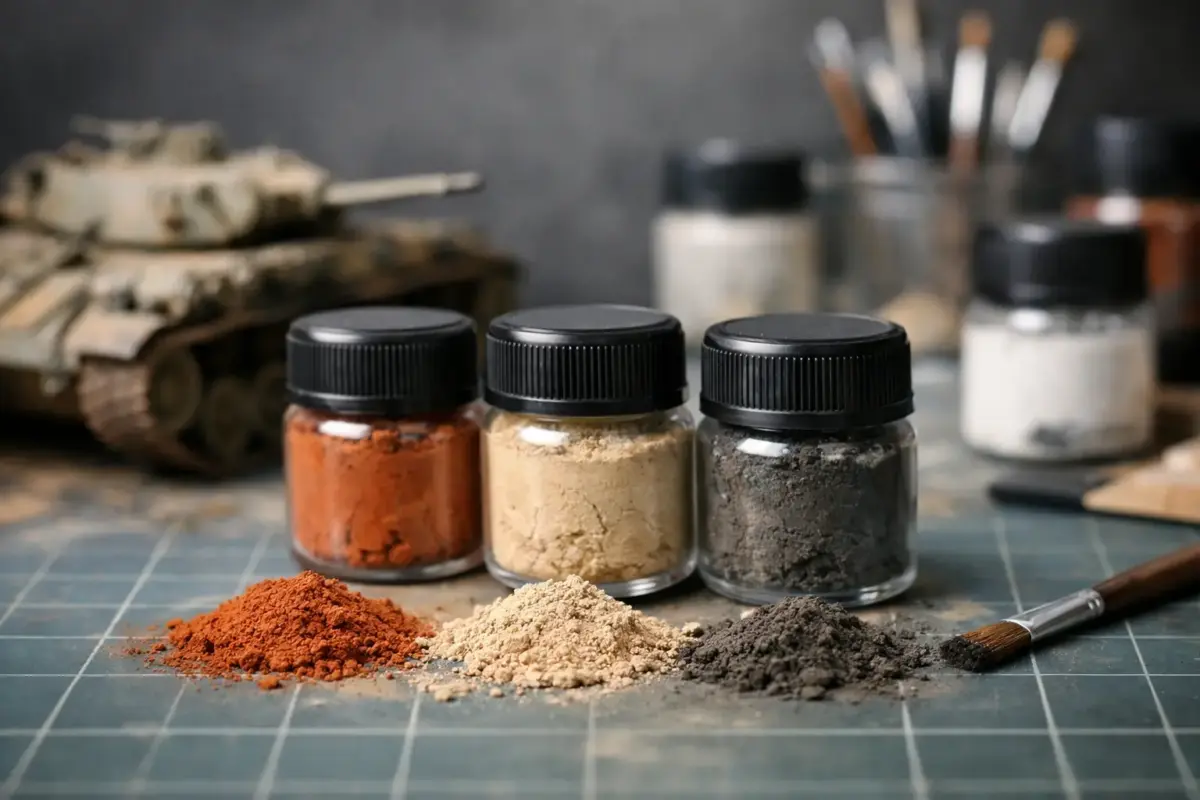
A convincing dusty track run, exhaust stain or dry earth finish often comes down to the last few layers, not the paint beneath them. This AK Interactive pigments review looks at where these fine weathering powders earn their place on the bench, how they compare with simpler dry-brushing approaches, and which applications suit armour, aircraft, figures and scenic work.
AK Interactive pigments review: what you get
AK Interactive pigments are dry, finely milled powders designed to reproduce the accumulated effects that ordinary paint can struggle to capture: loose soil, dried mud, road dust, soot, ash, rust deposits and faded mineral tones. The range is broad enough to build convincing regional colour variation rather than relying on one generic earth shade. That matters on a vehicle or diorama where the difference between pale European dust, darker damp soil and reddish iron-rich ground is immediately visible.
The powders are supplied ready to use. There is no thinning ratio to learn and no airbrush preparation, which makes them particularly useful at the end of a project when a small adjustment can tie the finish together. Applied dry, they retain a chalky, matt texture that looks much closer to real dust than a painted-on effect. Used with a suitable thinner, pigment fixer or enamel-based weathering medium, they can become stains, heavier deposits or textured mud.
The chief strength of the range is control. A modeller can apply a barely visible haze to an aircraft undercarriage, concentrate grime around an AFV suspension unit, or build several earthy tones around the base of a figure. They are not a replacement for washes, filters and chipping, though. Pigments work best as one stage in a layered weathering process, usually after the main paintwork and most decal work are complete.
Colour range and finish quality
The pigment selection is one of AK Interactive’s strongest points. There are practical staples for almost every workbench, including black, smoke, dark earth, light dust, mud, rust and concrete-type tones, alongside more specific shades for different terrain and industrial effects. This is useful because weathering is rarely one colour. Real dust gathers in layers, while rust can shift from orange-brown at an exposed edge to a deep, almost violet brown in a protected recess.
For armour builders, combinations are more convincing than a single all-over application. A darker earth pigment pushed into track links and lower hull corners, followed by a lighter dust tone brushed across raised edges, gives depth without making the vehicle look uniformly dirty. On a desert subject, pale buff and sand pigments can soften the contrast of camouflage while retaining panel and bolt detail.
Aircraft modellers may use less product, but pigments remain valuable. Soot shades work well around piston exhausts, gun muzzles and heat-stained areas when built up slowly. Earth shades add believable wear to tyres, wheel wells and rough forward operating strips. The fine powder is also effective for the slightly uneven, faded look of unsealed exhaust residue, although it should be used with a light hand on smaller scales.
For figures, the advantage is scale-sensitive texture. A small amount of dust around trouser hems, boots and equipment brings a miniature into the same environment as its base. Coarser-looking mud effects are better created by mixing the pigment with an acrylic resin, enamel medium or dedicated texture product, rather than trying to pile dry powder onto the surface.
Applying pigments without losing control
The simplest method is dry application over a fully cured matt or satin surface. Pick up a small amount with a soft, short-bristled brush, work most of it off on a palette or tissue, then stipple or sweep it onto the model. Start lighter than you think necessary. It is easy to add another layer; removing pigment from a textured suspension unit or a recessed panel line is less straightforward.
A matt surface gives the powder more grip, while a glossy finish tends to make it slide around and gather unpredictably. That does not mean pigments cannot be used over satin paint, but the effect will be softer and may need fixing. For delicate aircraft finishes, a controlled application over a satin varnish can be useful because it allows unwanted powder to be lifted with a clean brush before committing to it.
For heavier earth effects, place pigment in the desired area and touch in enamel thinner, odourless thinner or a dedicated pigment fixer with a separate brush. Capillary action draws the liquid through the powder and anchors it in place. Avoid flooding the area. Too much liquid can create tide marks, darken the pigment substantially, or leave a hard-edged deposit that looks more like a spill than naturally dried mud.
A useful working habit is to test the full process on a spare painted spoon, old hull section or plastic card. Pigments nearly always look darker when wet, and some fixers alter both the tone and the texture once dry. Testing is especially worthwhile before treating a pale aircraft finish, white winter camouflage or an expensive resin kit.
To fix or not to fix?
Leaving pigments unsealed gives the most natural dry finish and allows easy adjustment. It is ideal for a display model that will spend most of its time in a cabinet. The trade-off is fragility: fingertips, handling during transport and even a soft cloth can disturb the effect.
Fixing is the better choice on track runs, bases, gaming pieces and models likely to be handled. A dedicated fixer offers the most predictable result, while enamel thinner is often preferred for blending dusty deposits and creating damp-looking patches. A misted varnish can protect the work, but it can also reduce the powdery appearance and make colours darker. If varnish is required, use a very light coat from a sensible distance and check the finish as it dries.
Where AK pigments work best
These pigments are particularly effective when the model has physical detail for them to settle into. Armour running gear, cast hull texture, sandbags, brickwork, stone walls and railway ballast all benefit from the natural accumulation that dry powders provide. Diorama builders can also use them to blend a vehicle into its groundwork, carrying the same soil tone from the base onto wheels, tracks and boots.
On clean modern aircraft, polished racing subjects or high-gloss civilian vehicles, their role is narrower. The powder can still create subtle brake dust, exhaust staining or dirt in recessed areas, but broad pigment coverage may be out of character. Historical reference images should guide the intensity. A well-maintained vehicle in service can look less weathered than a museum piece left outdoors.
They are also less suitable as a shortcut for every type of weathering. A pigment cannot replace a sharp paint chip along a hatch edge, a controlled pin wash around raised details, or a translucent oil streak running down a vertical surface. Combining techniques is what produces believable variation. Think of pigments as the material for dry deposits and accumulated residue, rather than the answer to every mark on the model.
Common mistakes and practical corrections
The most common mistake is applying too much, too evenly. Dirt is affected by airflow, rain, crew movement and the shape of the vehicle, so it should not form a uniform blanket. Keep upper surfaces lighter, concentrate dust and mud around lower areas, and leave some clean paint visible to preserve contrast.
Another frequent issue is using a single brown tone for everything. Mixing two or three related shades produces a more natural result, even when the difference is subtle. A small amount of grey, black or pale dust mixed into an earth tone can stop a finish appearing flat or overly orange.
If the effect looks excessive before fixing, a soft flat brush, cotton bud or a little clean thinner can usually reduce it. Once the powders have been heavily fixed and sealed, correction becomes more difficult. Build the effect in stages and inspect the model from normal viewing distance, not only under a strong bench lamp.
Verdict: are AK Interactive pigments worth it?
AK Interactive pigments are a strong choice for modellers who want realistic dry weathering with a wide, practical colour selection. Their fine texture, ease of layering and flexibility with dry or wet application make them useful across armour, aircraft, figures, ships and dioramas. They reward patience rather than speed, and the best results come from matching the shade, density and fixing method to the subject.
For a first set, begin with a light dust, a darker earth, a rust tone and a soot or black shade suited to the models you build most often. Learn how each behaves dry and fixed, then add more specialist terrain colours as your projects demand them. A few carefully chosen pigments can turn separately finished wheels, tracks, figures and groundwork into one believable scene.
