
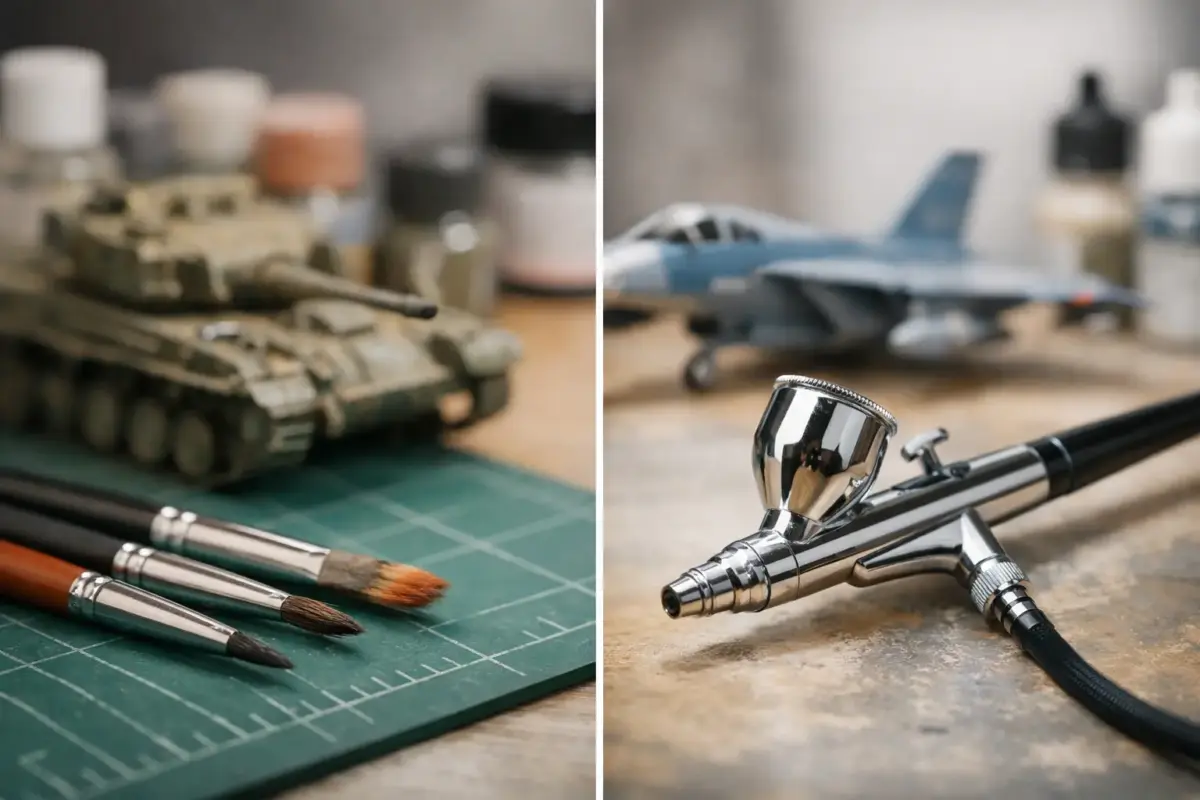
A 1/72 aircraft can look excellent with carefully applied brush paint, while a 1/35 tank can look lifeless if its subtle tonal variation is handled badly with an airbrush. That is why paint brushes vs airbrush is not really a question of beginner versus expert. It is a decision about the finish you need, the scale you are working in and which stage of the build is on the bench.
Both methods belong in a well-equipped modelling workspace. Brushes give direct control and remain essential for detail work. Airbrushes make broad, thin and graduated finishes far more achievable. Choosing one over the other completely can limit a project; knowing where each method excels produces better results with less frustration.
Paint Brushes vs Airbrush: the practical difference
The most obvious difference is how paint reaches the model. A brush places paint exactly where the bristles touch, which makes it ideal for small components, cockpit controls, figure faces, track tools and edge work. It is quiet, portable and requires little preparation. With suitable paint, a good brush and several thin coats, brush painting can produce a remarkably smooth finish.
An airbrush atomises thinned paint into a controlled spray. It covers large areas quickly and puts down very thin layers, making it particularly useful for priming, base coats, camouflage, varnish and weathering effects. Its real strength is consistency across broad surfaces. On an aircraft fuselage or a car body, that can be the difference between an even paint finish and visible brush marks.
There is a trade-off. Airbrushing asks more of the modeller before and after painting: suitable thinning, air pressure, masking, ventilation and thorough cleaning all matter. A brush can be picked up to paint a wheel hub in minutes. An airbrush session needs setup, but earns its place when several parts or a complete model need coating.
When brushes are the better choice
Brushes are not a compromise. For many jobs, they are the technically correct tool. Fine pointed brushes are indispensable for instrument panels, raised details, crew figures, small fittings and colour separation on parts that would be awkward to mask. Flat brushes are useful for applying decals solutions, pigments, washes and selected dry-brushing effects.
They are also an excellent way to start painting scale models. A modeller can learn paint consistency, coverage and colour placement without immediately investing in a compressor, air hose, spray booth and cleaning equipment. Acrylic paints formulated for brush application generally level well when used in thin coats, while enamel and oil paints remain popular for detail painting and weathering because of their longer working time.
Brush painting is especially practical for smaller builds, wargaming miniatures and subassemblies. A 1/72 cockpit, a 1/700 ship fitting or a Gundam detail part may only need a few carefully placed colours. Preparing an airbrush for such a limited task is often unnecessary.
The limitation is surface area. Large, flat panels expose brush strokes more readily, particularly with metallics, gloss colours or paint that is too thick. Repeated brushing over paint that has started to dry can pull up the layer underneath and leave texture. The answer is usually not more paint on the brush, but better preparation: stir the paint fully, thin it as required by the paint range, use a quality brush and allow each coat to cure before the next.
When an airbrush earns its place
For exterior finishes, an airbrush is hard to beat. Primers go on more evenly, pre-shading and marbling are possible, and a thin base coat is less likely to obscure fine rivets, recessed panel lines or delicate moulded texture. This matters on modern aircraft, armour with detailed surfaces, large ships and models where the paintwork is a major part of the finished appearance.
Camouflage is another clear advantage. A double-action airbrush gives control over both air and paint flow, allowing soft-edged patterns on RAF aircraft, Luftwaffe mottling, armour modulation or subtle exhaust staining. Hard-edged camouflage still benefits from masking, but an airbrush creates a flatter, more scale-appropriate painted edge than a heavily brushed coat.
Airbrushes also make varnishing less risky. A thin, even gloss coat prepares a model for decals and washes; satin or matt varnish can then unify the final finish. Applying these coatings by brush is possible, but larger areas demand care because pooling or overlap marks can be difficult to correct.
The equipment does require a sensible approach. A compressor with a moisture trap helps maintain stable airflow, and a tank reduces pulsing during close work. A spray booth or well-ventilated dedicated area is advisable, particularly with lacquer or enamel-based products. Use suitable respiratory protection for the paint system being sprayed; an open window alone is not a substitute for proper ventilation and filtration.
Cleaning is the part new users most often underestimate. Flush the airbrush between colours, clean the cup and nozzle after each session, and use the correct cleaner or thinner for the paint range. Dried paint in the nozzle leads to poor spray patterns, sputtering and a great deal of avoidable fault-finding. A few disciplined minutes after painting are easier than a full strip-down later.
Finish quality depends on more than the tool
A brush cannot compensate for poorly prepared plastic, and an airbrush cannot fix unsuitable paint consistency. Before either method, wash parts where needed, remove sanding dust and deal with seams. Primer is useful not only for checking surface work, but also for giving subsequent coats a consistent base to grip.
Paint type matters as well. Water-based acrylics are convenient and widely used, but different ranges behave differently through a brush or airbrush. Some are designed to brush smoothly straight from the bottle; others benefit from a dedicated thinner and retarder. Lacquer paints often spray exceptionally well and cure quickly, but require compatible thinners and more careful ventilation. Enamels provide long working time and are still valued for washes, filters and certain brush-painted details.
Scale should influence your choice. On a 1/144 aircraft, a broad airbrushed base coat can preserve crisp detail, but a brush remains more controlled for tiny undercarriage parts. On a 1/16 figure, brushes are usually the preferred route for layered flesh tones, eyes and fabric detail, while an airbrush can establish initial shadows or smooth base colours. For 1/35 armour, many modellers airbrush the main paintwork and then use brushes for chips, stowage, tools, washes and pigments.
The strongest workflow uses both
The most useful answer to paint brushes vs airbrush is usually both, used at the right point in the process. Airbrush the primer, base colours, camouflage, clear coats and broad weathering tones. Then move to brushes for details, hand-painted chips, tyres, navigation lights, cockpit work and selective weathering.
This mixed approach is not just about appearance. It makes each task more efficient. Rather than trying to spray every small detail, risking overspray and extra masking, brush it precisely. Rather than brushing a large hull or fuselage over several coats, spray a thin, even finish and retain the surface detail you paid for in the kit.
A practical starter setup can grow gradually. Begin with a small selection of good-quality brushes in fine round and flat shapes, suitable paint thinners, a palette and a brush cleaner. When you are ready to airbrush, a reliable dual-action airbrush, compressor with moisture trap, cleaning pot, appropriate thinner and safe spraying area will cover most scale modelling tasks. Spend time learning on plastic spoons, old kits or scrap card before committing to a favourite project.
Do not judge a method by the first attempt. Brush control improves through paint thinning and patience. Airbrush control improves through pressure, distance, trigger discipline and cleaning habits. Keeping notes on paint ratios and air pressure for the ranges you use can save hours when returning to a familiar finish.
For a first model, brushes may be all you need. For regular aircraft, armour, car or large-scale projects, an airbrush soon becomes a worthwhile workshop tool. Whatever your current setup, Scale Model Shop can help you build it around the paints, tools and finishing products that suit the models you actually enjoy making.
