A natural-metal aircraft finish can expose every small mistake in preparation, and that is exactly where paint choice matters. This Vallejo Metal Colour review looks at why the range has become a regular sight on workbenches, what it does particularly well, and where a different metallic system may suit the job better.
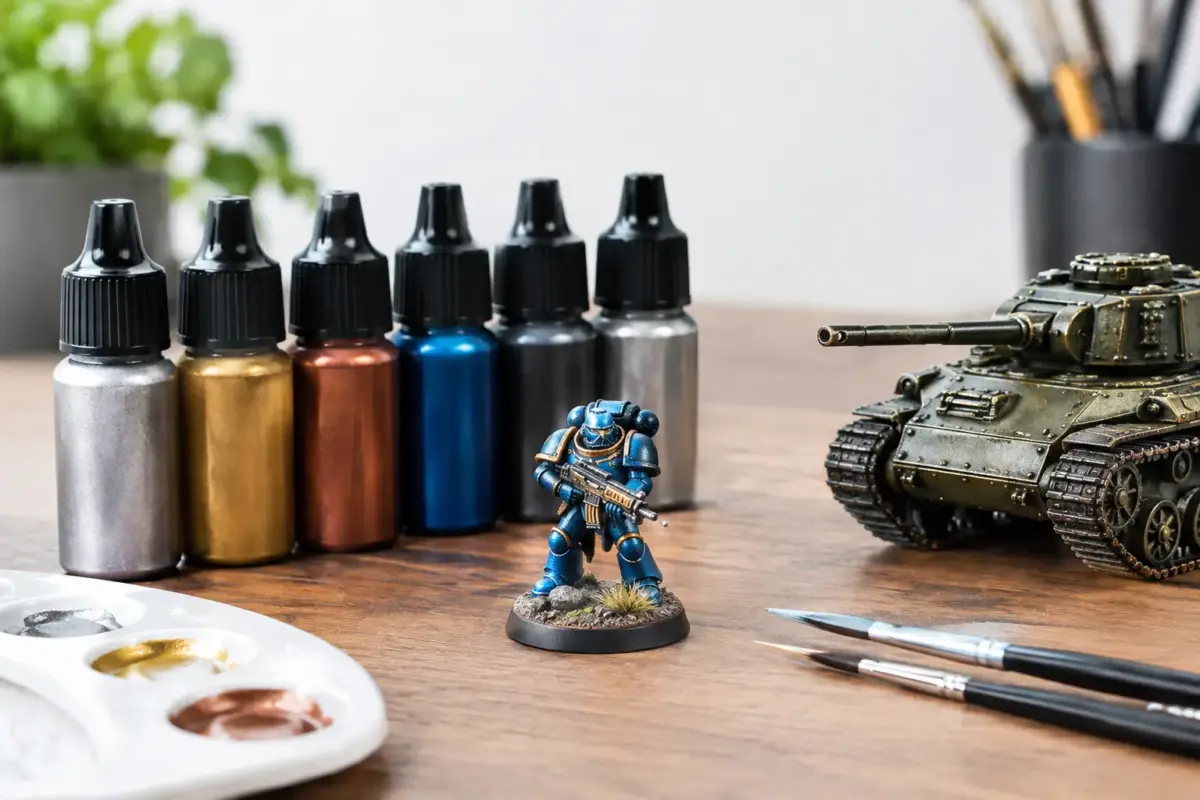
Vallejo Metal Colour is a water-based acrylic metallic range formulated primarily for airbrush use. It is sold in 32ml bottles, arrives much thinner than conventional acrylic paint, and is intended to produce an opaque, fine-grained metal finish without the heavy, glittery appearance that can spoil a scale model. For aircraft, armour details, spacecraft, engines and metallic figure elements, that promise is a compelling one.
Vallejo Metal Colour review: the finish
The standout quality is the pigment. Metal Colour sprays with an exceptionally fine metallic grain, particularly in the aluminium-family shades. On a well-prepared surface, Aluminium, White Aluminium, Duraluminium and Dark Aluminium can look convincingly like different panels of real metal rather than simply variations of silver paint. The finish is smooth enough for 1/72 aircraft yet has sufficient presence for larger 1/32 airframes, armour and science-fiction subjects.
It is not a mirror-finish product in the way some lacquer metallics can be over a polished black base. That is not a criticism so much as a useful distinction. Vallejo Metal Colour gives a realistic scale metal sheen: bright where it should be bright, but generally less toy-like and less prone to looking like chrome. For many RAF, Luftwaffe, USAAF and post-war natural-metal subjects, that restrained look is an advantage.
The result depends heavily on the colour beneath it. A smooth black gloss primer will deepen the sheen and make polished shades such as Chrome or Gloss Metal Aluminium more reflective. Grey, white or satin black primers tend to produce a softer operational-metal appearance. For a heavily used aircraft, a neutral grey or black base often looks more believable than an ultra-glossy undercoat.
Surface preparation still matters. Metal Colour is forgiving compared with some specialist lacquer finishes, but it cannot hide sanding scratches, dust or a rough primer coat. Work through the abrasives, polish the primer where necessary, and inspect the surface under a strong lamp before reaching for the airbrush.
Airbrushing: ready to use, but not foolproof
One reason the range is popular is its convenience. In most cases, Vallejo Metal Colour can be sprayed directly from the bottle. A 0.2mm or 0.3mm nozzle works well, although a larger nozzle is useful for broad 1/24 car panels or 1/32 wings. Low to moderate pressure and several controlled passes are better than trying to cover the model in one wet coat.
A practical starting point is around 15-20 psi, adjusted for your airbrush, nozzle size and room temperature. Spray close enough to keep the coat wet and even, but not so close that paint pools on panel lines or leading edges. The paint covers surprisingly quickly, so pause between passes and assess the surface rather than continuing from habit.
The bottle needs a thorough shake. Metallic pigment settles, and a quick rattle is rarely enough. A mixing ball helps, but the best approach is to shake well, then stir the paint if it has been sitting on the bench for several weeks. Inconsistent mixing is one of the main reasons a metallic coat can appear dull or patchy.
Although it is pre-thinned, there are occasions when a tiny amount of compatible acrylic thinner or flow improver helps, especially on a hot day or when using a very fine needle. Start without additions. Over-thinning can reduce coverage and make the paint more vulnerable while it dries.
Cleaning is straightforward compared with solvent-based metallics, but do not leave residue in the airbrush. Flush promptly with suitable airbrush cleaner and pay attention to the nozzle. Metallic particles are fine, yet any dried paint around the tip will affect the next session.
Masking and curing time
Metal Colour dries quickly to the touch, but drying is not the same as fully cured. For simple handling, a few hours may be enough. For masking fine anti-glare panels, coloured rudders or separate metal tones, leaving the model overnight is the safer choice.
Use low-tack tape, reduce its grip against your hand first, and remove it slowly by pulling back on itself. Over an imperfect primer or a very fresh coat, even a good metallic paint can lift. For complex masking, a gloss primer with a sound cure gives the paint a more secure foundation.
Which shades are most useful?
The range is broad enough that it is worth choosing shades by the actual component, not just selecting the brightest silver available. Aluminium is a dependable all-round base for airframes and metallic parts. Duraluminium is useful for slightly warmer or darker panels, while White Aluminium gives a lighter, fresher contrast on access panels and control surfaces.
Dark Aluminium and Magnesium work well around heat-stained structures, wheel bays, engine parts and varied aircraft panels. Steel, Burnt Iron and Exhaust Manifold have obvious uses on armour, ship fittings, exhausts, weapons and mechanical assemblies. Copper and Gold are particularly useful to figure painters and sci-fi modellers, though they still benefit from carefully chosen base colours.
For a natural-metal aircraft, avoid applying every shade in hard-edged blocks. The real effect usually comes from subtle changes. Begin with Aluminium or Duraluminium over the whole airframe, then use two or three nearby shades on selected panels. Change the angle of the spray, vary the transparency slightly, and keep references close. A restrained panel variation is more convincing than a patchwork finish.
Can it be brush painted?
It can, but brush painting is not where Metal Colour is at its best. The paint is thin by design, so it can pool, leave translucent edges and show brush direction on large flat areas. Small details such as hydraulic pistons, cockpit levers, gun barrels, landing gear and figure accessories are entirely manageable with a good brush and two careful coats.
For larger hand-painted areas, conventional Vallejo Model Colour metallics or another brush-oriented metallic range may be easier to control. The trade-off is that those thicker paints generally have a more visible metallic grain. Metal Colour wins on scale finesse and airbrush performance, not on one-coat brush coverage.
Weathering, decals and varnish
Metal Colour accepts decals well on a smooth finish, although a gloss coat may still be useful where a large decal needs maximum protection from silvering. The question is whether you need to varnish the entire model. Clear coats can slightly change the sheen, often reducing the lively metallic quality that made the finish appealing in the first place.
If the subject needs heavy washes, chipping, pigments or repeated handling, a light protective varnish is sensible. Test your preferred gloss, satin or matt finish on a spoon or scrap model first. A satin coat is often a good compromise for operational aircraft and armour, while selected unvarnished panels can preserve variation.
For weathering, use a measured hand. Panel-line washes and oil streaks look excellent over Metal Colour once the surface is protected, but overly opaque filters can turn a carefully varied metallic finish into a uniform grey. Exhaust staining, grime around access panels and restrained tonal shifts generally have more impact than heavy overall treatment.
How it compares with other metallic paints
Compared with standard acrylic metallics, Vallejo Metal Colour usually looks finer and more realistic through an airbrush. It is also more convenient for modellers who prefer to avoid strong solvent fumes. Its ready-to-spray consistency saves time, particularly when several metallic shades are needed during a single build.
Compared with lacquer metallic systems, it is generally easier to use in a typical home modelling space and simpler to clean from the airbrush. Lacquers can still be the better choice if you need the hardest possible finish, extensive masking or a highly polished, automotive-style shine. The trade-off is stronger odour, more demanding ventilation and a less forgiving clean-up process.
That makes Metal Colour an excellent middle ground. It gives a high-quality airbrushed metallic finish without requiring a dedicated lacquer setup, but it still rewards sound preparation, patient curing and careful masking.
Verdict for scale modellers
Vallejo Metal Colour is worth buying if your projects include natural-metal aircraft, armour details, engines, ship fittings, Gundam frames or metallic figure work, and you mainly paint with an airbrush. The range produces a notably fine finish, offers genuinely useful shade variation and is easy to integrate into an acrylic-focused paint bench.
Its limits are equally clear: do not expect it to replace brush-friendly metallics for broad hand-painted surfaces, and do not treat it as indestructible immediately after spraying. Give it a properly prepared base and enough time to cure, however, and it is one of the most dependable ways to add convincing metal to a scale model. For a first test, choose Aluminium alongside one darker companion shade, paint a spare wing or plastic spoon, and let the result guide the colours for your next build.
