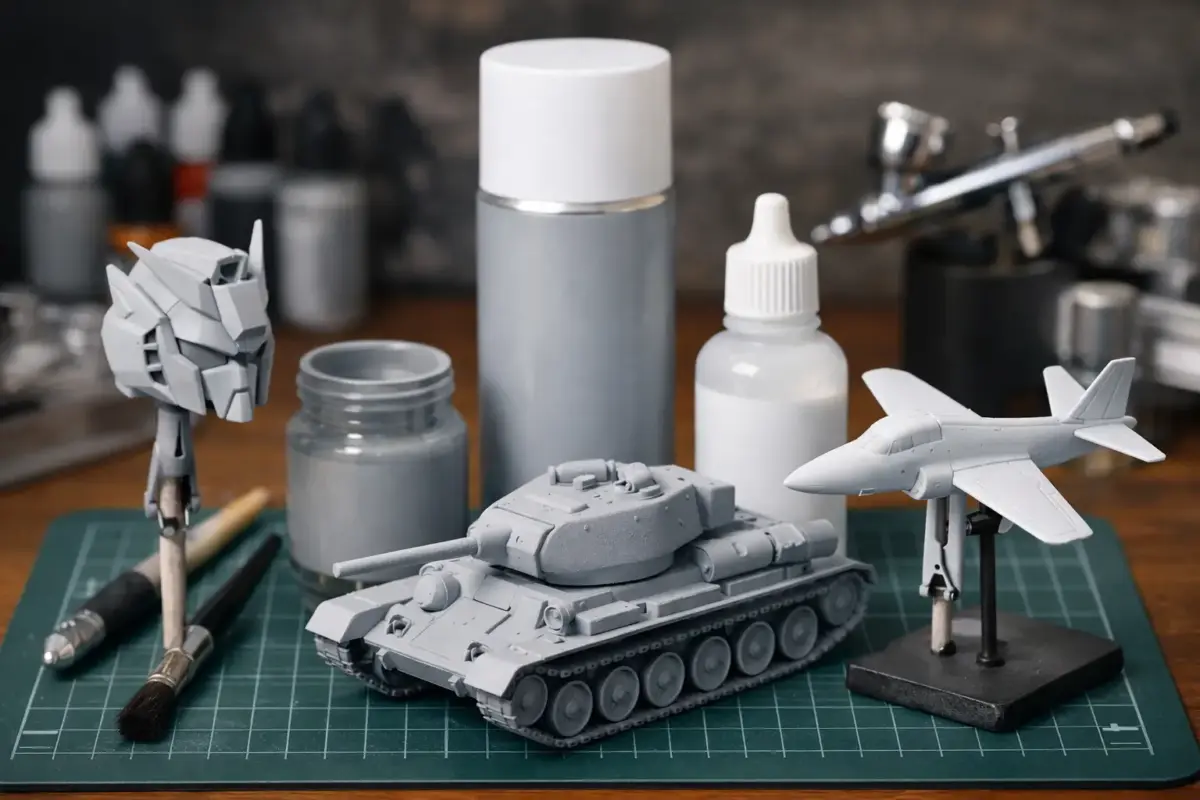
A primer can be the difference between paint that grips cleanly and paint that beads, chips or highlights every sanding mark you thought had disappeared. If you are asking what primer for model kits is best, the answer depends on the material, the finish you want, and how you plan to paint – brush, airbrush or aerosol.
Priming is not just an extra step for perfectionists. On plastic kits it improves paint adhesion and helps reveal seam lines, sink marks and scratches before the colour coats go on. On resin, metal and photo-etch parts, it becomes even more important because those surfaces are less forgiving and more likely to shed paint if prepared poorly.
What primer for model kits actually does
At its simplest, primer gives your paint a surface it can hold onto. It also creates a more uniform base colour, which matters when you are painting over mixed materials or over plastic in strong tones like red, yellow or white. A good primer coat makes later paint layers more predictable.
There is also a diagnostic side to priming. The first light coat often exposes flaws you missed during assembly. A fuselage seam that looked tidy in bare styrene can suddenly stand out. The same goes for filler shrinkage, sanding scuffs and rough joins around turret halves, figure arms or ship hull sections.
That is why experienced modellers rarely treat primer as optional, especially on builds using resin accessories, turned metal barrels, 3D printed parts or extensive aftermarket detail.
What primer for model kits should you choose by material?
The first question is not brand. It is surface.
Plastic kits
Most injection-moulded styrene kits will accept a wide range of hobby primers. Acrylic polyurethane primers, lacquer-based primers and aerosol hobby primers all work well if applied properly. For a typical aircraft, armour or car kit in standard polystyrene, you have the most freedom of choice.
If you want easy use, low odour and straightforward clean-up, acrylic polyurethane primers are a sensible starting point. These are popular with airbrush users and often available in black, grey and white. They suit indoor work well, though they usually need proper curing time and do not always sand as nicely as lacquer types.
If you want the toughest finish and excellent surface bite, lacquer primers are often the benchmark. They level beautifully, show detail clearly and are particularly good when you want a very smooth base for natural metal finishes, gloss colours or fine figure work. The trade-off is stronger fumes and the need for suitable thinners and ventilation.
Resin kits and resin parts
Resin benefits from primer more than standard styrene does. It is naturally slicker, and many resin parts carry mould release residue. Before priming, wash the parts thoroughly with warm water and a little washing-up liquid, then let them dry fully.
For resin, a primer with strong adhesion is usually the safest choice. Lacquer primers perform especially well here, and many modellers use them as their default for resin cockpits, conversion sets and full resin figures. Acrylic primers can work too, but surface prep matters more and heavy handling too soon can lift the finish.
Metal and photo-etch
White metal figures, brass barrels and photo-etch almost always need priming. These parts are smooth and easy to chip if left unprimed. A high-adhesion primer is the right choice, ideally in a thin coat that does not swamp delicate rivets, folds or etched surface detail.
Lacquer primers are a strong option, but specialist acrylic primers formulated for metal can also work if you prefer lower odour products. Whatever you use, keep the coats fine. Metal detail is easy to lose if you flood it.
3D printed parts
3D printed accessories often show faint print lines or texture that only become obvious after primer. In that sense, primer is both a coating and an inspection tool. If the part is finely printed, use a thinner primer to avoid filling detail. If the print is rougher, a microfiller primer can help, followed by light sanding.
Choosing the right primer colour
Grey is the default for a reason. It is neutral, works under most camouflage and civilian finishes, and makes flaws easy to spot. If you only keep one primer on the bench, grey is the practical choice.
Black primer is useful when you want instant shadow in recesses, especially for armour, figures and pre-shading work. It can also help with metallic finishes, depending on the paint system. The downside is that lighter top coats may need more coverage.
White primer is best when brightness matters. Yellow trainer aircraft, red race cars, white spacecraft and vivid fantasy figures often look cleaner and stronger over white. It is less forgiving at showing surface defects, but excellent when colour vibrancy is the goal.
Some modellers also use pink, oxide red or other tonal primers for very specific jobs. Those are specialised choices rather than general recommendations.
Airbrush, aerosol or brush-on?
The best answer to what primer for model kits depends partly on how you apply it.
Aerosol primer
Aerosol cans are convenient and often give excellent coverage on larger subjects like 1/35 armour, 1/48 aircraft and automotive bodies. They are quick, consistent and useful if you do not want to clean an airbrush afterwards. Good hobby aerosols lay down very well if sprayed in light passes.
The limitations are control and weather. In the UK, cold or damp conditions can affect the finish badly, causing graininess or poor curing. Aerosols also make it easier to over-apply primer around fine detail.
Airbrush primer
Airbrushing gives the most control. You can vary coverage, work around delicate detail and prime sub-assemblies without loading everything at once. It is ideal for figures, cockpit parts, ship superstructures and mixed-media builds.
This route does demand a bit more setup. Some primers spray straight from the bottle, while others perform better with thinning or the correct air pressure. If a primer tip-dries heavily or dries rubbery, that is usually a compatibility or technique issue rather than a sign the product category is poor.
Brush-on primer
Brush-on primer is useful for very small parts, detail painting, gaming figures and touch-up work. It is not usually the first choice for large smooth surfaces because brush marks and uneven build can become a problem. Still, for modellers without spray equipment, a good brush primer is better than skipping the step entirely.
Lacquer vs acrylic primer
This is where preferences get strong, but the practical differences matter more than brand loyalty.
Lacquer primers generally bite harder, cure faster and sand better. They are often preferred for serious surface preparation, especially on aircraft fuselages, car bodies, resin conversions and any build where finish quality is critical. They do, however, need proper ventilation and are less forgiving if you are working in a confined space.
Acrylic primers are easier to use in many home setups. They are popular with figure painters, wargamers and general modellers who want simpler clean-up and lower odour. The best ones adhere well and level nicely, but they tend to be more sensitive to surface grease, handling and cure time.
Neither is universally better. If you build a lot of armour and brush-paint details over an airbrushed base coat, an acrylic primer may suit your workflow perfectly. If you are chasing a flawless gloss finish on a 1/24 car body, a lacquer primer is often the stronger choice.
Common primer mistakes
Most primer problems come from application, not the tin or bottle. Too much at once is the classic error. Fine detail softens, surfaces turn pebbly, and drying times stretch out.
Poor surface prep is the other big one. Finger oils, sanding dust and mould release residue all reduce adhesion. Before priming, wash parts if needed, remove dust, and handle clean surfaces carefully.
Temperature matters too. A cold shed, damp garage or poorly warmed aerosol can all affect the result. Thin, even coats in stable conditions are usually worth more than trying to finish the job quickly.
So, what primer for model kits is best for most builders?
For general plastic modelling, a quality grey hobby primer is the most versatile place to start. If you airbrush and want lower odour, an acrylic polyurethane primer is a dependable everyday option. If you need stronger adhesion, better sanding and excellent surface levelling, a lacquer primer is often the better technical choice.
For resin, metal or mixed-media builds, lean towards a primer with stronger bite. For bright top coats, use white. For armour, figures or darker finishes, black or grey usually makes more sense.
That is the real answer: the best primer is the one that matches your material, your painting method and the finish you are aiming for. If you are unsure, start with a trusted grey primer from an established hobby brand and test it on a spare part or mule model first. A little time spent choosing well at the primer stage usually saves a lot more time once the paintwork begins.
