
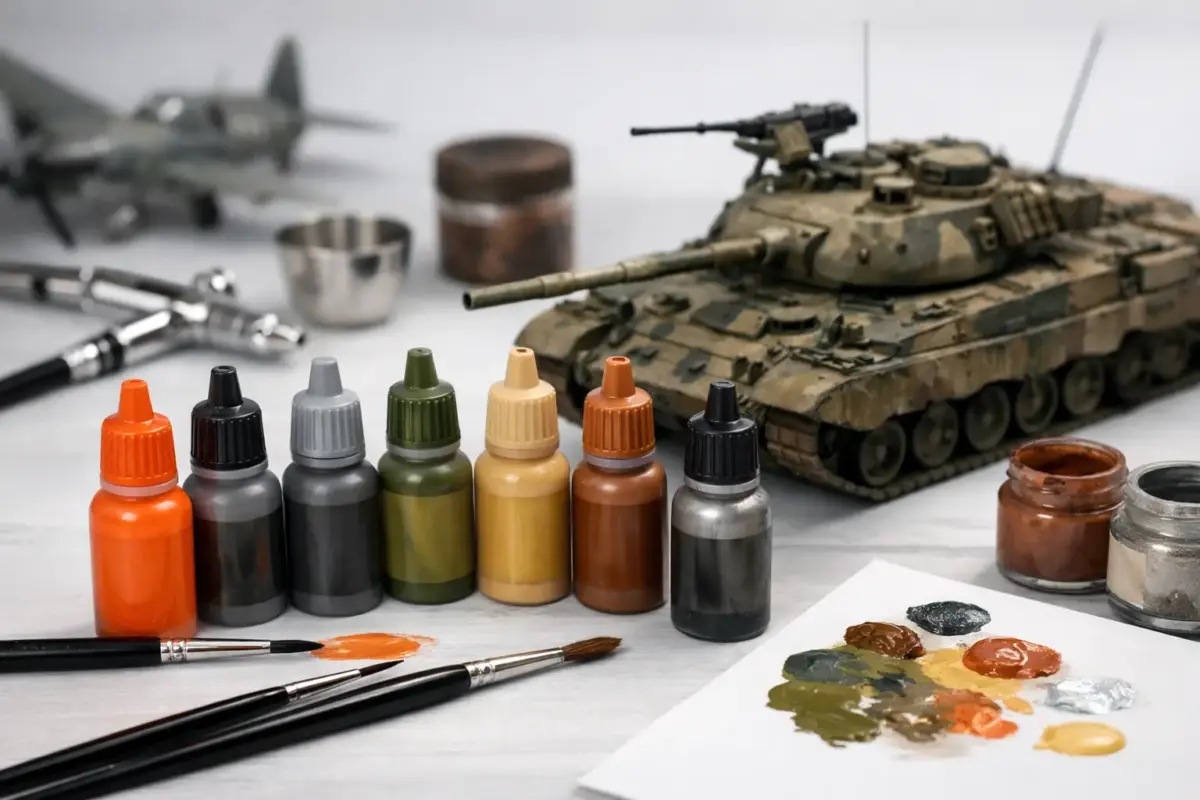
A good paint range should do more than offer an impressive rack of bottles. It needs to make sense at the bench: colours should match the subject, the paint should behave predictably, and the associated primers, thinners and weathering products should work as a system. This AK Interactive paint review looks at how the brand performs across those practical concerns, and where each range is most useful for aircraft, armour, ships, figures and scenic work.
AK Interactive has become a familiar name in serious scale modelling because its catalogue follows the full finishing process. There are colour ranges for brush and airbrush work, specialist historical sets, metallics, primers, varnishes, filters, washes, streaking effects and pigment products. That breadth is a genuine advantage when you want to keep a project’s finishing materials compatible, although it does mean choosing the right AK range matters more than simply picking a colour from a chart.
AK Interactive paint review: the short verdict
AK paints are capable, well-supported products with particular strengths in historically focused colour selection and weathering. The 3rd Generation acrylic range is an especially practical choice for most modellers: it brushes smoothly, sprays well when correctly thinned, and suits the layered, controlled finish needed on modern kits. Real Colours offers a different proposition, favouring a lacquer-type formulation and a very durable, fine sprayed coat for modellers equipped to use it safely.
Neither range is automatically the best choice for every bench. If you mainly brush-paint small details and figures, 3rd Generation is usually the more forgiving starting point. If you favour an airbrushed, hard-wearing finish on armour or aircraft and have good extraction, Real Colours may better suit your process. The key is not to treat AK Interactive as one single paint formula.
Understanding the main AK paint ranges
3rd Generation Acrylics
AK 3rd Generation Acrylics are water-based acrylic paints supplied in dropper bottles. For many builders, this is the core range. The bottles make it easy to dispense repeatable amounts for mixing and help reduce waste compared with wide-necked pots.
The paint has a high pigment load and a satin-to-matt appearance depending on the colour and application. Straight from the bottle it is generally suitable for controlled brush work, particularly on details, interiors and smaller sub-assemblies. Two thin coats are normally preferable to one heavy coat, especially over a contrasting primer. With that approach, coverage is strong and brush marks are modest.
For airbrushing, 3rd Generation paint benefits from thinning rather than being forced through at high pressure. AK’s dedicated thinner is the straightforward option, while a little retarder can be useful in warm rooms or during longer sessions. Start with light, misted coats and allow each pass to settle. A common cause of grainy results is spraying too far from the model or using a mix that is too thick, not a fault with the paint itself.
The range is particularly appealing for brush painters who also own an airbrush. You can use one colour family across the build without switching paint chemistry halfway through. It is also less odorous than solvent-based alternatives, although sensible ventilation and normal workshop care still apply.
Real Colours
AK Real Colours is designed primarily for airbrush application and uses a solvent-based, lacquer-type system. It levels extremely well when applied in thin passes, dries to a tough finish and is well suited to crisp masking work after adequate curing time. For large aircraft surfaces, armoured vehicles and subjects requiring a smooth base beneath decals or weathering, those qualities can be very persuasive.
Real Colours must be treated as a different workflow from water-based acrylics. Use the recommended thinner, spray in a well-ventilated area with suitable respiratory protection, and clean the airbrush with a compatible cleaner. Do not assume it will mix safely with 3rd Generation Acrylics or other water-based products. Keeping separate labelled thinner and cleaning bottles at the bench avoids expensive mistakes.
This range is not necessarily more difficult, but it is less casual. Its advantages are most evident when an airbrush is central to the build and you are comfortable working with solvent-based paints. For a quick session painting cockpit levers by hand, 3rd Generation is the more convenient option.
Metallics, primers and clear coats
AK’s supporting products are a major part of the attraction. A reliable primer gives subsequent paint a consistent surface and reveals seams or sanding marks before the main colours go on. Primer choice should reflect the finish you want: black helps metallic shades look deeper, while grey is a flexible option for most camouflage schemes and light colours.
For metallic finishes, preparation matters as much as the bottle. Any rough sanding or dust will show through a natural metal finish. Spray light coats over a smooth primer and resist handling the model until the finish has cured. A protective clear coat can help before decals and weathering, but test your chosen combination on a spare spoon or old kit part first. Different paint systems can react unpredictably if rushed.
Colour accuracy and subject-specific sets
One of AK Interactive’s strongest points is its colour research. The catalogue includes shades and sets aimed at specific national schemes, service periods and vehicle types. This is useful for builders who want a credible starting point for RAF aircraft, Luftwaffe subjects, WWII armour, modern military vehicles, naval subjects or railway and civilian projects.
There is still room for judgement. Full-size paint fades, photographs vary, museum restorations are not always definitive, and the scale effect is open to interpretation. A colour labelled for a particular vehicle or aircraft should be seen as a well-researched foundation, not a rule that prevents subtle lightening, fading or tonal variation. On a 1/72 aircraft, for example, a slightly lightened centre-panel colour can look more convincing than a single unmodulated shade. On 1/35 armour, variation between panels and horizontal surfaces helps a finish avoid looking freshly moulded.
Sets are worthwhile when they match a planned project because they remove the uncertainty of assembling a compatible palette. Individual bottles make more sense when you already have core shades, only need one or two camouflage colours, or build across several eras and subjects.
Brush painting, airbrushing and weathering performance
For brush painting, preparation is simple but essential. Wash plastic parts to remove mould-release residue where needed, prime difficult surfaces, and stir or shake the bottle thoroughly. Apply the paint with a good quality synthetic brush, loading the brush without flooding it. Let the first coat dry before judging opacity. Trying to cover everything in one pass is the quickest way to obscure fine detail.
For airbrushing, use a clean airbrush and work from light coats to full coverage. Exact pressure, thinning ratio and needle size vary with the paint, room temperature and your own spraying style. Testing on a plastic card first is more reliable than following a universal ratio. If the paint spiders, reduce pressure or spray closer. If it looks dry and dusty, improve the thinning or move closer to the surface.
AK’s enamel-based weathering products, including washes, filters and streaking effects, are among the brand’s most useful tools. They allow controlled adjustment over a properly cured acrylic or lacquer base. A gloss or satin varnish helps a pin wash flow around raised detail, while a matt surface gives filters and dust effects more grip. Work in small areas and use a clean brush lightly dampened with compatible thinner to soften or remove excess.
The trade-off is drying time. Enamel effects stay workable longer than acrylic weathering products, which is excellent for blending but requires patience before sealing the finish. This slower pace often produces better results on armour and ships, where grime, rain marks and tonal variation need to look gradual rather than painted on.
Common pitfalls to avoid
The most frequent problems with AK paint are avoidable. Confusing the different formulations is the first. Keep water-based acrylics, Real Colours and enamel weathering products clearly separated in your workflow. The second is inadequate surface preparation: paint cannot hide sanding scratches, fingerprints or dust. The third is impatience with drying and curing, particularly before masking, clear coating or applying enamel effects.
It is also worth recording successful mixes. A small note of thinner ratio, air pressure and primer used can save time when you return to the same colour weeks later. This is particularly useful on multi-session builds and large camouflage schemes where colour consistency matters.
For modellers looking to build a complete finishing setup, AK Interactive is a strong, practical choice rather than a one-bottle solution. Start with the paint chemistry that suits how you work, add a compatible primer and thinner, then choose weathering products only when the subject calls for them. A well-prepared test piece will tell you more than any colour chart, and it gives you the confidence to put the first proper coat on the model.
