
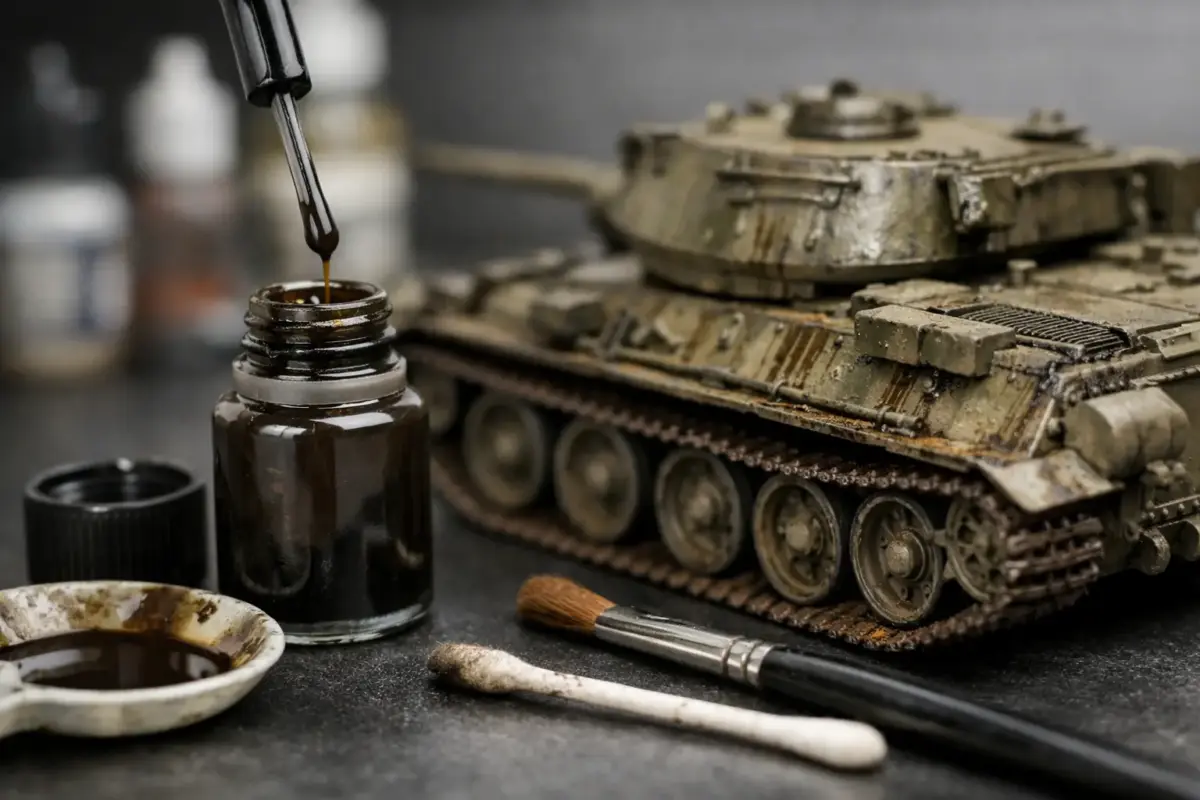
Fresh paint can make a model look sharp, but weathering is what gives it history. In this ammo streaking grime review, the real question is not whether the product works – it does – but how well it fits different subjects, finishes and skill levels.
Ammo by Mig Streaking Grime is one of those weathering products that appears on workbenches for good reason. It is designed to create vertical rain marks, grime runs and general dirt accumulation over painted surfaces, especially on armour, softskins, railway stock and naval subjects. It can also be used more selectively on aircraft, although the effect usually needs a lighter hand there.
Ammo Streaking Grime review – what it actually does
At its core, this is an enamel effect product formulated to leave subtle dirty streaks and tonal variation. Straight from the bottle, it has enough body to place precisely with a fine brush, but it can also be softened and blended with enamel thinner to avoid hard, obvious marks. That balance is a large part of its appeal. It is accessible for newer modellers, while still giving experienced builders room to control the finish.
The colour is pitched well for general dirt and runoff rather than extreme rust or heavy oil staining. On green, sand, grey and faded camouflage finishes, it usually reads as accumulated grime instead of a painted-on special effect. That makes it particularly useful if you want to build weathering gradually rather than jump straight to dramatic contrast.
It is worth saying that the result depends heavily on the surface underneath. On a matt coat, the product tends to bite quickly and can be harder to move once placed. Over a satin or gloss varnish, it stays workable for longer and blends much more smoothly. For most modellers, that means preparation matters just as much as the bottle itself.
How Ammo Streaking Grime performs on the bench
In use, the product is straightforward. You place small vertical lines or dots beneath raised details, panel edges, hinges, bolts or drain points, then pull them downward with a brush dampened with thinner. If you have used enamel washes before, the behaviour will feel familiar. If you have not, this is still a fairly forgiving place to start.
Drying time is sensible rather than rushed. You get enough working time to adjust the effect, reduce it, or remove it almost completely if it looks overdone. That slower drying window is one of the advantages of enamel weathering products compared with fast-drying acrylic effects. You are not forced to get everything right in a few seconds.
The finish can be very convincing when applied in layers. One pass gives you light rain marks and subtle runoff. Repeated applications build a more neglected, operational look. This is where the product earns its place, because it does not only create streaks. It also helps break up flat paintwork and adds visual movement to broad surfaces such as tank sides, turret panels and ship hull plating.
There are, however, trade-offs. If too much is applied at once, the effect can become muddy and uniform. Instead of natural variation, you end up with broad brown smears. It is also easy to overuse on smaller scales, where heavy streaking can quickly look oversized. On 1/72 armour or aircraft, restraint usually gives the better result.
Best surfaces and subjects
Armour is where this product feels most at home. Vertical plates, stowage bins, fuel drums and side skirts all suit grime streaking naturally. On late-war vehicles, post-war AFVs and anything operating in wet or dirty conditions, the effect can look particularly convincing.
Ships are another strong match, especially around drainage paths, scuppers, anchor handling areas and hull sides. Here, Ammo Streaking Grime works well as a base layer before adding darker, rustier or salt-stained effects. It helps establish a used surface without pushing too far into corrosion unless that is the look you want.
Aircraft are more situational. On heavily worked naval aircraft, older piston types, undersides near service panels, or areas behind access doors, it can be useful. On cleaner jets or finely finished competition builds, it needs very careful blending. Aircraft weathering often looks best when more restrained and more localised than armour weathering.
Ammo Streaking Grime review – strengths and limitations
The main strength here is control. The product is consistent, blends well with the right thinner and allows for gradual weathering rather than all-or-nothing results. That makes it a practical choice for modellers who want realism without relying on dramatic pre-mixed effects.
Another plus is versatility. Although marketed for streaking, it also works as a filter-like dirtying effect on selected areas, around details, or in corners where grime would collect. Used sparingly, it can tie together decals, paint modulation and pin washes into a more coherent finish.
The limitation is that it is not magic in a bottle. If the paint finish underneath is rough, if the varnish is too flat, or if the modeller uses too much thinner too soon, the result can look patchy. It also sits within an enamel workflow, so you need to think about compatibility with acrylic layers, oils and varnishes. That is not difficult, but it does reward a bit of planning.
The smell and clean-up are also part of the equation. As with most enamel products, proper ventilation is sensible, and brushes need cleaning with suitable thinner. If you prefer a fully water-based bench routine, this may feel less convenient than acrylic weathering systems.
Is it beginner-friendly?
Yes, with one condition: practise on a spare hull side, old kit or painted spoon first. The product itself is not difficult, but weathering is easier to overdo than underdo. A beginner who starts with tiny amounts, works over a satin surface and blends with a nearly dry brush will usually get a far better result than someone trying to produce dramatic streaking in one pass.
For more experienced modellers, the appeal is speed and repeatability. You can create convincing operational wear in a controlled way without mixing oils each session. That makes it a useful bench staple, especially if you build armour or maritime subjects regularly.
How to get the best result from Ammo Streaking Grime
Application matters more than volume. Put the product where water, dirt or oil would realistically start, then draw it down in the direction gravity would take it. Raised details, handles, weld seams, hinges and drainage points are the obvious places. Random full-panel streaking tends to look less convincing than targeted placement.
A soft flat brush slightly dampened with enamel thinner usually gives the best blending control. Too wet, and you remove everything. Too dry, and the lines stay harsh. It is a small balance, but after a few minutes of testing, most modellers find the right amount easily enough.
Working over a protective clear coat is highly advisable. It gives you more control, protects the paintwork beneath and lets you reduce the effect if needed. If you are building up multiple weathering stages – decals, washes, streaking, pigments – that barrier coat helps keep each stage manageable.
Less is usually more. A model covered in identical streaks can look theatrical rather than realistic. Natural vehicles and structures weather unevenly, so vary the length, width and intensity. Some streaks should almost disappear. Others can be more visible near fuel fillers, hatches or drainage points.
Value and where it fits in a weathering range
As specialist weathering products go, Ammo Streaking Grime offers solid value because a bottle lasts quite a while. You typically use small amounts, especially when blending it out properly. For regular armour builders, it can cover a lot of projects before replacement becomes necessary.
It also fits neatly into a broader weathering system. If you already use panel line washes, dust effects, rust streaks and pigments, this product fills the middle ground between clean paint and heavily distressed finishes. It is not the only streaking product on the market, and some modellers will prefer artist oils for maximum mixing flexibility, but the convenience here is hard to ignore.
For a shop like Scale Model Shop, products like this make sense because they answer a specific stage in the finishing process. Modellers are not only looking for paint and kits. They are looking for compatible materials that help them move from assembly to a believable final finish without guesswork.
Final verdict
This ammo streaking grime review comes down firmly on the positive side. It is a dependable, well-pitched enamel weathering product that does exactly what most modellers need it to do: add realistic dirt streaking, soften flat paintwork and create a more lived-in finish without demanding advanced techniques.
It is best on armour and ships, good on selected aircraft applications, and most effective when used over a satin or gloss-sealed surface. If you want dramatic rust, it is not the right single product. If you want controlled, believable grime that can be layered into a broader weathering approach, it is easy to recommend.
The best results come when you treat it as one part of the story rather than the whole finish. Used with a bit of restraint, it helps a model stop looking painted and start looking used.
