
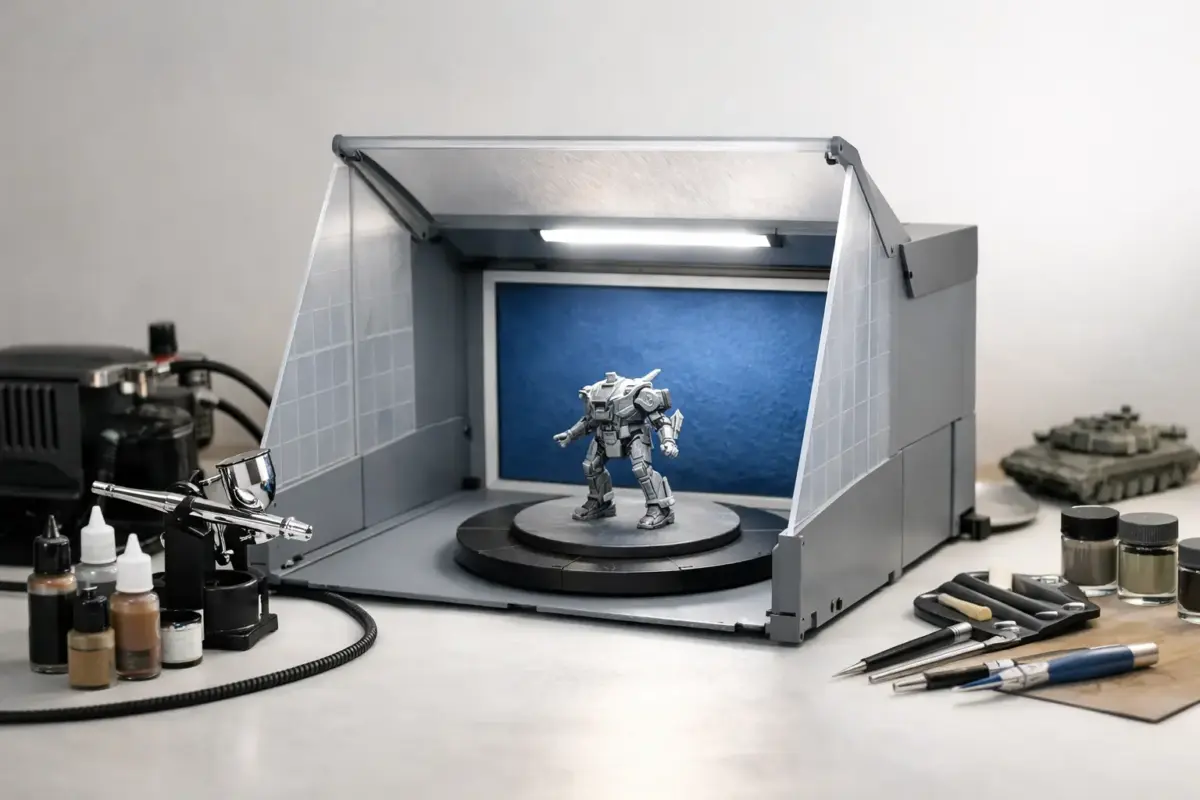
Paint dust on the bench, overspray on nearby tools, and that lingering smell of thinners in a spare room usually tell you the same thing – it is time to look at an airbrush booth for models. For many builders, a booth stops being a nice extra as soon as airbrushing moves from the occasional primer coat to regular base coating, mottling, varnishing and weathering.
A good booth does two jobs at once. It helps keep your work area cleaner, and it improves control over where airborne paint particles and fumes go. That matters whether you build 1/72 aircraft, 1/35 armour, resin figures or wargaming scenery. It also matters even more if your modelling bench shares space with the rest of the house.
Why an airbrush booth for models makes a real difference
Airbrushing gives a finish that brushes cannot easily match, especially for smooth primers, subtle modulation and fine camouflage work. The trade-off is that you are atomising paint into the air. Some of that paint lands on the model. Some of it does not.
Without a booth, overspray settles on benches, lamps, cutting mats and anything else nearby. If you spray lacquers or stronger acrylic thinners, fumes can also become a problem very quickly in a small room. Even with water-based acrylics, airborne particles are still part of the process.
An airbrush booth pulls that spray away from the immediate work area through a filter and extraction fan. It is not a replacement for sensible safety habits, but it is one of the most useful workshop upgrades a regular airbrush user can make. For many modellers, it is the difference between airbrushing when conditions allow and airbrushing whenever the bench time appears.
What to look for in an airbrush booth for models
The right booth depends on what you build, what you spray and where you work. There is no single best option for every modeller, because a compact desktop setup for 1/72 fighters has very different demands from someone painting 1/16 figures or large RC bodies.
Extraction and airflow
This is the part that matters most. A booth needs enough airflow to pull overspray away from the model as you work, not just after the paint cloud has already drifted round the room. Weak extraction is one of the main reasons budget booths disappoint.
If you mostly spray acrylic primers, standard colour coats and varnishes in light passes, a decent hobby booth will often be enough. If you use lacquer paints regularly, spray heavier wet coats, or work on larger subjects, stronger extraction becomes much more important. A booth that struggles with sustained spraying can leave you with a false sense of security.
Filter arrangement
Most hobby booths use replaceable filter media to catch paint particles before they reach the fan or ducting. That helps protect the unit and keeps performance more consistent. Filters are consumables, so it is worth checking how easy they are to replace and how readily available spares are.
A clogged filter reduces airflow. If a booth suddenly seems less effective, the fan is not always the problem. Often it is simply time for a fresh filter.
Booth size and working area
This is where scale and subject matter come into play. A compact booth may be perfectly adequate for 1/48 single-engine aircraft, 28mm figures and small armour projects. It can become frustrating if you regularly paint larger bombers, ship hulls, railway structures or diorama sections.
Think about the model plus your hand position, airbrush angle and the room needed to rotate parts safely. If the booth feels cramped, you are more likely to spray partially outside the capture area, which defeats the point.
Noise level
Most portable booths are not silent. Some are perfectly acceptable for an evening hobby session, while others become tiring during longer paint sessions. If you model in a shared home environment, noise can be as important as extraction.
A louder unit is not always more powerful, and a quiet one is not always weak. It is worth viewing noise as part of daily usability rather than a minor specification detail.
Lighting and visibility
Integrated LED lighting is useful, especially when checking paint coverage, metallic finishes and clear coats. That said, built-in lights vary in quality. Many experienced modellers still prefer a separate bench lamp for accurate colour visibility and better control over shadows.
If a booth includes lighting, treat it as a practical bonus rather than the deciding factor.
Portable booth or fixed setup?
For many UK hobbyists, a foldable portable booth is the sensible answer. It stores easily, suits a spare room or shared workspace, and can be packed away after a session. That flexibility is a genuine advantage if modelling space is limited.
A fixed setup has benefits too. If you have a dedicated hobby room, a permanently installed booth with external venting can be more convenient and more capable. It saves setup time and usually supports a more comfortable workflow for frequent airbrush use.
The compromise is space. Portable units suit occasional to regular use in tighter areas. Fixed installations suit modellers who airbrush often and have the room to dedicate to it.
Vented and non-vented options
Some booths are designed to vent through an exhaust hose towards a window or other outlet. Others rely more heavily on internal filtration. In practical terms, external venting is usually the better option when spraying stronger paints or spending long sessions at the bench.
If you mainly spray small amounts of water-based acrylics, a filtered portable booth may be workable in the right room with sensible ventilation. If you use lacquers, enamel thinners or heavy primer sessions, venting outside is far more reassuring. The paint type you use should strongly influence your choice.
This is also where expectations need to stay realistic. A hobby spray booth improves the environment around your bench, but it does not turn an enclosed room into an industrial spray area. Good airflow in the room and proper protective equipment still matter.
Matching the booth to your modelling projects
Aircraft modellers often need space for wings, drop tanks and awkward painting angles. Armour builders may spray smaller parts more often, but also deal with dusty pigments, primers and repeated weathering layers. Figure painters may need excellent visibility and careful control for zenithal priming and smooth blends. Gundam and sci-fi builders often spray numerous sub-assemblies and clear finishes, which can mean long booth sessions rather than a few quick passes.
That is why the best buying decision usually starts with your actual bench habits. Ask yourself what you paint most often, how large the parts are, and whether you tend to spray in short controlled bursts or extended sessions. A booth that looks good on paper can still be the wrong fit if it does not match the way you model.
A few practical points people often overlook
The first is replacement filters. If a booth uses awkward or hard-to-source filter sizes, ownership becomes more of a nuisance than it should be. The second is cleaning. Paint residue builds up over time, especially if you prime frequently, so accessible internal surfaces are a real advantage.
The third is assembly and storage. Some foldable booths are genuinely easy to set up. Others are technically portable but still awkward enough that you will put off using them. If your workspace has to be cleared after every session, convenience matters.
It is also worth thinking about turntables. A booth with enough depth to accommodate a rotating stand makes painting more controlled and reduces the temptation to handle fresh paint.
Safety, but in realistic terms
An airbrush booth for models is part of a safer and cleaner setup, not the whole solution. If you spray fine particulates or solvent-heavy products, wear suitable respiratory protection as well. Keep the room ventilated. Replace filters when needed. Do not assume the fan alone is doing all the hard work.
That may sound obvious, but in hobby use it is easy to focus on finish quality and forget the workshop side of the process. The same discipline you apply to seam work, masking and paint compatibility should apply to airbrushing conditions too.
Is a booth worth it for casual modellers?
If you only airbrush a handful of times a year, perhaps not immediately. You may be better off investing first in a reliable airbrush, a compressor with tank, and paints that suit your chosen workflow. But once airbrushing becomes a regular part of building, a booth quickly moves up the priority list.
It saves cleaning time, helps protect the surrounding workspace, and makes indoor spraying more manageable. For many hobbyists, it also removes a small layer of friction from the process. If setup feels cleaner and more controlled, you are more likely to use the airbrush properly rather than reaching for a brush when the job really calls for sprayed paint.
For modellers building out a more complete bench setup, this is one of those purchases that tends to prove its value over time rather than in the first five minutes. Choose for the paints you actually use, the scales you actually build, and the space you actually have. If you do that, your booth becomes less of an accessory and more of a dependable part of the workbench.
