
A paint range earns its place on the bench when it works across more than one stage of a build. It needs to cover a cockpit detail without obscuring it, behave predictably on a 1/35th figure and provide enough control for small corrections after assembly. This Vallejo Model Colour review looks at why the range remains a regular choice for brush painters, where it performs best, and what to expect before committing it to your next aircraft, armour, ship or figure project.
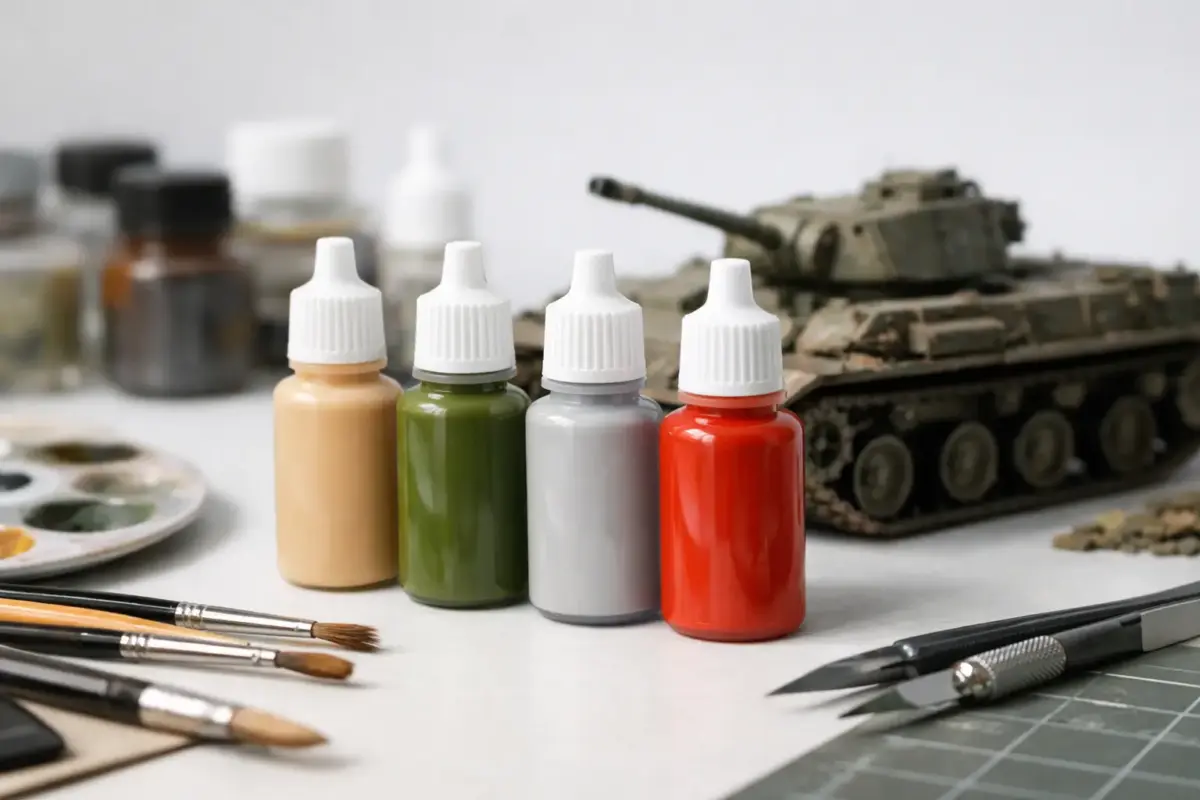
Vallejo Model Colour is a water-based acrylic range supplied in 17ml dropper bottles. It is best known for its extensive, carefully arranged colour selection and its brush-painting qualities, although it can also be airbrushed with the right thinning and cleaning routine. The range is not a single answer for every finishing task, but it is one of the most flexible paint systems a scale modeller can keep in regular use.
Vallejo Model Colour Review: What It Does Well
The central strength of Model Colour is its high pigment load. Straight from the bottle, many shades provide strong coverage while remaining controllable with a good quality brush. That matters when painting ejection-seat cushions, instrument details, stowage, crew figures, wheel hubs or the fine fittings on a ship model. Rather than flooding a recessed line, the paint can be worked precisely where it is needed.
Opacity varies by colour, as it should. Dark greens, browns, blues and many greys normally cover very well. White, yellow, bright red and some pale flesh tones can need several thin coats over a suitable undercoat. This is not a defect unique to Vallejo – lighter pigments are naturally less opaque – but it is worth planning for. A light grey, ivory or pinkish base coat can make yellow, red and flesh tones far easier to build cleanly.
The finish is generally matte to satin-matte, with the exact sheen depending on the colour and how heavily it has been applied. For most military subjects, figures and scenic items, that is a useful starting point. A subsequent varnish gives you control over the final sheen and creates the appropriate surface for decals, washes and weathering.
The dropper bottle advantage
The dropper bottle is practical rather than glamorous, but it solves several everyday problems. Paint can be dispensed onto a wet palette, ceramic tile or mixing cup one drop at a time, making repeatable mixes much easier. It also reduces the chance of contaminating the whole bottle with dirty brush water.
For regular users, a few stainless-steel mixing balls in each bottle and a thorough shake before use help keep colours consistent. Acrylic paint can settle, particularly after a bottle has been stored for some time. If the first drops appear thin or glossy, mix the bottle further before judging the colour.
Brush Painting Results and Technique
For brush work, Model Colour is at its best in thin, controlled layers. It can be used neat for small details, but broad areas such as 1/48th aircraft wings, 1/35th vehicle hulls or large ship superstructures benefit from a little thinning. Water can work, though an acrylic thinner or flow improver gives more consistent flow and can reduce brush marks.
The key is not to overwork the surface. Apply the paint, guide it into place, then allow it to level and dry. Going back over an area as it starts to dry is the quickest way to create dragging, texture and uneven coverage. Two or three light coats will usually look better than one thick one, especially over a smooth primer.
A wet palette is particularly useful with this range. It extends working time, supports subtle colour mixing and prevents small quantities of paint drying on the palette before a session is complete. Figure painters will appreciate this when blending highlights and shadows, while vehicle modellers can use it to keep a mixed detail colour available for tools, packs and interior fittings.
There is a practical limitation. Model Colour is formulated primarily with the brush painter in mind, so it does not self-level across very large surfaces as effortlessly as some dedicated airbrush or lacquer-based systems. If your main aim is a perfectly uniform finish on a large 1/24th car body or extensive aircraft fuselage, a purpose-designed airbrush paint may be the simpler route. Model Colour remains useful for the cockpit, landing gear, ordnance and detail work around that build.
Can Vallejo Model Colour Be Airbrushed?
Yes, but treat it as paint that needs preparation rather than a ready-to-spray product. Use a suitable acrylic thinner, mix thoroughly and test the flow on a spare spoon, mule or piece of primed plastic before approaching the model. The exact ratio depends on nozzle size, air pressure, temperature and the particular colour, so there is no single ratio that suits every setup.
A sensible starting point is a thin, milk-like consistency, applied in several light passes. Lower pressure and patience are usually preferable to trying to force a heavy coat through a fine nozzle. A flow improver can help with tip dry, which is the most common frustration when airbrushing this type of acrylic.
Clean the airbrush promptly. Do not allow leftover Model Colour to dry in the cup, nozzle or needle cap. Rinse between colours, use an appropriate airbrush cleaner at the end of the session and inspect the needle tip. This routine is not difficult, but it is less forgiving than using a dedicated airbrush-ready formula. For modellers who want to spray Model Colour regularly, keeping thinner, cleaner and a few mixing cups alongside the paint makes the process much more reliable.
Colour Range, Accuracy and Mixing
The Model Colour range is one of its biggest attractions. It includes a broad spread of military tones, natural colours, flesh shades, fantasy colours and useful neutrals. That breadth makes it possible to paint a complete build without constantly changing paint systems, from an RAF cockpit and seat harness to groundwork, ammunition boxes and a crew figure.
Named colours are helpful guides, not final proof of historical accuracy. Scale effect, weathering, lighting, period variation and the specific vehicle or airframe being represented all affect the right choice. A colour marked as a particular uniform, camouflage or national shade may still benefit from adjustment once it is on the model. A small amount of buff, grey, white or a neighbouring tone can shift the result without losing its character.
This is where dropper bottles are especially useful. Record mixes by drops in a notebook or on a project card. If you need to revisit a camouflage colour after fitting the undercarriage or completing the weathering, you have a realistic chance of matching it again.
Shades for figures and weathering
Model Colour has long been popular with figure painters because the range supports tonal progression. Base colours, mid-tones and lighter shades can be combined for faces, uniforms, leather and equipment without forcing every highlight from white. The same principle suits armour and aircraft details: use related tones rather than stark contrasts to give canvas, wood, rubber and stowage a more convincing appearance.
For weathering, the paints are excellent for chips, dry-brushed edges, dust effects and painted streaking once diluted appropriately. Their fast drying time helps when building effects in stages. However, if you require a long working time for broad filters or highly controlled streaking, specialist enamel or oil products may offer more forgiveness.
Preparation, Priming and Durability
Model Colour adheres best to a clean, primed surface. Wash plastic, resin or metal parts where necessary to remove mould-release residue, sanding dust and skin oils. A good primer provides tooth for the acrylic paint and makes coverage more predictable, especially with light colours.
Once fully cured, Model Colour is durable enough for normal handling, but it is still wise to hold sub-assemblies carefully and avoid repeated contact with sharp edges. A protective varnish is recommended before decals and weathering, and again at the end if the model will be transported or regularly handled. Wargaming pieces and gaming miniatures, in particular, benefit from a hard-wearing final varnish.
Do not confuse dry paint with fully cured paint. Acrylics can feel dry quickly yet remain more vulnerable underneath for longer. Giving a base coat proper time to settle before masking or applying stronger weathering products reduces the risk of lifted paint and unwanted marks.
Who Should Choose Model Colour?
Model Colour is an excellent fit for brush-first modellers, figure painters and anyone building a versatile paint collection for detail work. It is especially strong where precision, colour choice and measured layering matter more than covering a large model in the fewest possible passes. Beginners can get very good results because it is water-based, low-odour and straightforward to clean up, provided they learn to use thin coats.
For an airbrush-only workflow, it is still a capable option but not always the most convenient one. Dedicated airbrush paints reduce mixing and can be more predictable across large panels. Many experienced modellers sensibly use both: airbrush-ready paint for major surfaces, then Vallejo Model Colour for the cockpit, figures, tools, tracks, stowage and finishing details.
A well-chosen selection will go further than buying colours at random. Start with the specific camouflage or subject colours your project needs, then add dependable basics: black, white, a warm and cool grey, metallics, leather and wood tones, and colours for tyres, interiors and details. Scale Model Shop can help bring those materials together with primers, thinners, varnishes, brushes and weathering supplies for a more complete finishing setup.
The best test is a small one: prime a spare part, paint a few thin coats, try a wash and varnish a section. Once you understand how Vallejo Model Colour responds to your brush, palette and preferred primer, it becomes less of a paint range to manage and more of a dependable part of the bench.
