
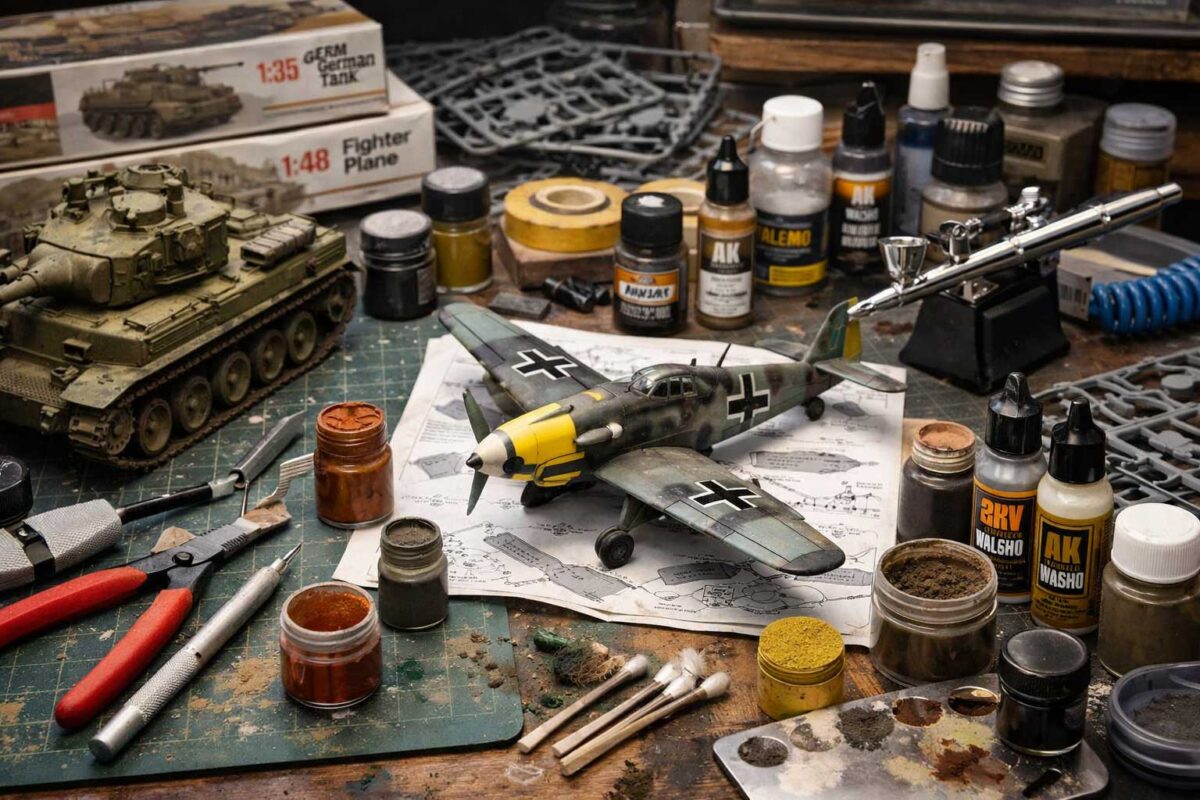
Starting out in scale modelling can feel a bit overwhelming at first. There are so many kits, paints, tools and techniques that it is easy to overthink the whole thing before you even glue the first part together. The truth is, you do not need a workshop full of gear or years of experience to enjoy the hobby. You just need a decent kit, a few basics, and the confidence to get stuck in.
Scale modelling is one of those hobbies that can be as simple or as detailed as you want it to be. Some people enjoy a straightforward weekend build, while others spend months refining every panel line, adding weathering, and chasing complete historical accuracy. Both approaches are valid. That is part of the appeal. Whether you are interested in tanks, aircraft, military vehicles or display pieces, there is always something new to learn and another project waiting on the bench.
If you are completely new to the hobby, or maybe coming back to it after years away, this guide will walk you through the basics. We will cover how to choose the right kit, which tools you actually need, how painting works, what weathering means, and how to avoid common beginner mistakes. Along the way, we will also point you towards products and categories that can help you get started with confidence.
Why Scale Modelling Still Matters
Scale modelling has been around for decades, but it has never really gone away. In fact, it has grown into a hobby with more choices than ever before. Modern kits are more detailed, paints are better, tools are smarter, and there is now a huge range of finishing products that help modellers create more realistic results than was possible years ago.
What makes scale modelling so satisfying is that it combines several hobbies in one. It is part craft, part collecting, part research, and part problem-solving. You are building something with your hands, learning new techniques, and ending up with a finished model you can display. There is a real sense of progress to it. A box of parts slowly becomes an aircraft, a tank, or a vehicle with its own character.
For many people, scale modelling is also a good way to switch off. It gives you something practical to focus on. Trimming parts, cleaning seams, brushing on paint, testing a wash, all of it has a steady rhythm to it. It is not rushed. That is probably why so many people stick with it once they start.
Choosing the Right First Kit
Your first model kit does not need to be the most detailed or the most ambitious. Actually, it probably should not be. A good first build is one that helps you understand the basics without making the whole process harder than it needs to be. That means choosing a subject you genuinely like, but also being realistic about complexity.
For beginners, a sensible starting point is usually a plastic kit with clear instructions, a manageable part count, and a subject that is not too tiny. Larger scales can be easier to handle because the parts are bigger and there is more room for detail. That said, there are plenty of smaller kits that are beginner-friendly too.
Some of the most popular categories include 1/35 Vehicles, which are ideal if you enjoy military subjects and want a kit with plenty of visual presence. Aircraft fans often start with 1/48 Aircraft, a scale that offers a great balance of detail and manageable size. If you prefer something smaller, 1/72 Vehicles can be a really good way to build up experience without taking up too much shelf space.
When choosing your first kit, look for:
- A subject you are genuinely interested in
- Clear, well-printed instructions
- A reasonable number of parts
- Good manufacturer reputation
- No need for aftermarket extras to get a good result
If you enjoy the subject, you are much more likely to finish the build. That matters more than people sometimes think. Finishing your first model teaches you far more than endlessly starting complicated ones and leaving them half done.
Understanding Scale
Scale is simply the size ratio between the real subject and the model. A 1/35 tank is thirty-five times smaller than the real vehicle. A 1/48 aircraft is forty-eight times smaller than the original aircraft. Once you have built a couple of kits, scales start to make sense quite quickly, but at first they can feel a bit abstract.
Different scales suit different subjects. Military vehicles in 1/35 are popular because they offer good detail and work well with accessories, figures, and weathering. Aircraft in 1/48 are often seen as the sweet spot between size and detail. Smaller scales like 1/72 are ideal if you want to build several models without needing loads of room.
There is no best scale overall. It depends on the subject, the available space, and what sort of build experience you enjoy. Some modellers love the extra presence of larger kits. Others prefer compact projects they can finish more quickly. You kind of find your own lane with it.
The Essential Tools You Actually Need
This is the point where beginners often assume they need to buy everything at once. You really do not. There are loads of specialised tools out there, and many of them are genuinely useful, but you only need a small core set to start building properly.
A basic starter tool setup should include:
- Plastic cutters or sprue cutters
- A hobby knife
- Sanding sticks or sanding sponges
- Tweezers
- Plastic cement or model glue
- A cutting mat
- A few paint brushes
You can browse a wide selection of Tools & Accessories to put together a starter setup that fits your budget and the kind of kits you want to build. Good tools make the process smoother, but they do not have to be the most expensive options on day one.
Sprue cutters help you remove parts cleanly from the frame. A hobby knife is useful for trimming leftover plastic and cleaning small seams. Sanding tools help smooth attachment points and tidy joins. Plastic cement is usually better than super glue for standard plastic kits because it softens the plastic slightly and creates a stronger bond.
One thing beginners sometimes underestimate is how much difference neat preparation makes. Even before painting, careful cutting, clean glue joints and a little sanding can make a model look far better. A lot of a good finish starts before the paint even comes out.
Building the Kit, Step by Step
Once you have chosen a kit and gathered a few basic tools, the building stage becomes much less intimidating. The instructions are your roadmap. It is worth taking your time and reading ahead before glueing anything. That one habit alone can save a lot of frustration.
A sensible build process usually looks like this:
- Read the instructions fully before starting
- Identify the parts needed for the first stage
- Cut parts carefully from the sprue
- Clean attachment points and mould lines
- Test fit parts before gluing
- Glue sparingly and allow time to set
- Work in small sections rather than rushing the full kit
Dry fitting, which simply means checking how parts fit together before using glue, is one of the best habits you can develop. Even very good kits can benefit from a quick test fit. It helps you spot alignment issues early and gives you a chance to adjust things before they become harder to fix.
Try not to rush. That sounds obvious, but it is usually where avoidable mistakes happen. Too much glue, fingerprints in soft plastic, parts glued the wrong way round, paint applied before assembly is ready, all of it tends to come from trying to do too much in one sitting.
Do You Need to Prime a Model?
Priming is one of those steps that beginners sometimes skip because it does not seem exciting. Fair enough. It is not the glamorous part. But it does make life easier. Primer gives paint a better surface to grip to, helps highlight imperfections, and creates a more even base for your colours.
If you want smoother, more reliable paint coverage, priming is worth doing. It is especially helpful if your model has a mix of plastic, filler or photo-etched parts, or if you are using light colours over dark plastic. A primer coat also makes it easier to spot seam lines or small flaws that need fixing before you move on.
You do not always need a thick coat. In fact, you should avoid that. A light, even coat is usually enough. The idea is to prepare the surface, not bury the details.
Brush Painting vs Airbrushing
This is probably one of the biggest questions for anyone new to the hobby. Do you need an airbrush? No, not at all. Plenty of excellent models are brush-painted. A good brush painter with decent technique can get results that look very clean and convincing.
Brush painting is often the easiest way to begin because it requires less setup and less equipment. It is ideal for detail painting, figures, cockpit parts, tools, stowage, tyres and lots of smaller areas. If you are only building occasionally, it may be all you need for a while.
That said, airbrushing opens up another level of control for base coats, camouflage, varnishes and subtle effects. It allows smoother coverage across larger surfaces and can make repetitive painting jobs much faster once you get used to it. If you want to explore that side of the hobby, take a look at the range of Airbrushes available for modellers.
Neither method is better in every situation. Most experienced modellers end up using both. Brush painting and airbrushing are really just different tools for different tasks. Starting with brushes is completely fine, and probably the most natural way in for most people.
Choosing the Right Paints
Paint choice can seem confusing at first because there are several types, each with its own strengths. Acrylics, lacquers, enamels, washes, pigments, weathering products, it can look like a whole language of its own. Still, once you break it down, it is not too bad.
Three popular paint ranges for scale modellers include AK Interactive paint, Ammo Paint, and Vallejo Paint. Each brand offers a wide variety of colours and finishing products suited to different preferences and techniques.
Vallejo is widely used for brush painting and detail work, with a strong reputation for easy handling and broad colour choice. Ammo and AK Interactive both offer extensive paint ranges as well as weathering products that work well for military modelling, dioramas and realistic finishes.
The key is not to buy every product at once. Start with the colours your kit actually needs, plus a few useful basics such as black, white, metallic shades and perhaps a brown or dark wash for detail. You can expand your paint collection naturally as you build more kits.
How to Get Better Paint Results
Good paint results usually come down to a few simple things rather than one magic trick. Surface preparation matters. Thin, controlled coats matter. Patience matters. Most paint problems, like brush marks, poor coverage or rough finishes, come from trying to do too much in one go.
Here are a few practical tips:
- Make sure the surface is clean before painting
- Use primer where possible
- Apply thin coats rather than one heavy coat
- Allow each coat to dry properly
- Use the right thinner if the paint range requires it
- Do not overload the brush
If your first painted model is not perfect, that is normal. Every modeller has had rough finishes, visible brush strokes, accidental fingerprints or paint that looked better in theory than in real life. That is not failure; it is just how the learning curve works.
What Is Weathering?
Weathering is the process of making a model look used, worn, dusty, muddy, faded or operational rather than factory fresh. It is one of the most enjoyable parts of the hobby because it adds depth, realism and character. Suddenly, the model starts to look less like a toy and more like a miniature vehicle or aircraft with a story behind it.
Weathering can be subtle or dramatic. A few gentle panel line washes and some dusty tyres can be enough to bring a model to life. On the other hand, heavily used tanks, armour and battlefield vehicles can take much more intense weathering, including mud, rust, streaking and chipped paint.
If you want to explore this area, the Weathering category is packed with products designed specifically for modellers. You can also look at specialist items such as Pigments and Washes, both of which are incredibly useful when adding realism to military subjects.
Using Washes, Pigments and Effects
Washes are thin products designed to flow into recessed detail. They are brilliant for panel lines, bolts, rivets and areas where you want more depth. A wash can make details stand out with very little effort, which is why it is often one of the first weathering products beginners try.
Pigments are dry powders used to create dust, dirt, soot and earth effects. They can be applied dry for soft dusty finishes or fixed in place with thinner or pigment fixer for more durable results. On vehicle models, pigments are especially useful around wheels, tracks and lower hull areas.
Other weathering effects can include streaking grime, rust tones, mud textures, chipping colours and oil-based filters. It sounds like a lot, and it can be, but you do not need every effect on every model. In fact, restraint usually yields better results. Realism often comes from layering a few techniques well rather than throwing everything at the kit at once.
Common Beginner Mistakes to Avoid
Honestly, everyone makes mistakes when learning. That is part of it. Still, there are a few common ones that are worth watching out for because they can trip up almost every beginner at some point.
- Using too much glue and damaging surrounding detail
- Skipping surface preparation before painting
- Applying paint too heavily
- Rushing through the instructions
- Trying advanced weathering techniques too early
- Choosing an overly complex first kit
- Expecting the first model to look like a competition piece
The last one is probably the big one. It is very easy now to look online and see beautifully built models with professional-level finishes. Those results are inspiring, but they can also make beginners feel as though they are already behind. You are not. Everyone starts somewhere. The goal of your first few kits is not perfection. It is progress.
How to Improve With Each Build
The best way to improve in scale modelling is simply to keep building. Every project teaches you something, even the awkward ones. You start noticing better ways to clean parts, smarter painting sequences, where to leave assemblies separate, how much weathering looks believable, and which tools genuinely make your life easier.
A useful approach is to give each build a small focus. Maybe on one model, you work on seam cleanup. Next, you practise brush painting. On another, you try a wash for the first time. That way, each kit adds a new skill without making the whole hobby feel like homework.
It also helps to build subjects you actually enjoy. If you like armour, start there. If aircraft are your thing, lean into that. Motivation carries you through the trickier stages. There is no point forcing yourself into a genre you do not really care about just because someone says it is the ideal starting point.
Building a Starter Modelling Setup
You do not need a huge workspace, but having a small dedicated area does help. Even a tidy corner of a desk can work well if it gives you enough light, a stable surface, and somewhere to keep your tools together. Good lighting makes a bigger difference than people expect. It helps with part cleanup, painting, decals and all those little details that are easy to miss otherwise.
A practical starter setup might include:
- A cutting mat to protect the surface
- A lamp with bright, even light
- Your basic tools and glue
- A small selection of paints
- Brushes for base painting and details
- Storage trays or boxes for parts and tools
You can expand later if you decide to add an airbrush, compressor, spray booth or more advanced finishing products. Early on, keeping the setup simple can actually make the hobby more approachable. Less clutter, fewer decisions, more building.
Why Internal Product Choice Matters
Not all modelling products behave the same way, and using hobby-specific tools and paints usually makes a real difference. Model paints are designed for finer surfaces and smaller details. Modelling washes are made to flow where you want them. Dedicated sanding tools give you more control. That is why specialist hobby products tend to be worth it, even if you do not go for the most expensive versions.
Having access to trusted ranges also makes it easier to build a consistent workflow. Whether you are picking up paints from AK Interactive, exploring finishes from Ammo, or stocking up on brush-friendly colours from Vallejo, using products designed for scale modelling helps remove a lot of guesswork.
Final Thoughts on Getting Started
If you are new to scale modelling, the best advice is probably the simplest. Start with a kit you like, use a few decent tools, take your time, and do not overcomplicate it. You do not need to master every technique straight away. You just need to begin.
Scale modelling is a hobby that grows with you. At first, you are learning how to cut, glue and paint cleanly. Then you start experimenting with washes, pigments, airbrushing and weathering. Later, maybe you can try photo-etch, resin upgrades or more advanced finishing work. It builds naturally over time, and that is part of what makes it so rewarding.
Whether you are planning your first armour build from the 1/35 Vehicles range, browsing 1/48 Aircraft for an aircraft project, picking up something smaller from 1/72 Vehicles, or adding finishing products like Washes, Pigments and broader Weathering supplies, the important thing is to enjoy the process.
Some builds go smoothly. Some do not. Some become shelf favourites, others quietly teach you what not to do next time. That is kind of the charm of it. Every model adds something. And once you finish that first one, you will almost certainly already be thinking about the next.
