Dora Wings Plastic Model Kit
Fairey Delta 2 (1/48) DW48064
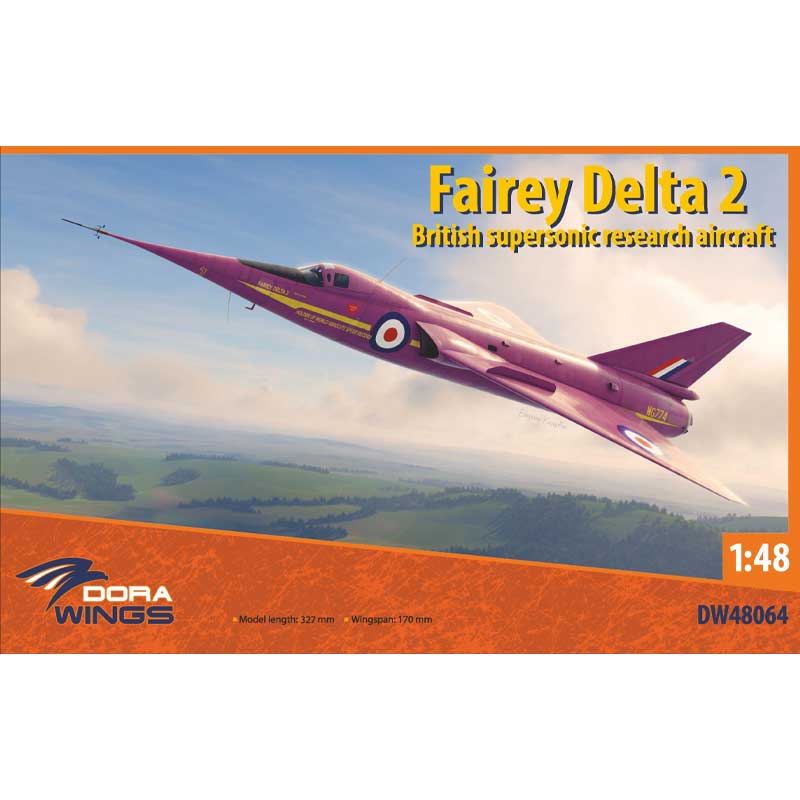
This kit recreates the remarkable Fairey Delta 2, an aircraft that played a quiet but significant role in the development of British high speed aviation. Dora Wings presents the FD2 in 1/48 scale with detailed components that capture the clean lines, slender fuselage, and distinctive drooped nose that made the real aircraft so unusual. The parts come crisply moulded, and the airframe geometry has been carefully reproduced to highlight the research-focused shape of this experimental design.
The cockpit features fine interior elements, and the streamlined delta wing is engineered to assemble with precise alignment. Builders will find clear parts for the canopy, subtle surface textures, and optional positioning for selected details. The kit aims to balance accuracy and buildability, giving a rewarding project that reflects the sleek simplicity of the original aircraft while still offering enough depth to satisfy modellers who enjoy careful painting and refinement.
- 1/48 scale kit with detailed mouldings
- Accurate delta wing and fuselage shape
- Drooped nose profile faithfully represented
- Clear canopy parts and cockpit detail
- Carefully engineered for clean assembly
The Fairey Delta 2 emerged in the early 1950s as Britain sought to understand behaviour at transonic and supersonic speeds. Built by Fairey Aviation to a Ministry of Supply research specification, the FD2 carried a slender fuselage, sharply swept delta wing, and an adjustable drooped nose for improved pilot visibility. On 6 October 1954, Fairey test pilot Peter Twiss flew the aircraft for the first time. Over subsequent flights, the FD2 proved capable of exceptional performance and eventually broke the world air speed record, reaching speeds in excess of 1,100 miles per hour. Although only two prototypes were constructed, the programme yielded valuable data that influenced later aircraft, including design philosophies seen in the Concorde. The FD2 marked the final aircraft produced by Fairey as an independent company and remains an important stepping stone in British aeronautical research history.