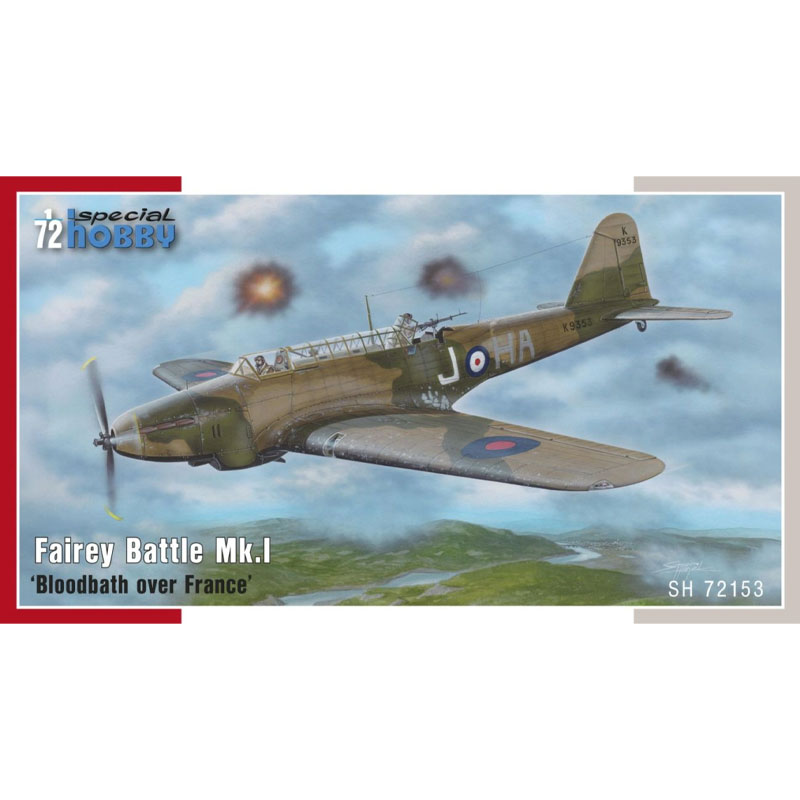
Special Hobby Fairey Battle Mk.I (1/72) SH72153
In stock
SKU: SH72153
 Special Hobby
Wishlist and stock alertsLog in to save products or join back-in-stock notifications.
Special Hobby Plastic Model Kit
Fairey Battle Mk.I – Bloodbath Over France
This 1/72 scale kit from Special Hobby represents the Fairey Battle Mk.I, an early-war British light bomber that saw extensive service during the opening stages of the Second World War. The model captures the clean lines of this low-wing monoplane design, one of the first of its type to enter RAF service.
Part of the aircraft model kits range, the kit includes plastic and clear parts along with detailed decals for multiple aircraft. The marking options represent RAF machines lost during the intense fighting in Western Europe in 1940.
- 1/72 scale plastic model kit
- Includes grey plastic sprues and clear parts
- Decals for 4 RAF aircraft
- Detailed exterior and cockpit features
- Represents aircraft from the 1940 France campaign
The kit offers a straightforward build with good surface detail, making it suitable for a range of finishing approaches. The included decals provide options to depict aircraft with varied operational histories.
History
The Fairey Battle was developed in the 1930s as a replacement for older biplane bombers such as the Hawker Hart. It represented a significant step forward in design, featuring an all-metal, low-wing configuration and modern aerodynamic layout.
Entering service in 1937, the aircraft was considered advanced for its time, but it soon became clear that its single engine did not provide sufficient power for its size and role. Despite this, large numbers were produced and assigned to RAF squadrons at the outbreak of the Second World War.
During the German invasion of France in 1940, Fairey Battles were deployed in large numbers. They faced heavy opposition from German fighters and anti-aircraft defences, resulting in significant losses. The aircraft’s vulnerability in combat quickly became apparent, leading to its withdrawal from frontline operations.
After its combat role ended, the Fairey Battle found new purpose as a training aircraft across the Commonwealth. It was used in a variety of roles throughout the war, contributing to the training of aircrew in Britain, Canada, Australia, and beyond.
Discover more from this range