
Tamiya Plastic Model Kit
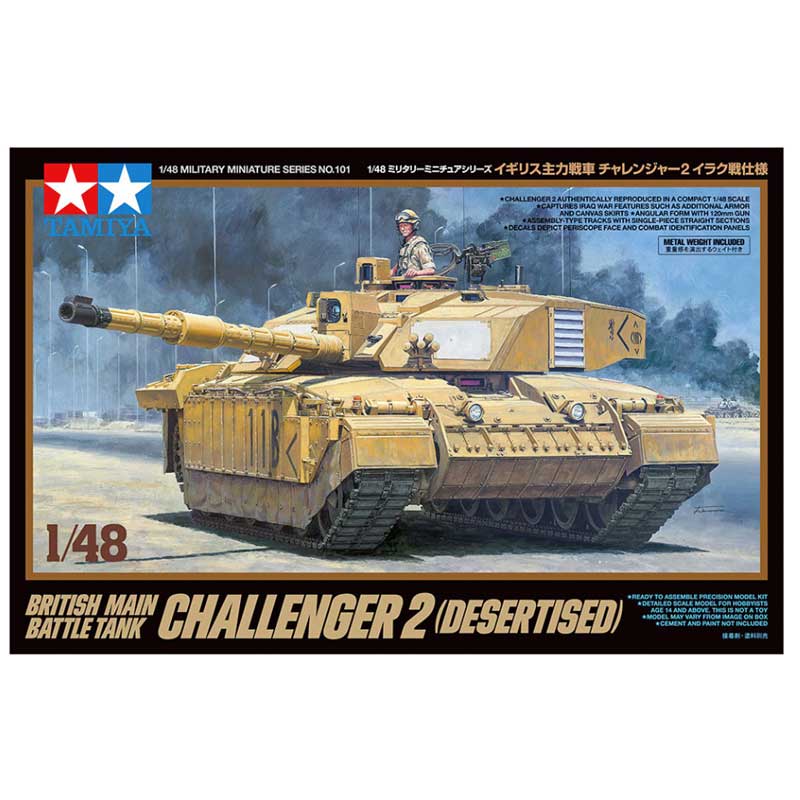
British Main Battle Tank Challenger 2 Desertised (1/48)
I think there is something quietly satisfying about seeing this tank reduced to a small scale, as if all that bulk and history has been distilled into something you can hold in one hand. This kit captures the Challenger 2 during its desert service, where the vehicle gained its distinctive appearance and reputation for toughness. Looking at it up close you can almost imagine the heat haze and dust, even though the thing is sat on a workbench rather than a battlefield.
The model feels well balanced, maybe because Tamiya included a metal chassis weight, so it does not behave like an empty shell. Details such as the canvas skirts, turret shape and square muffler cover stand out straight away. The tracks come with one piece straight lengths which keeps the build calm rather than fiddly. There is a commander torso figure for the hatch which gives the finished model a bit of life, and you get markings for a tank that served during the 2003 invasion of Iraq which adds a little story to the final build.
- 1/48 scale plastic model assembly kit with a length of 243mm and width of 84mm
- New mould captures Challenger 2 desert configuration with accurate turret and skirt details
- Main gun includes moving elevation
- Weld lines, side skirt texture and engine deck features are sharply reproduced
- Metal chassis weight included for a realistic sense of mass
- Tracks feature one piece straight sections for easier assembly
- Commander torso figure provided for the cupola hatch
- Markings for a vehicle deployed in Iraq during 2003
History
The Challenger 2 represents a long line of British tank development that stretches back through the Cold War and beyond. It entered service in the mid 1990s as a major step forward from the earlier Challenger 1, taking lessons learned during the Gulf War and folding them into new armour, improved fire control and better crew protection. In many ways it was designed as a modernised answer to a changing world where armoured warfare was shifting away from central Europe and becoming a tool used in more fluid, unpredictable environments.
When British forces rolled into Iraq in 2003 the Challenger 2 was still relatively new, but it quickly proved its worth. Its armour held up to harsh conditions, its automotive unit coped with the dust and heat better than most expected and the tank earned a reputation for staying power. Units of the 7th Armoured Brigade relied heavily on it as they pushed through the desert and urban areas. Even now the vehicle is remembered for its resilience during that campaign, a reminder of how modern engineering and real world experience sometimes meet in a way that just works.