
Airfix Plastic Model Kit
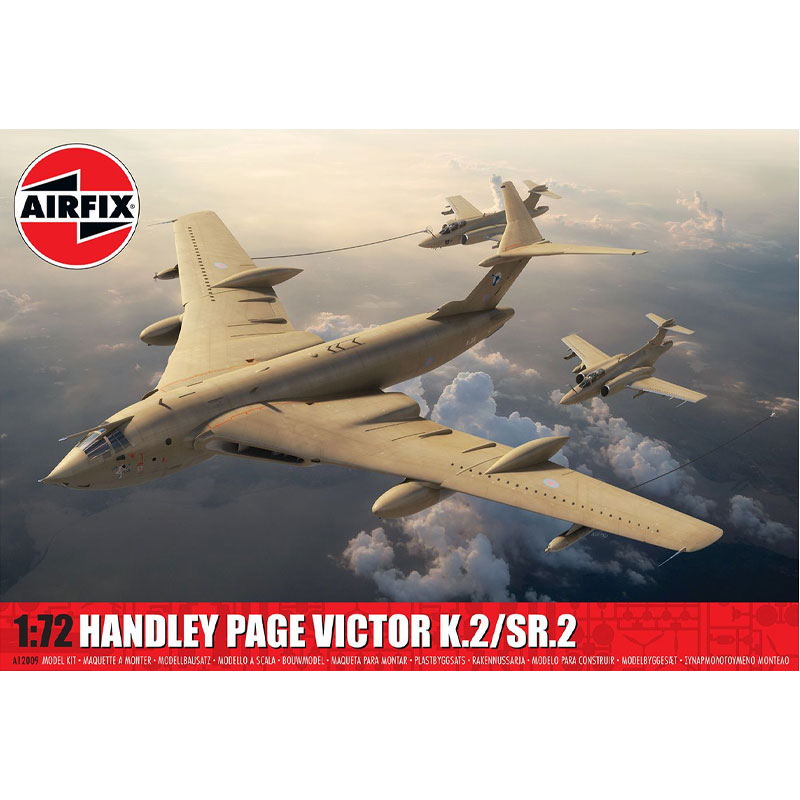
Handley Page Victor K.2 (1/72) A12012
This 1/72 scale Handley Page Victor K.2 gives you a proper sense of what made the RAF’s Cold War tanker fleet so distinctive. The kit arrives with 257 parts, crisp moulding, and three scheme options that let you explore different moments of the aircraft’s long service life. Even before assembly you can feel the size of it, that sweeping crescent wing and the clean fuselage lines that set the Victor apart from the rest of the V-bomber family.
There’s a steady rhythm to this build, something that feels considered. The wing joins lock in with confidence, the undercarriage bays have convincing depth, and the refuelling pods and intakes come together more neatly than you might expect for a subject of this scale. It rewards careful dry-fitting and a bit of patience, but the result is a bold centrepiece, especially once those large decals settle into place over the broad surfaces.
- 1/72 scale construction with 257 parts
- Includes three RAF scheme options
- Large crescent wing and detailed fuselage moulding
- Refuelling probe and underwing tanker pods
- Detailed cockpit and wheel bays
- Impressive display footprint once completed
History
The Handley Page Victor sat alongside the Vulcan and Valiant as part of Britain’s early nuclear deterrent, a trio of futuristic machines designed in an age when speed, altitude, and reach meant everything. The Victor carried that sweeping crescent wing, a shape that looked ahead of its time, and it spent its early years ready for long-range, low-level nuclear strike missions. As technology and strategy moved on it became clear that the Victor’s future lay elsewhere.
The B.2 variant arrived in the late 1950s, fitted with powerful Rolls Royce Conway engines and built to meet the RAF’s demands for greater manoeuvrability and altitude performance. While it served well in the strategic bomber role, the shift to submarine-launched Polaris missiles changed Britain’s approach to nuclear deterrence. The Victor evolved again, this time becoming an aerial refuelling aircraft. In this role it found a lasting purpose, supporting operations for decades and proving itself one of the most adaptable aircraft of the Cold War era.