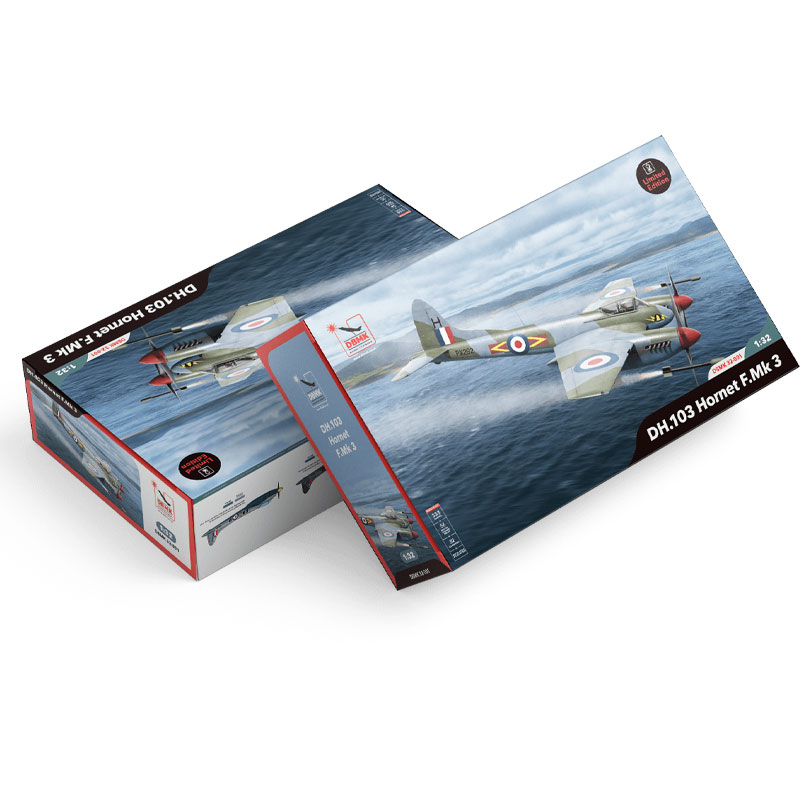
DBMK Models DH.103 Hornet F Mk.3 (1/32) 32001
In stock
SKU: DBMK32001
 DBMK Models
Wishlist and stock alertsLog in to save products or join back-in-stock notifications.
DBMK Models Plastic Model Kit
DH.103 Hornet F Mk.3
This 1/32 scale kit from DBMK Models recreates the de Havilland DH.103 Hornet F Mk.3, a high-performance twin-engine fighter developed at the end of the Second World War. Designed with speed and efficiency in mind, the Hornet combined advanced aerodynamics with powerful Merlin engines, resulting in one of the fastest piston-engine aircraft ever to enter service.
As part of the 1/32 aircraft model kits range, this release offers a detailed representation of the aircraft with a comprehensive parts layout. The kit includes plastic components, clear parts, photo-etch, and 3D printed elements, allowing for a high level of detail throughout the build. Multiple external stores such as rockets, bombs, and fuel tanks are included, along with three marking options.
- 1/32 scale plastic model kit
- 192 plastic parts and 8 clear parts
- 56 photo-etch components and 32 3D printed parts
- Includes rockets, 1000lb bombs, and fuel tanks
- Three marking schemes included
- Metal rod and clear film components
- Detailed surface and structural features
The combination of materials allows for a more refined finish, particularly in smaller details and structural elements. This makes the kit suitable for modellers aiming to achieve a high level of realism in their finished build.
History
The de Havilland DH.103 Hornet was developed during the early 1940s as a long-range fighter intended for operations in the Pacific. Building on experience gained with the Mosquito, de Havilland created a refined design featuring a slimmer fuselage, laminar flow wings, and twin Rolls-Royce Merlin engines with contra-rotating propellers.
These design choices gave the Hornet exceptional performance. It was capable of reaching speeds approaching 485 mph, making it one of the fastest piston-powered aircraft of its time. Its armament of four 20mm cannons, combined with the ability to carry bombs and rockets, made it a versatile strike aircraft.
Although it arrived too late to see combat in the Second World War, the Hornet entered service with the Royal Air Force in 1946. It proved effective in operations during the Malayan Emergency, where its speed and range were valuable in tropical conditions. A navalised version, the Sea Hornet, was also developed for the Fleet Air Arm.
Despite its relatively short service life, the Hornet is often regarded as one of the most advanced piston-engine fighters ever built. It represents the peak of propeller-driven aircraft development, bridging the gap between wartime innovation and the emerging jet age.
Related products