
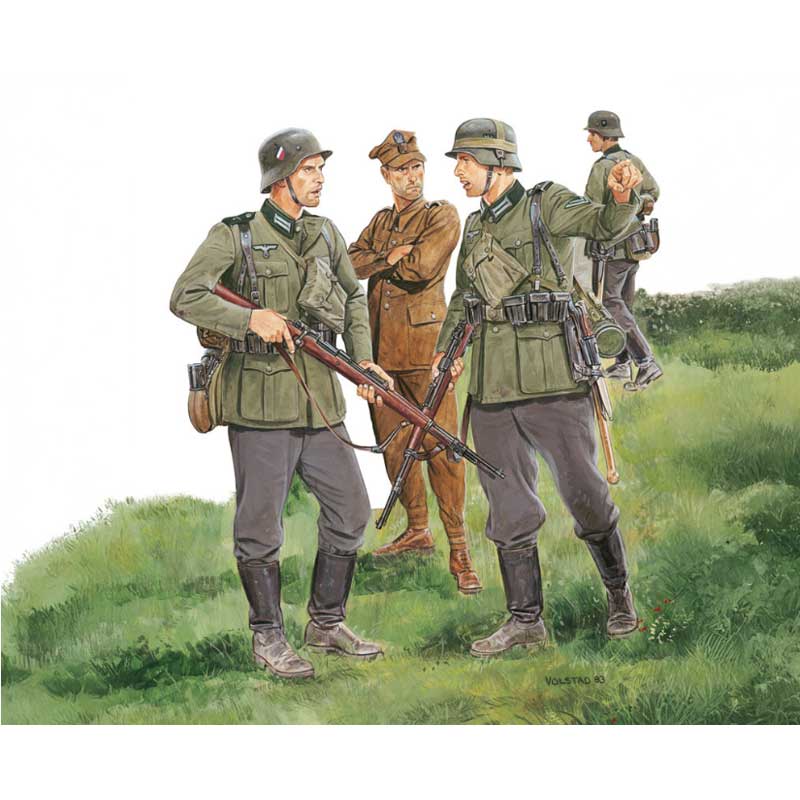
Dragon 28th Infantry Division Poland 1939 (1/35) 6344
In stock
SKU: D6344
MPN: 6344
 Dragon
Wishlist and stock alertsLog in to save products or join back-in-stock notifications.
Dragon Models Plastic Model Kit
28th Infantry Division (Poland 1939) (1/35)
This 1/35 scale figure set from Dragon Models represents troops from the German 28th Infantry Division during the invasion of Poland in 1939. The figures depict early-war German infantry, capturing the uniforms and equipment typical of the opening phase of the Second World War. As part of the 1/35 figures range, the set is well suited to diorama work and vehicle-based scenes.
The figures are sculpted to reflect the appearance and posture of infantry soldiers in active service, with attention given to uniform details, gear placement, and natural poses. Early-war equipment and clothing are represented, offering a contrast to later-war figures and allowing for historically accurate scene building. The scale provides a good balance between detail and ease of assembly, making it suitable for a wide range of modelling projects.
This set can be used to create dynamic dioramas depicting the early stages of WWII, particularly those focused on the Polish campaign. It pairs well with early-war vehicles and environments, providing context and narrative to a display. The figures can also be used individually or combined with other sets to expand a scene.
- 1/35 scale plastic model kit figure set
- Depicts German 28th Infantry Division troops
- Based on Poland campaign, 1939
- Early-war uniforms and equipment represented
- Detailed sculpting suitable for painting
- Ideal for diorama and vehicle scene integration
The invasion of Poland in 1939 marked the beginning of the Second World War in Europe. German infantry divisions, including the 28th Infantry Division, played a central role in the campaign, advancing rapidly using combined arms tactics alongside armoured units and air support. These early operations demonstrated the effectiveness of coordinated movement and communication, setting the stage for subsequent campaigns across Europe. This figure set reflects that period, offering a representation of the soldiers involved in the opening stages of WWII.