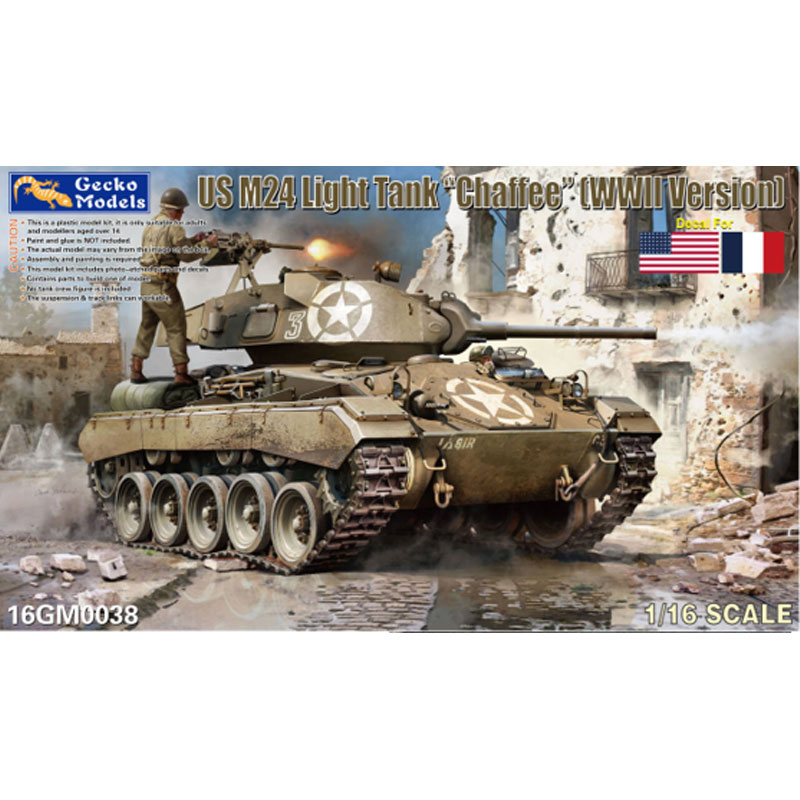

Gecko Models Plastic Model Kit
US M24 Light Tank “Chaffee” (WWII Version) (1/16)
This 1/16 scale kit of the M24 Chaffee has that immediate sense of presence that larger scale armour brings, the kind where you start noticing small textures and fittings before even gluing anything together. The fighting compartment interior is fully represented, so you get that layered build where cables, seats, ammo racks and controls slowly fill the hull with a bit of life. The turned metal barrel looks clean and sharp, and having the rifled bore already there saves a lot of fiddly work.
The workable suspension and track links add a nice mechanical feel to the build, making the whole thing behave more like a miniature machine than a static shell. Etch parts sharpen up the finer details, while the stowage set helps break up the exterior and gives it that field-worn look once painted. Decals are provided for US Army and Free French WWII vehicles, letting you choose between two distinct wartime identities.
- 1/16 scale plastic model kit of the M24 “Chaffee”
- Decals for WWII US Army and Free French Army
- Turned metal gun barrel with rifled bore
- Workable track links and suspension
- Detailed interior within the fighting compartment
- Etch parts included
- Stowage set for exterior detailing
- SKU: 16GM0038
History
The M24 Chaffee entered service late in the Second World War as the US Army’s new light tank, replacing the ageing M5 Stuart. It was designed to offer better firepower, mobility and crew comfort, with its 75mm main gun providing a significant improvement in combat capability. Despite arriving late in the conflict, the M24 saw action in Europe from late 1944 onwards, proving nimble and reliable in reconnaissance and infantry support roles.
Free French forces also operated the Chaffee, valuing its combination of speed and firepower during the final push into Germany. After the war the tank went on to serve in numerous armies worldwide, showing surprising longevity thanks to its balanced design. Its early wartime service, paired with its distinctive compact shape, has kept it a popular subject for modellers who enjoy vehicles that bridge the transition from WWII into the post-war era.