ICM Churchill's 'Flying Suitcase' Hampden (1/48) 48354
In stock
SKU: ICM48354
MPN: 48354
 ICM
ICM
Wishlist and stock alertsLog in to save products or join back-in-stock notifications.
ICM Plastic Model Kit
HP.52 Hampden Bomber (1/48)
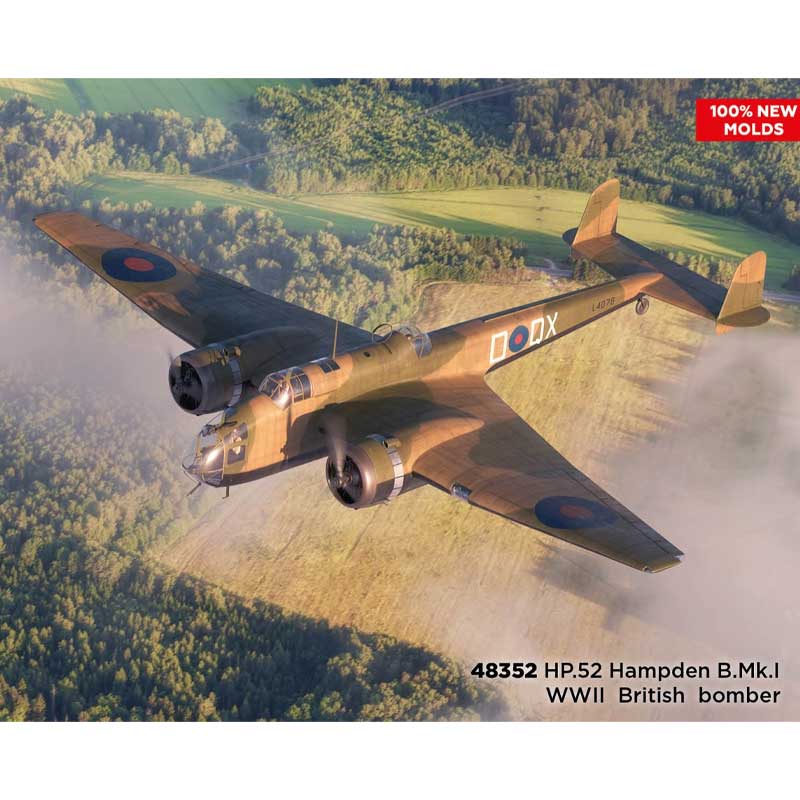
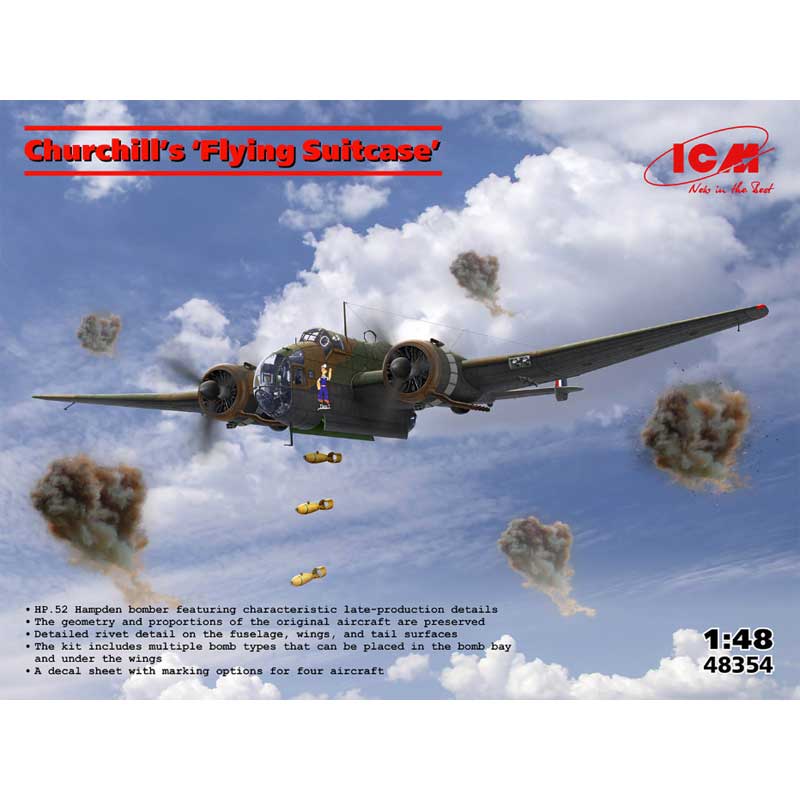
This 1/48 scale HP.52 Hampden bomber from ICM represents one of the early twin-engine bombers used by the Royal Air Force during the opening years of the Second World War. Known for its narrow fuselage and distinctive profile, the aircraft earned the nickname “Flying Suitcase.” This kit captures those unique proportions along with the fine structural details that define the type.
Designed for modellers interested in RAF subjects, this kit fits naturally within a collection of 1/48 aircraft kits, offering a highly detailed build with extensive surface detail. The model features finely reproduced rivet lines across the fuselage, wings, and tail, along with a detailed bomb bay that can be equipped with a variety of ordnance options. Multiple marking choices are included, allowing different operational aircraft to be represented.
- 1/48 scale plastic model kit
- Detailed HP.52 Hampden bomber representation
- Accurate fuselage geometry and proportions
- Fine rivet detail across all surfaces
- Includes multiple bomb load configurations
- Decals for four RAF aircraft schemes
The completed model highlights the unusual shape and operational character of this early-war bomber, making it a distinctive addition to any WWII aircraft collection. Its level of detail also provides a solid base for further enhancement and customisation.
Note: This model kit requires assembly and painting. Glue, paints and tools are not included and must be purchased separately.
History
The Handley Page HP.52 Hampden was developed in the late 1930s in response to British Air Ministry requirements for a modern twin-engine bomber. Featuring an enclosed cockpit, retractable landing gear, and a relatively high bomb load for its size, it represented a significant step forward in RAF bomber design at the time. The aircraft entered service in 1938 and quickly became part of Britain’s expanding air power.
Its narrow, deep fuselage gave it a distinctive appearance and led to its “Flying Suitcase” nickname. Despite its somewhat cramped interior, the Hampden was capable of carrying out long-range bombing missions during the early years of the war. By 1940, it was actively involved in operations over Europe as part of RAF Bomber Command.
As newer and more capable heavy bombers were introduced, the Hampden was gradually withdrawn from front-line bombing duties. However, it found a second life with Coastal Command, where it was adapted for torpedo bombing and maritime operations. In this role, it proved to be effective in long-range patrol and strike missions against enemy shipping.
The Hampden played an important role during the transitional period of bomber development in the RAF, bridging the gap between earlier light bombers and the more advanced heavy bombers that followed. Its service highlights the rapid evolution of aircraft design during the early years of the Second World War.
Discover more from this range