Special Hobby Messerschmitt Me 163A (1/72) SH72334
In stock
SKU: SH72334
 Special Hobby
Wishlist and stock alertsLog in to save products or join back-in-stock notifications.
Special Hobby Plastic Model Kit
Messerschmitt Me 163A ‘First Rocket Fighter’
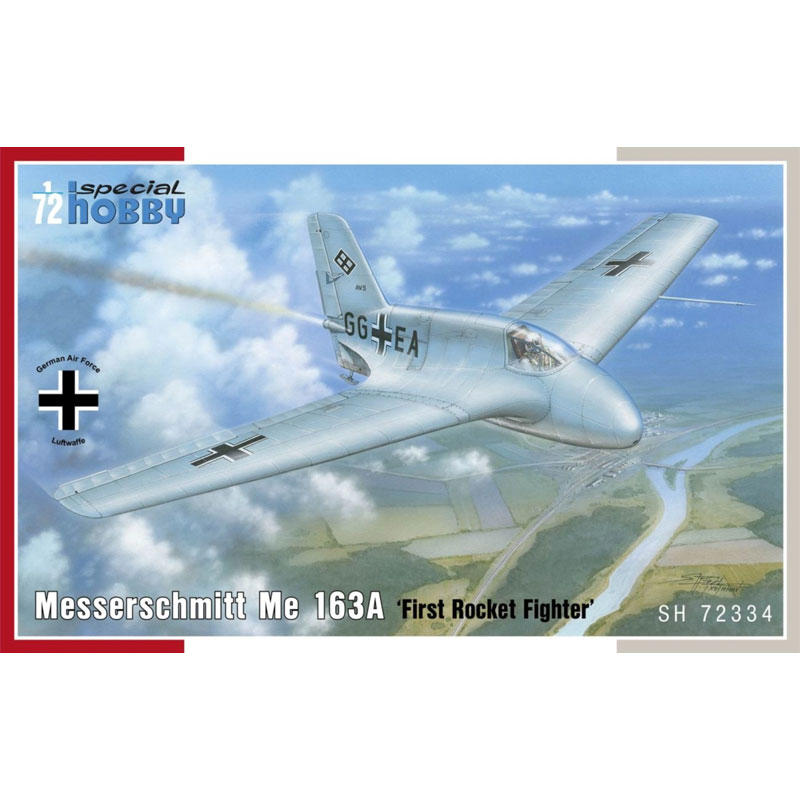
This 1/72 scale kit from Special Hobby represents the Messerschmitt Me 163A, an early rocket-powered aircraft that played a key role in aviation development. The model captures the compact and distinctive shape of the Komet, including its unique take-off and landing arrangement.
Part of the 1/72 aircraft model kits range, the kit includes plastic, clear, resin, and photo-etched components to enhance detail. The cockpit is particularly well represented with resin parts and etched details, offering a more refined interior.
- 1/72 scale plastic model kit
- Includes resin cockpit detail parts
- Photo-etched components included
- Clear canopy parts
- Decals for 3 marking options
- Re-release of a previously unavailable kit
The combination of materials allows for improved detailing across key areas of the build. The kit provides a solid base for painting and finishing, with options to represent different aircraft used during testing and training.
History
The Messerschmitt Me 163 was a groundbreaking aircraft, becoming the world’s first mass-produced rocket-powered fighter. Developed in Germany during the early years of the Second World War, it was designed to achieve unprecedented speeds using a rocket propulsion system rather than a conventional engine.
The Me 163A was primarily used as a development and training platform for the later Me 163B combat version. One of its most notable achievements came on 2 October 1941, when test pilot Heini Dittmar exceeded 1,000 km/h, becoming the first person to reach this speed in level flight.
The aircraft’s design was highly unconventional. It took off using a detachable wheeled trolley, which was released after take-off, and landed on a retractable skid. While this allowed for weight savings and improved performance, it also introduced operational challenges.
Although the Me 163 showed remarkable speed, its limited flight time and complex handling reduced its overall effectiveness in combat. Despite these limitations, it remains one of the most significant experimental aircraft of the war, representing a major step forward in high-speed aviation.
Discover more from this range