
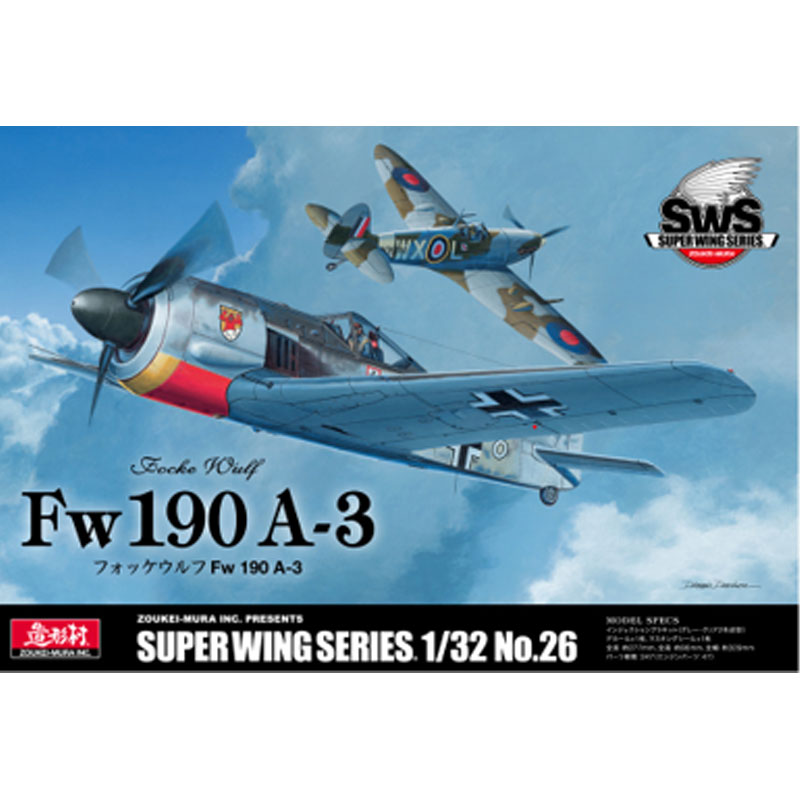
Zoukei-Mura Focke-Wulf Fw 190 A-3 (1/32) SWS26
In stock
SKU: SWS26

Wishlist and stock alertsLog in to save products or join back-in-stock notifications.
Zoukei-Mura Plastic Model Kit
Focke-Wulf Fw 190 A-3
The Zoukei-Mura 1/32 scale Focke-Wulf Fw 190 A-3 captures one of the most important Luftwaffe fighter aircraft of the Second World War with exceptional structural detail and engineering precision. Developed as part of the acclaimed Super Wing Series (SWS), this kit focuses not only on the aircraft’s exterior appearance, but also on the internal systems and engineering philosophy behind the real machine.
Part of the 1/32 aircraft model kits range, the model recreates the early short-nose Fw 190 A-3 configuration with extensive internal detail, highly accurate surface features, and multiple display options. Designed following years of research and refinement, the kit reflects the robust yet elegant design approach of Dr. Kurt Tank and the Focke-Wulf engineering team.
- 1/32 scale plastic model kit
- Total parts count: 347
- Includes clear and grey moulded parts
- Detailed BMW 801 radial engine assembly
- Full cockpit interior with highly detailed instrumentation
- Open or closed canopy options included
- Masking sheet and decal sheet included
- Two historically researched marking options
- Detailed internal fuselage and engine structures
- Comprehensive full-colour instruction manual in English and Japanese
The BMW 801 engine is one of the highlights of the kit, featuring detailed push rods, cooling baffles, engine mounts, and the distinctive Kommandogerät engine management system. Zoukei-Mura has engineered the model so the builder can appreciate how the aircraft’s mechanical systems interacted internally, creating a far more immersive build experience than a standard exterior-only kit.
The cockpit is equally impressive, accurately representing the compact yet highly functional layout developed by Kurt Tank, himself an experienced pilot engineer. Instruments, controls, switches, and armour protection are all recreated with careful attention to scale fidelity. The canopy system also reflects the real aircraft’s changing geometry when opened or closed, with the correct A-3 style headrest included.
Surface detail across the airframe is exceptionally refined, capturing the subtle curves and transitions of the Fw 190’s fuselage and engine cowling. Particular attention has been given to the short-nose proportions of the early A-series aircraft, preserving the aggressive yet balanced appearance that made the Fw 190 one of the most respected fighters of the war.
The included decal options represent two operational aircraft from 1942:
- Fw 190 A-3 “White 12”, 10./JG 1, Netherlands, Summer 1942
- Fw 190 A-3 “Blue 6”, 10.(Jabo)/JG 2, France, Spring 1942
The “White 12” aircraft includes the updated interpretation of JG 1’s famous demon emblem, while “Blue 6” carries the distinctive fighter-bomber Staffel fox emblem associated with JG 2 operations in occupied France.
History
The Focke-Wulf Fw 190 was introduced during the Second World War as a modern alternative to the Messerschmitt Bf 109. Designed under the leadership of Kurt Tank, the aircraft prioritised strength, reliability, firepower, and operational practicality over lightweight racing-style performance.
Unlike many contemporary fighters that relied on liquid-cooled inline engines, the Fw 190 used the BMW 801 air-cooled radial engine. Although radial engines typically created greater aerodynamic drag, Tank’s design team successfully minimised these disadvantages through an extremely compact engine installation and carefully designed cooling arrangements.
The Fw 190 A-3 became one of the most important early production variants and quickly earned a reputation for excellent low and medium altitude performance, heavy armament, strong acceleration, and outstanding roll rate. Allied pilots were often surprised by its ruggedness and combat capability when it first appeared over Western Europe in 1941 and 1942.
The aircraft served in multiple roles including fighter interception, ground attack, and fighter-bomber missions. Its versatility and survivability made it one of the Luftwaffe’s most successful combat aircraft throughout the war.
Zoukei-Mura’s SWS interpretation of the Fw 190 A-3 focuses heavily on understanding the engineering logic of the original aircraft, allowing modellers to explore both the visual appearance and the internal mechanical structure of one of Germany’s most iconic wartime fighters.