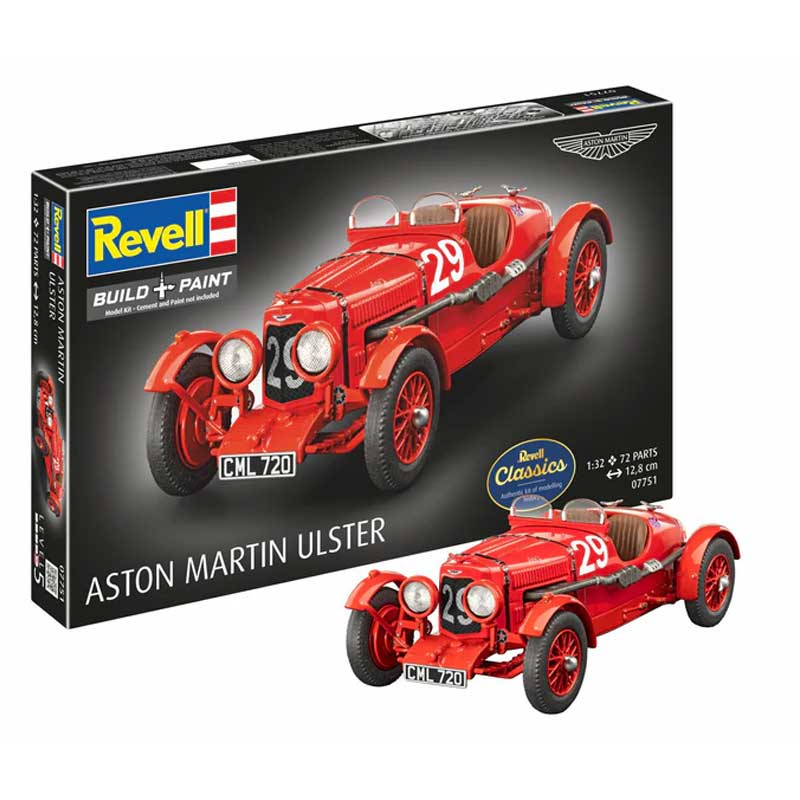
Revell Aston Martin Ulster (1/32) 07751
Out of stock
SKU: RV07751
MPN: 67750
 Revell
Join the waitlist
Enter your email below and we will notify you when this item is back in stock.
Revell Plastic Model Kit
Aston Martin Ulster (1/32)
This 1/32 scale Aston Martin Ulster from Revell recreates one of the most iconic pre-war racing cars, capturing the elegance and engineering of 1930s motorsport. Despite its smaller scale, the kit offers a high level of detail and complexity, making it a rewarding project for modellers who enjoy precision work. The long bonnet, open cockpit, and distinctive rear design are all faithfully represented, reflecting the classic styling of the original vehicle.
The model includes finely moulded components that bring out key features such as spoked wheels, body contours, and external details like bonnet straps. The interior is kept true to the period, with a simple yet functional layout that reflects the stripped-back nature of racing cars from this era. Decals are included to allow the model to represent vehicles that competed in famous endurance events.
- 1/32 scale plastic model kit
- Detailed replica of the Aston Martin Ulster
- Includes 70 parts for precise assembly
- Features classic open cockpit and long bonnet design
- Includes decals for historic racing schemes
- Suitable for advanced modellers
This kit provides an opportunity to recreate a classic racing machine in miniature, offering a balance of detail and craftsmanship. Its compact size does not limit its visual impact, making it a strong addition to any vintage vehicle collection.
Note: This model kit requires assembly and painting. Glue, paints and tools are not included and must be purchased separately.
History
The Aston Martin Ulster was introduced in 1934 as a road-going version of the marque’s successful racing cars. Named after Aston Martin’s achievements in the RAC Tourist Trophy held in Ulster, the car quickly gained a reputation for both performance and reliability. It was powered by a 1.5-litre engine, delivering competitive speed for its class while maintaining durability over long distances.
The Ulster proved its capabilities in major endurance events, including the Mille Miglia and the 24 Hours of Le Mans. During an era when racing demanded both skill and mechanical endurance, the car stood out for its balanced design and consistent performance. Its lightweight construction and efficient engineering made it well suited to the challenging conditions of long-distance racing.
Only a limited number of Ulster models were produced, adding to their exclusivity and historical significance. Today, surviving examples are highly valued and regarded as some of the finest sports cars of the pre-war period. The vehicle represents a time when motorsport was defined by mechanical simplicity, driver skill, and innovation.
Discover more from this range